
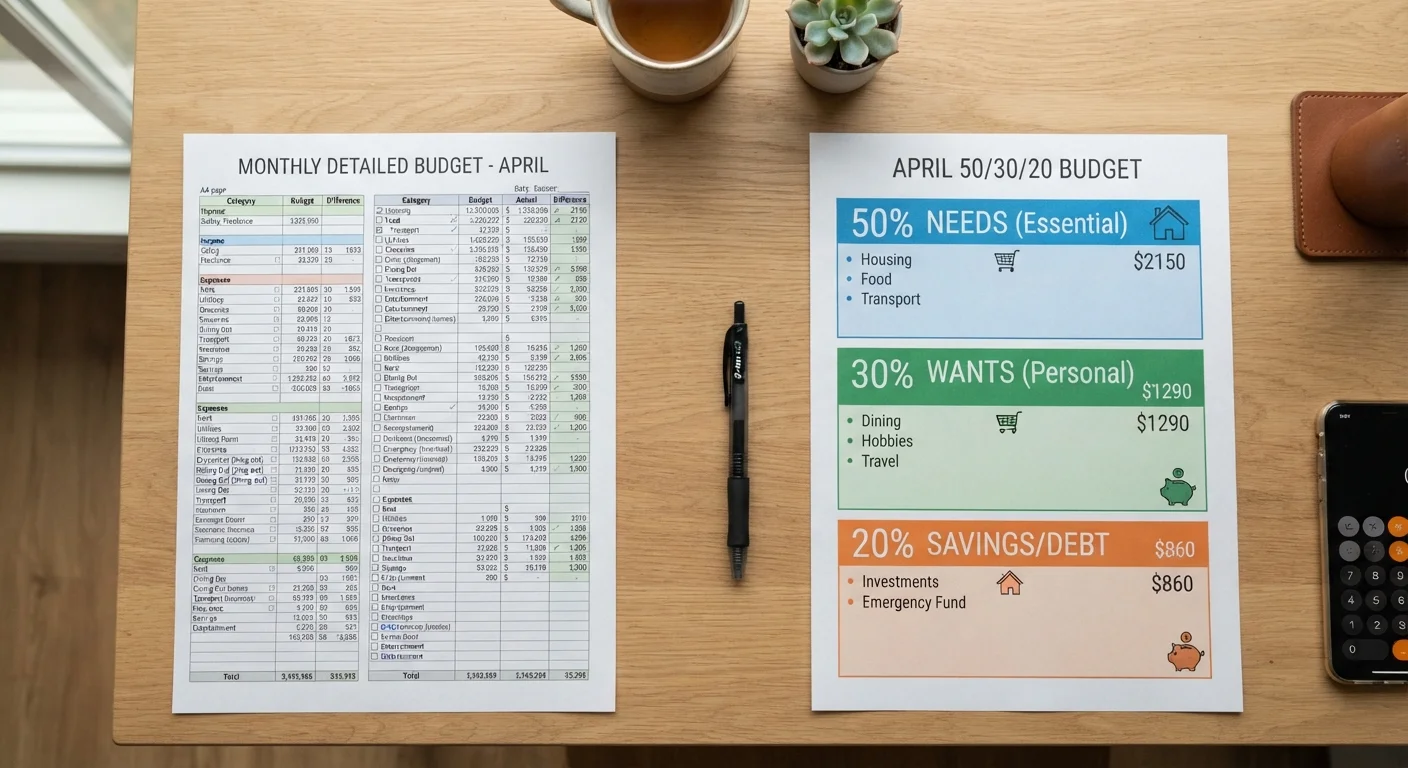
How Each Method Works
Understanding the mechanics of each framework is the first step to choosing one that actually sticks.
Zero-based budgeting (ZBB) starts fresh every month. You take your total expected income and subtract every planned expense - bills, groceries, transportation, entertainment, savings contributions - until you reach zero. The goal isn't to spend everything; it's to intentionally allocate every dollar so nothing sits unexamined. If you earn $3,500 this month, every dollar gets a named category before the month begins.
The 50/30/20 rule takes a top-down view. You divide your after-tax income into three buckets: 50% for needs (rent, utilities, groceries, insurance), 30% for wants (dining out, streaming services, hobbies), and 20% for savings and debt repayment beyond the minimum. On that same $3,500, you'd aim for roughly $1,750 on needs, $1,050 on wants, and $700 toward savings or extra debt payoff. For a deeper look at the savings implications of this split, see how the 50/30/20 savings slice maps onto retirement goals.
| Criterion | Zero-Based Budgeting | 50/30/20 Rule |
|---|---|---|
| Core concept | Every dollar assigned a specific job | Income split into three percentage buckets |
| Setup time | Higher - requires itemizing all expenses | Lower - three categories only |
| Monthly maintenance | Rebuild from scratch each month | Check totals against three targets |
| Best for variable income | Yes - adapts each month | Less ideal - percentages shift with income |
| Spending visibility | Very high - line-item detail | Moderate - category-level only |
| Ease for beginners | Steeper learning curve | Easy to understand immediately |
| Savings flexibility | Fully customizable each month | Fixed at 20% of take-home pay |
Cutting Spending: Where Each Method Shines
Both frameworks aim to reduce waste - but they expose it differently.
Zero-based budgeting is especially effective at surfacing spending you've stopped noticing. When you're forced to justify every category from scratch, it's harder to let a forgotten gym membership or unused app subscription slide by. Many people who try ZBB report a genuine surprise at where their money actually goes. The tradeoff is time: building a detailed budget monthly takes real effort, particularly early on.
The 50/30/20 rule doesn't dig into individual line items, but it does create an immediate benchmark. If your "needs" regularly exceed 50%, that's a clear signal to examine fixed costs - housing, car payments, insurance - and explore whether any can be reduced. Similarly, a bloated "wants" category at 40% rather than 30% tells you exactly where to start trimming, even if it doesn't tell you which specific expenses to cut.
For a broader comparison of how these and other frameworks stack up, see this comparison of popular budgeting frameworks.
What If 50/30/20 Doesn't Fit Your Numbers?
In high cost-of-living areas, housing alone can push "needs" well above 50% of take-home pay. If that's your situation, the 50/30/20 percentages are useful as a directional goal rather than a strict rule. You might aim for 60/20/20 or another ratio that reflects reality while still protecting some savings. The underlying principle - spend less than you earn and set aside something consistently - matters more than hitting any exact percentage.
Which Approach Fits Your Situation?
No budgeting method works in isolation from your real life. A few practical factors can point you toward the right starting point.
Income type matters. Salaried workers with predictable paychecks can set up either method once and largely maintain it. Freelancers, gig workers, or anyone with variable income often benefit more from zero-based budgeting because they're already thinking in terms of "what came in this month" rather than a fixed number.
Time and personality play a role too. If detailed tracking energizes you and you enjoy seeing exactly where your money goes, ZBB may feel rewarding rather than burdensome. If a complex spreadsheet feels like a chore you'll abandon in week two, the 50/30/20 rule's simplicity is a real advantage - a budget you actually follow beats a perfect budget you ignore.
Your current financial pressure matters. If you're trying to aggressively eliminate debt or build an emergency fund quickly, ZBB's granular control can help you squeeze more savings out of each paycheck. If your finances are relatively stable and you mainly want guardrails, the 50/30/20 rule may be all you need.
You can also explore a direct side-by-side breakdown of both methods to see how they differ in practice. And remember - there's no rule against blending elements of both, such as using the 50/30/20 percentages as targets while itemizing the details within each bucket.
This article is for general informational and educational purposes only. It is not personalized financial advice. For guidance tailored to your circumstances, consider speaking with a qualified financial professional.