
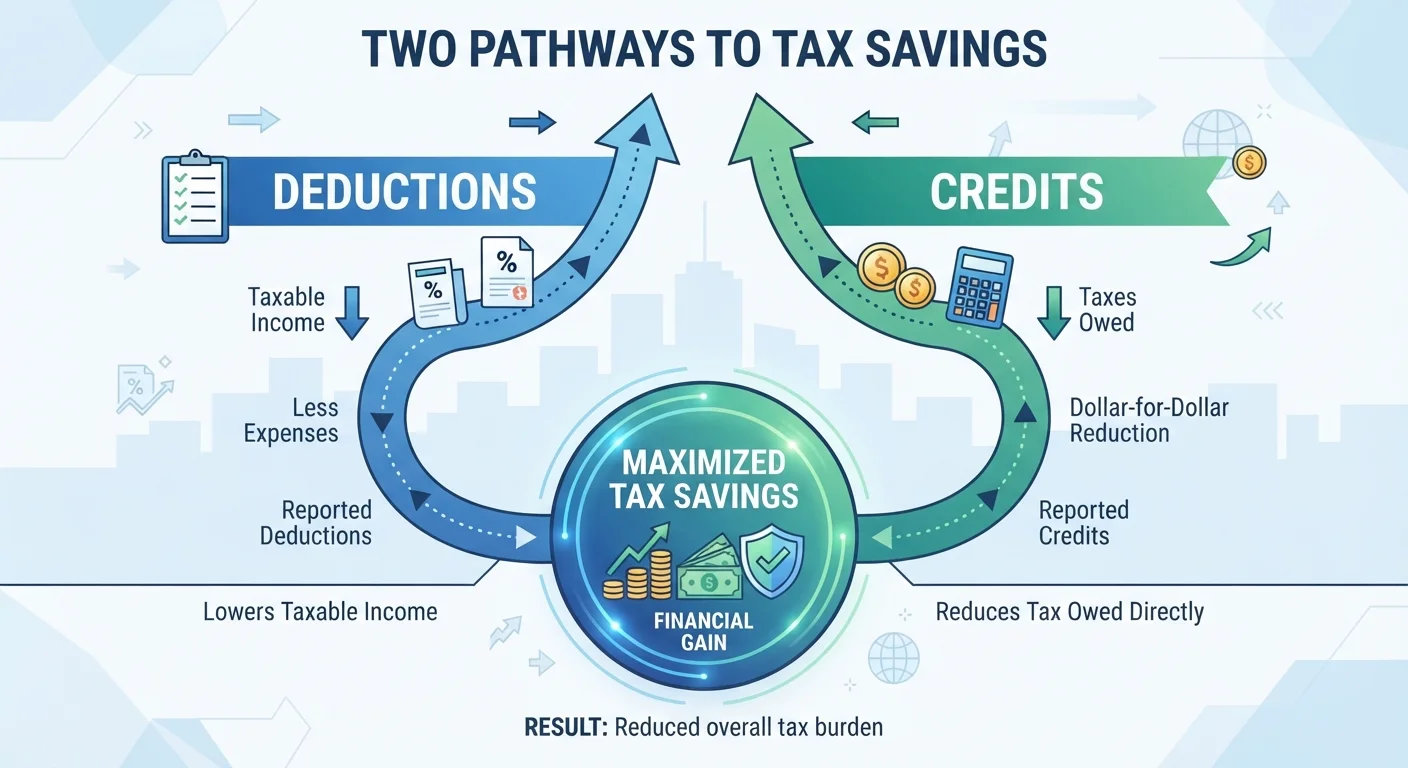
How Deductions and Credits Each Work
When people hear they can "lower their tax bill," they often picture a single mechanism. In reality, the IRS recognizes two distinct tools: tax deductions and tax credits. Understanding the difference between them is one of the most practical things a new taxpayer can learn.
A tax deduction reduces your taxable income - the amount of income your tax rate is actually applied to. Think of it as shrinking the pile of money that gets taxed. If you earned $50,000 and claimed $5,000 in deductions, the IRS treats only $45,000 as taxable. The savings you get depend on your marginal tax rate (the rate that applies to your top dollar of income). If your rate is 22%, a $1,000 deduction saves you $220 - not $1,000.
A tax credit works differently. Instead of reducing the income that gets taxed, a credit reduces the actual tax you owe - directly and at full value. A $1,000 credit cuts your bill by exactly $1,000, regardless of your tax bracket. That dollar-for-dollar impact is why credits are generally considered more powerful.
| Criterion | Tax Deductions | Tax Credits |
|---|---|---|
| What it reduces | Taxable income | Tax owed directly |
| Savings calculation | Depends on your tax bracket | Dollar for dollar, any bracket |
| Example: $1,000 benefit at 22% rate | $220 saved | $1,000 saved |
| Can it create a refund? | No - only reduces taxable income | Yes, if refundable credit type |
| Common examples | Standard deduction, mortgage interest | Earned Income Credit, Child Tax Credit |
| Applied at which stage | Before tax is calculated | After tax is calculated |
For a deeper walkthrough of both concepts, see our plain-language guide to deductions and credits.
Types of Deductions: Standard vs. Itemized
Most taxpayers choose between two deduction approaches when filing: the standard deduction or itemizing. The standard deduction is a flat dollar amount set by the IRS each year based on your filing status - no receipts or records required. Itemizing means listing individual qualifying expenses (mortgage interest, state and local taxes, charitable donations, and others) and claiming the actual total.
You can only use one approach per tax year, so it pays to compare both amounts before filing. Most filers, particularly those earlier in their careers or without a mortgage, find the standard deduction simpler and more beneficial. For a thorough look at the trade-offs, our article on standard deduction vs. itemizing walks through the decision step by step.
There are also above-the-line deductions - adjustments you can claim regardless of whether you itemize. Examples include the student loan interest deduction and the self-employed health insurance deduction. These reduce your adjusted gross income (AGI), which can unlock additional benefits elsewhere in your return.
Types of Credits: Refundable, Non-Refundable, and Partially Refundable
Not all credits work identically - their value to you depends on whether they are refundable, non-refundable, or partially refundable.
- Non-refundable credits can reduce your tax bill to zero, but any leftover credit amount is lost. If you owe $400 and claim a $700 non-refundable credit, you pay nothing - but you do not receive the remaining $300.
- Refundable credits can push your bill below zero, generating an actual refund. The Earned Income Tax Credit (EITC) is a well-known example. If you owe $200 and claim a $700 refundable credit, you could receive a $500 refund.
- Partially refundable credits fall in between - a portion can be refunded even if it exceeds your bill, but not the full amount.
For a detailed breakdown of how refundable and non-refundable credits differ, visit our guide on refundable vs. non-refundable tax credits.
Putting It Together: You Can Use Both
Deductions and credits are not competing choices - you can and often do benefit from both in the same tax year. The sequence matters: deductions are applied first to arrive at your taxable income, then your tax is calculated, and then credits are subtracted from that tax amount.
For example, claiming the standard deduction reduces your taxable income, which determines your tentative tax. If you also qualify for the Child Tax Credit, that credit then directly reduces the resulting bill. Each tool does its job at a different stage of the calculation.
If you are just starting out, our resource on deductions and credits for first-time taxpayers explains the most common opportunities available to beginners in plain language. You can also explore the full deductions and credits hub for more guides on reducing your tax bill legally and confidently.
This article is for general informational purposes only and does not constitute personalized tax, legal, or financial advice. Tax rules change periodically and individual situations vary. Consult a qualified tax professional for guidance specific to your circumstances.