
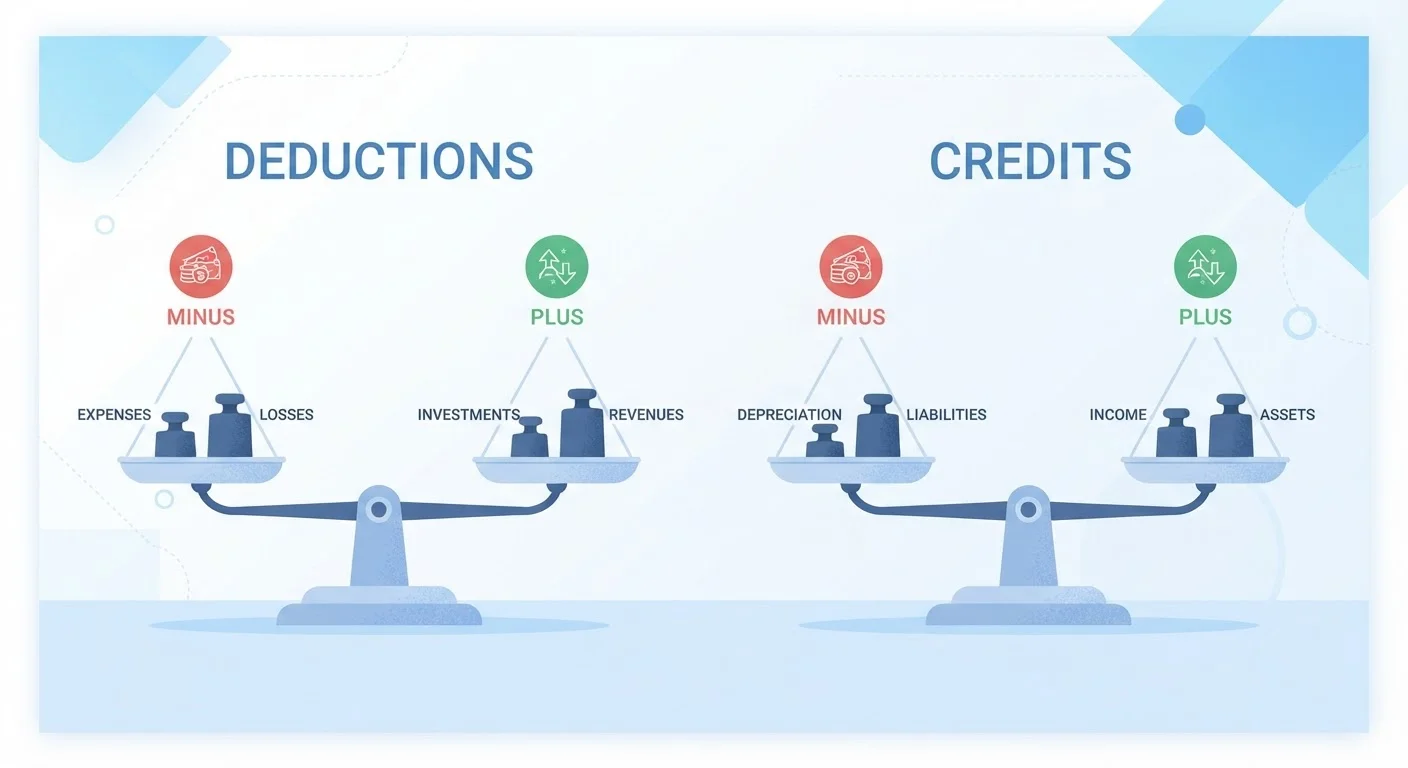
The Core Difference: What Each One Actually Does
When people talk about "writing something off" on their taxes, they're usually referring to a deduction. But deductions and credits are two entirely different mechanisms - and confusing them is one of the most common mistakes beginners make.
A tax deduction lowers your taxable income - the amount of your earnings that the IRS uses to calculate how much tax you owe. It doesn't eliminate tax dollar for dollar; it shrinks the income figure that gets taxed.
A tax credit, by contrast, is applied directly to your tax bill after that calculation is done. It reduces the amount you owe to the IRS line by line, dollar for dollar.
Here's a simple illustration. Suppose your income puts you in the 22% tax bracket:
- A $1,000 deduction reduces your taxable income by $1,000, saving you $220 in taxes (22% of $1,000).
- A $1,000 credit reduces your tax bill directly by $1,000.
The credit saves you nearly five times more. That's why tax professionals often describe credits as the more powerful of the two tools - when you qualify for one, it's worth claiming.
For a deeper side-by-side breakdown, see Deductions vs. Credits: Two Ways to Lower Your Tax Bill.
How Tax Deductions Work in Practice
Every taxpayer who files a federal return gets to subtract at least one deduction from their gross income: the standard deduction. The IRS sets this amount each tax year and adjusts it for inflation. For most beginners, taking the standard deduction is the simplest and most beneficial choice - no receipts, no calculations, just a fixed amount off your income.
The alternative is itemizing, where you list out individual qualifying expenses - things like mortgage interest, state and local taxes (up to the applicable cap), charitable donations, and certain medical costs. You'd choose to itemize only if the total of those expenses exceeds your standard deduction amount.
One rule worth knowing: you cannot take both the standard deduction and itemize. You pick one or the other each year based on whichever gives you the larger reduction.
| Criterion | Tax Deductions | Tax Credits |
|---|---|---|
| What it reduces | Taxable income | Tax owed directly |
| Dollar-for-dollar impact | No - savings depend on tax bracket | Yes - $1 credit = $1 off bill |
| Can generate a refund? | Not directly | Yes, if refundable |
| Common examples | Standard deduction, mortgage interest, student loan interest | EITC, Child Tax Credit, education credits |
| Applied at which stage? | Before tax is calculated | After tax is calculated |
| Requires itemizing? | Some do; standard deduction does not | No - claimed separately on return |
Some deductions - called above-the-line deductions - are available even if you don't itemize. Student loan interest and contributions to a traditional IRA are common examples. These are deducted from your gross income before you even apply the standard deduction, making them available to nearly everyone who qualifies.
Learn more about which deductions may be available to you at Deductions & Credits for First-Time Taxpayers.
How Tax Credits Work - and Why They're So Valuable
Once your taxable income is established and your preliminary tax bill is calculated, credits step in and reduce that bill directly. Some of the most common credits available to individual filers include the Earned Income Tax Credit (EITC), the Child Tax Credit, the American Opportunity Tax Credit for education expenses, and the Child and Dependent Care Credit.
Each credit has specific eligibility rules - income limits, filing status requirements, and qualifying expense thresholds. Meeting the criteria is what matters; the credit then reduces your liability automatically when you claim it on your return.
One important distinction within credits: whether they are refundable or non-refundable. A non-refundable credit can reduce your bill to zero but not below - you won't receive the unused portion back. A refundable credit, on the other hand, can push your liability below zero, resulting in a refund even if you owed nothing to begin with. The EITC is a well-known example of a fully refundable credit.
For a full explanation of how refundability works, see Refundable vs. Non-Refundable Tax Credits.
Understanding both tools together - deductions and credits - gives you a clearer picture of how your tax bill is built and where opportunities may exist. For a broader look at how income taxes work, visit the Tax Basics hub.
This article is for general informational and educational purposes only and does not constitute personalized tax, legal, or financial advice. Tax rules change regularly. Consult a qualified tax professional for guidance specific to your situation.