
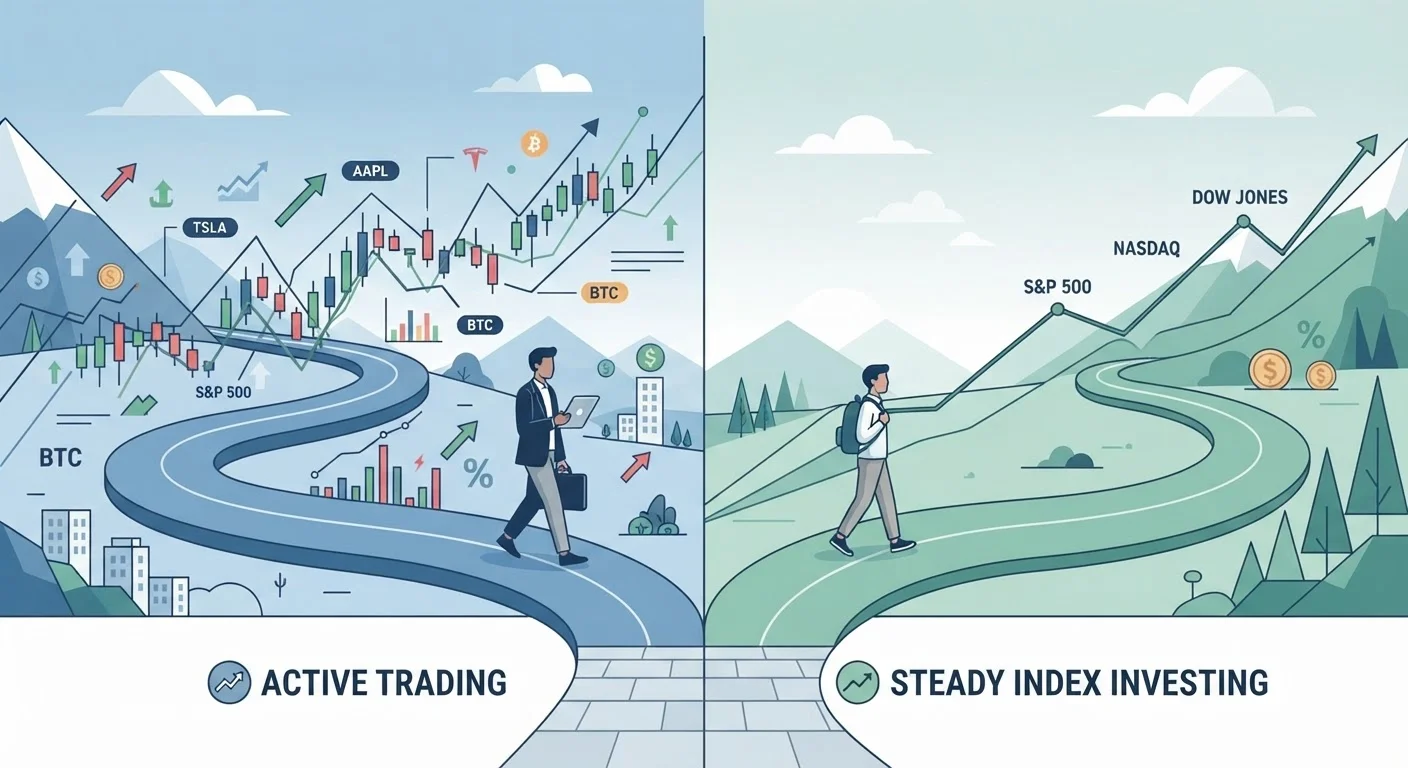
The Core Difference: Trying to Beat vs. Accepting the Market
Every investor makes a fundamental choice: should you try to outperform the market, or simply ride along with it? That question sits at the heart of the active versus passive debate.
Active investing assumes that careful stock selection, market timing, or specialized expertise can generate returns above what the broader market delivers. An active investor - or the fund manager acting on their behalf - makes deliberate buy and sell decisions in pursuit of that edge.
Passive investing takes the opposite view. It accepts that markets are reasonably efficient, meaning prices already reflect available information. Rather than trying to outsmart the market, passive investors aim to replicate its performance by holding a diversified basket of assets that tracks an index - such as the S&P 500.
These aren't just tactical differences; they reflect genuinely competing beliefs about how financial markets work and where investor returns come from. For a deeper look at how these philosophies translate into specific fund types, see active funds vs. index funds.
Costs, Turnover, and What They Mean for You
Cost is one of the clearest practical distinctions between the two approaches. Active strategies require research analysts, portfolio managers, and frequent trading - all of which cost money. Those costs are passed to investors through higher expense ratios (the annual fee charged as a percentage of your investment).
Passive funds, by contrast, simply track an index mechanically. They trade infrequently, require little active management, and typically carry much lower fees.
| Criterion | Active Investing | Passive Investing |
|---|---|---|
| Primary goal | Beat the market | Match the market |
| Typical expense ratio | 0.5%-1.5%+ annually | 0.03%-0.20% annually |
| Trading frequency | High - frequent buys and sells | Low - tracks index mechanically |
| Decision-making required | Constant research and judgment | Minimal - set and maintain |
| Tax efficiency | Lower - more taxable events | Higher - low turnover |
| Diversification | Varies by strategy | Broad by design |
| Long-term track record | Most funds trail benchmarks | Closely mirrors benchmark |
Why does this matter so much? Because fees compound just like returns do - but in the wrong direction. A 1% annual fee difference may sound trivial, but over 30 years it can meaningfully reduce your ending balance, even if gross returns are identical.
Active strategies also tend to generate more taxable events from frequent buying and selling, which can add an additional cost layer in taxable accounts. Passive strategies, by comparison, tend to be more tax-efficient due to lower turnover.
What the Evidence Suggests
The performance record of active management is one of the most studied topics in finance. The S&P Dow Jones SPIVA (S&P Indices Versus Active) scorecard - published regularly - has consistently found that the majority of actively managed U.S. equity funds underperform their benchmark index over periods of 10 to 20 years, especially after accounting for fees.
~85%
Active large-cap funds underperforming S&P 500
According to S&P Dow Jones SPIVA data, roughly 85% of U.S. large-cap active funds have underperformed the S&P 500 over rolling 15-year periods.
1%+
Typical active fund fee premium over passive
Morningstar research has found active funds charge, on average, more than 1 percentage point higher in annual fees than comparable passive index funds.
30+ years
Time horizon where cost differences compound most
Financial planning models consistently show that fee differences have their greatest compounding impact across multi-decade investment periods.
This doesn't mean active management never outperforms. Some managers do beat their benchmarks - sometimes for extended periods. The challenge for investors is identifying those managers in advance, and research suggests past outperformance is not a reliable predictor of future outperformance.
It's also important to note that evidence varies by market segment. Active managers may have more potential to add value in less efficient corners of the market - such as small-cap international stocks - where information is less uniformly available. In highly efficient markets like large-cap U.S. equities, outperforming the index is considerably harder.
This article is general financial education, not personalized advice. For decisions suited to your situation, consult a qualified financial adviser.
Choosing an Approach That Fits Your Goals
Neither philosophy is universally superior - but they suit different investors in different circumstances. Your investing time horizon matters enormously here. Short-term and long-term investing goals involve different trade-offs that intersect with whether an active or passive approach makes sense.
For most beginners, passive investing offers a compelling starting point: low costs, built-in diversification, and no requirement to pick individual stocks or time markets. Understanding the vehicles available - including how mutual funds and ETFs differ - will help you see how passive exposure is typically delivered in practice.
Active investing, meanwhile, demands more: time to research holdings, discipline to manage emotions, and the intellectual honesty to measure your results against an appropriate benchmark. Done well, it can be rewarding. Done poorly - or with high costs - it often trails a simple index strategy.
Many investors ultimately use elements of both: a core passive portfolio supplemented by targeted active positions in areas they understand well. What matters most is that your approach aligns with your goals, your risk tolerance, and the time you can realistically commit.
This article is for informational and educational purposes only and does not constitute personalized financial, investment, tax, or legal advice. All investing involves risk, including the possible loss of principal. Past performance does not guarantee future results. Consult a licensed financial professional before making investment decisions.