
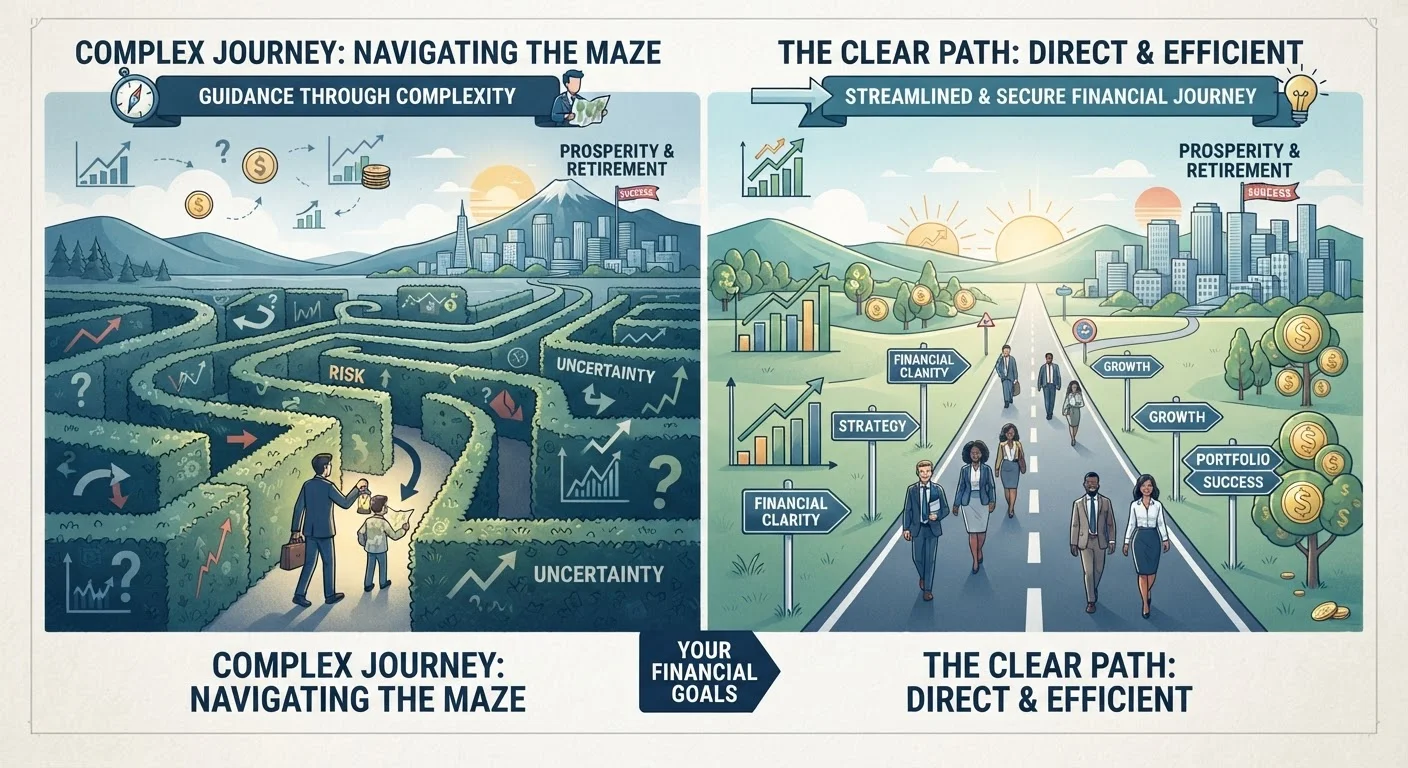
How Each Fund Type Actually Works
When you invest in a fund, you're pooling your money with other investors to buy a basket of securities - but the way that basket is built differs dramatically between active and index funds.
An active fund is run by a portfolio manager (or a team) whose explicit goal is to beat a specific benchmark - often an index like the S&P 500. They research individual companies, analyze economic conditions, and buy or sell securities based on their judgment. They are trying to outsmart the collective market.
An index fund takes the opposite approach. Rather than selecting securities, it simply holds every security in a given index - such as the S&P 500 or the Total Stock Market - in proportion to its size. There is no human judgment about which stocks to favor. The fund rises and falls with the index itself. This is often called passive investing.
To understand the broader landscape of investment types these funds operate within, see our plain-language investment overview.
| Criterion | Active Funds | Index Funds |
|---|---|---|
| Management style | Human manager selects securities | Automatically tracks an index |
| Typical expense ratio | 0.5%-1%+ per year | Often below 0.1% per year |
| Goal | Beat a benchmark index | Match a benchmark index |
| Trading frequency | High - frequent buys and sells | Low - holds index constituents |
| Historical outperformance | Minority outperform after fees | Returns match the index, minus small fees |
| Market risk | Yes - plus manager risk | Yes - mirrors full market movements |
| Complexity for new investors | Higher - requires evaluating managers | Lower - straightforward to understand |
The Real Cost Difference - and Why It Matters
Fees are where the two approaches diverge most sharply - and for new investors, this may be the single most important practical distinction.
Active funds require paying analysts, research teams, and portfolio managers. Those costs are passed to investors through the expense ratio - an annual percentage of your invested assets. Active fund expense ratios typically range from 0.5% to over 1% per year.
Index funds, which require no active management team, run at a fraction of that cost. Many broad index funds carry expense ratios well below 0.1% annually.
That gap compounds. On a $10,000 investment growing at 7% annually over 30 years, a 1% fee difference could cost you tens of thousands of dollars in lost growth - money that would otherwise have stayed in your account. Fees are one of the few factors you can control as an investor, which is why they deserve serious attention.
~85%
Active large-cap funds underperforming S&P 500
According to S&P Dow Jones Indices' SPIVA reports, roughly 85% of actively managed US large-cap funds have trailed the S&P 500 over 15-year periods.
0.03%-1%+
Range of fund expense ratios
Expense ratios vary widely: broad index funds can charge as little as 0.03% annually, while some active funds exceed 1%, according to industry data from Morningstar.
For a deeper look at how index funds work mechanically, our index funds explainer walks through the structure in plain language.
Performance: What the Evidence Suggests
Active fund managers are skilled professionals - so you might expect them to outperform the market reliably. The historical evidence, however, tells a more complicated story.
Studies tracking fund performance over long periods consistently find that the majority of actively managed funds underperform their benchmark index after fees are accounted for. This doesn't mean all active funds underperform - some do beat the market - but identifying which ones will do so in advance is genuinely difficult, even for experts.
One reason: markets are highly competitive. Millions of informed participants are trading simultaneously, which means prices already reflect most available information. A manager needs to be consistently right in ways the rest of the market is consistently wrong - a high bar to clear year after year.
Index funds accept average market returns by design. In a world where beating the market is hard, matching it reliably and cheaply has proven to be a strong long-term outcome for many investors. That said, index funds are not risk-free - when the overall market drops, so does your index fund.
To explore the broader philosophical debate behind these two strategies, see Active vs. Passive Investing: Two Philosophies, One Decision.
What This Means for a New Investor
If you're early in your investing journey, the choice between active and index funds is less about finding a winner and more about understanding what you're paying for - and what risks remain either way.
Both fund types carry market risk: the possibility that your investment loses value. Neither guarantees a return. What differs is how much additional risk and cost you accept in pursuit of potentially better results.
For most beginners, index funds offer a clear, low-friction starting point: broad diversification, low fees, and no need to evaluate manager skill. They won't deliver excitement, but they won't require constant monitoring either.
Active funds can play a role in a portfolio - particularly in market areas where research and expertise may add more value - but they require more scrutiny: What is the fund's track record relative to its benchmark? What does it actually cost? Does its strategy match your goals?
If you're also weighing how different fund structures - like mutual funds versus ETFs - affect your options, our mutual funds and ETFs comparison explains the structural differences clearly.
This article is for general educational purposes only and does not constitute personalised financial or investment advice. All investments involve risk, including the potential loss of principal. Past performance does not guarantee future results. Please consult a qualified financial adviser before making decisions about your own investments.