
Why You Need a Map Before You Invest
Walking into the investment world without any orientation is like arriving in an unfamiliar city with no map. You can still get somewhere, but you're likely to take wrong turns, waste time, and feel anxious the whole way. The good news: the investment landscape is far more navigable than it first appears.
This guide gives you that orientation. It covers the main investment categories - what they are, how they work, and what trade-offs each one involves. It does not tell you what to buy or recommend any specific product. Instead, it builds the foundational vocabulary you need to make informed decisions and to have productive conversations with a licensed financial professional.
Before putting any money to work, it helps to understand what how investing works at a basic level - including how money can grow over time through returns and compounding.
Asset class
A broad category of investment - such as stocks, bonds, or real estate - whose members share similar characteristics and behave similarly in the market.
Diversification
Spreading investments across different asset types or securities so that a loss in one area does not devastate your entire portfolio.
Expense ratio
The annual fee charged by a fund, expressed as a percentage of your investment. A 0.10% expense ratio means you pay $1 per year for every $1,000 invested.
Liquidity
How quickly and easily an investment can be converted to cash without significantly affecting its price. Stocks are highly liquid; real estate is not.
Risk tolerance
Your personal ability to handle investment losses - both financially (can you afford it?) and emotionally (can you stay calm and stick to your plan?).
Time horizon
How long you plan to keep your money invested before you need to use it. A longer time horizon generally allows you to take on more short-term risk.
The Main Investment Types Explained
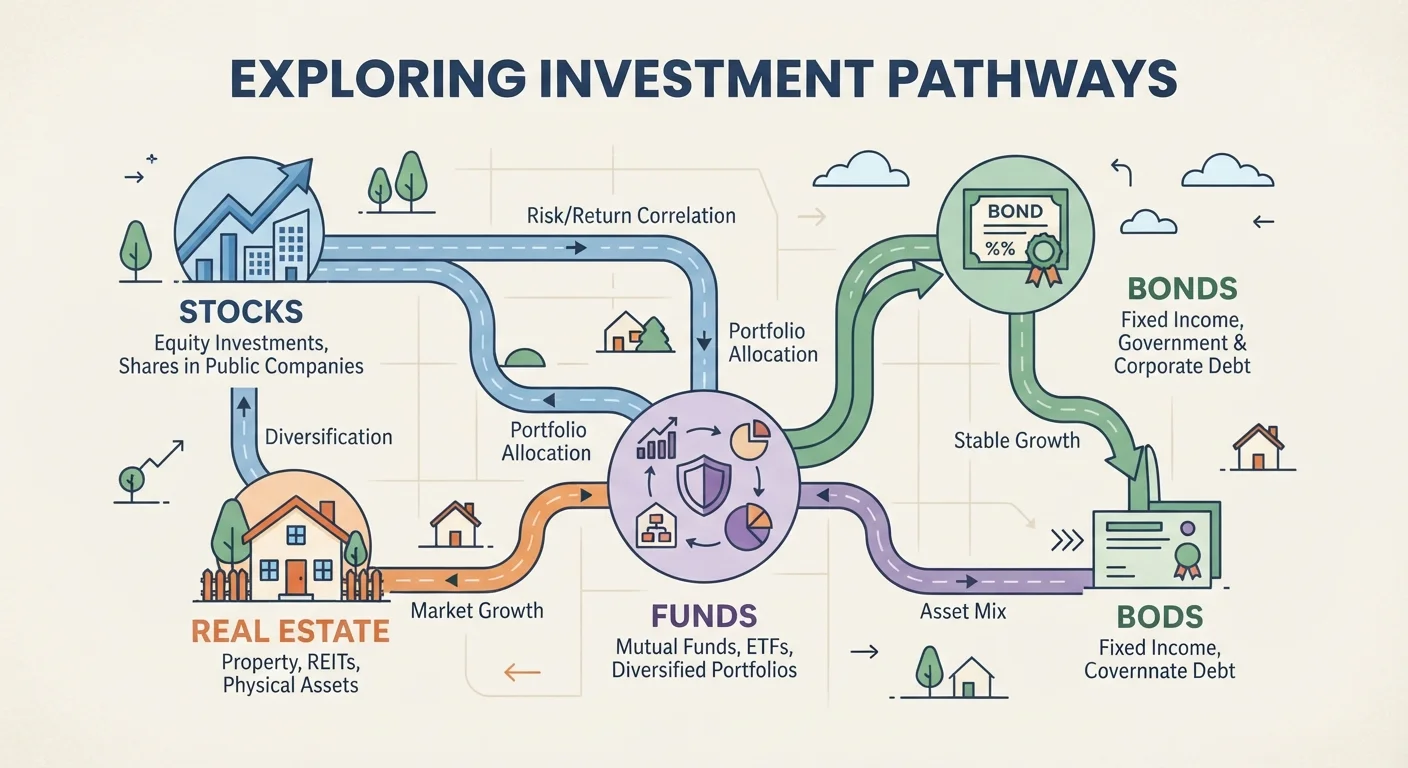
Most investments fall into a handful of broad categories. Here is a plain-language look at each one.
Stocks (Equities)
When you buy a stock, you buy a small ownership stake in a company. If the company grows and becomes more valuable, your stake is worth more. If it struggles, the value falls. Stocks can also pay dividends - periodic cash distributions from company profits. Stocks have historically delivered stronger long-term returns than many other asset types, but they can also lose significant value in short periods. For a deeper comparison, see our article on stocks, bonds, and cash as asset classes.
Bonds (Fixed Income)
A bond is a loan. You lend money to a government or corporation, and in return they agree to pay you a fixed interest rate (called a coupon) and return your principal on a set date (called the maturity date). Bonds are generally considered less volatile than stocks, but they are not risk-free - issuers can default, and rising interest rates can reduce a bond's market value before maturity.
Funds: Mutual Funds and ETFs
Funds pool money from many investors to buy a collection of securities. A mutual fund is priced once per day and often actively managed - a professional decides which assets to hold. An ETF (Exchange-Traded Fund) trades on a stock exchange throughout the day like a stock, and many ETFs passively track a market index. Index funds - whether mutual funds or ETFs - aim to match the performance of an index like the S&P 500. Because they require less active management, their fees (called expense ratios) tend to be lower.
Real Estate
Real estate investing can mean buying physical property to rent or resell, but it doesn't have to. REITs (Real Estate Investment Trusts) are companies that own income-producing properties and trade on stock exchanges, giving investors exposure to real estate without the complexity of direct ownership. Real estate can provide income and long-term value growth, but direct property ownership involves significant costs and illiquidity.
Cash and Cash Equivalents
Savings accounts, money market accounts, and short-term government securities are considered cash equivalents. They offer capital preservation and easy access, but their returns are modest - often below the rate of inflation over the long term. They serve an important role in a portfolio as a stability buffer, not a growth engine.
For definitions of these and other terms in one place, the investment types reference guide is a useful companion resource.
How Risk and Return Relate
One of the most important principles in investing is that risk and potential return are linked. Investments that offer higher potential gains typically carry a higher chance of loss. This is not a flaw in the system - it is a fundamental trade-off.
Match Risk to Your Timeline
A useful rule of thumb: the longer you have before you need the money, the more short-term market volatility you can typically afford to ride out. Someone with a 20-year horizon before retirement can generally tolerate more stock exposure than someone saving for a home purchase in three years. Always review this balance with a financial professional.
Consider a simple spectrum. At one end: cash in a savings account - very low risk, very low return. At the other end: shares in a single small startup - very high risk, very high potential reward. Stocks, bonds, and funds sit between these extremes, each in different positions depending on the specific security or fund.
Your personal position on this spectrum should reflect two things: your time horizon (how long before you need the money) and your risk tolerance (how much loss you could absorb financially and emotionally without abandoning your plan). A longer time horizon generally allows for more short-term volatility because there is more time to recover. A shorter horizon usually calls for more stable investments.
Past performance of any investment does not guarantee future results. Markets move in unpredictable ways, and no category of investment is immune to loss.
Putting the Pieces Together
Understanding investment types individually is useful, but investors rarely hold just one type. A portfolio is the full collection of investments a person holds. Spreading that portfolio across different asset types - a practice called diversification - can reduce the impact of any single investment performing poorly.
The right mix of assets in your portfolio is a personal question that depends on your goals, timeline, and financial situation. There is no universal formula. What works for a 30-year-old saving for retirement looks very different from what suits someone who needs income within five years.
To explore practical first steps toward building a portfolio, the Starting Your Portfolio hub walks through what to consider when you're ready to move from learning to action. For a focused look at how stocks, bonds, and cash each play a specific role in a balanced portfolio, see stocks, bonds, and cash as portfolio building blocks.
This article is general financial education, not personalized investment advice. Before making any investment decisions, consider consulting a licensed, fiduciary financial adviser who can assess your individual circumstances.
This article is intended for informational and educational purposes only. It does not constitute personalized financial, investment, tax, or legal advice. All investing involves risk, including the possible loss of principal. Consult a qualified financial professional before making investment decisions.