
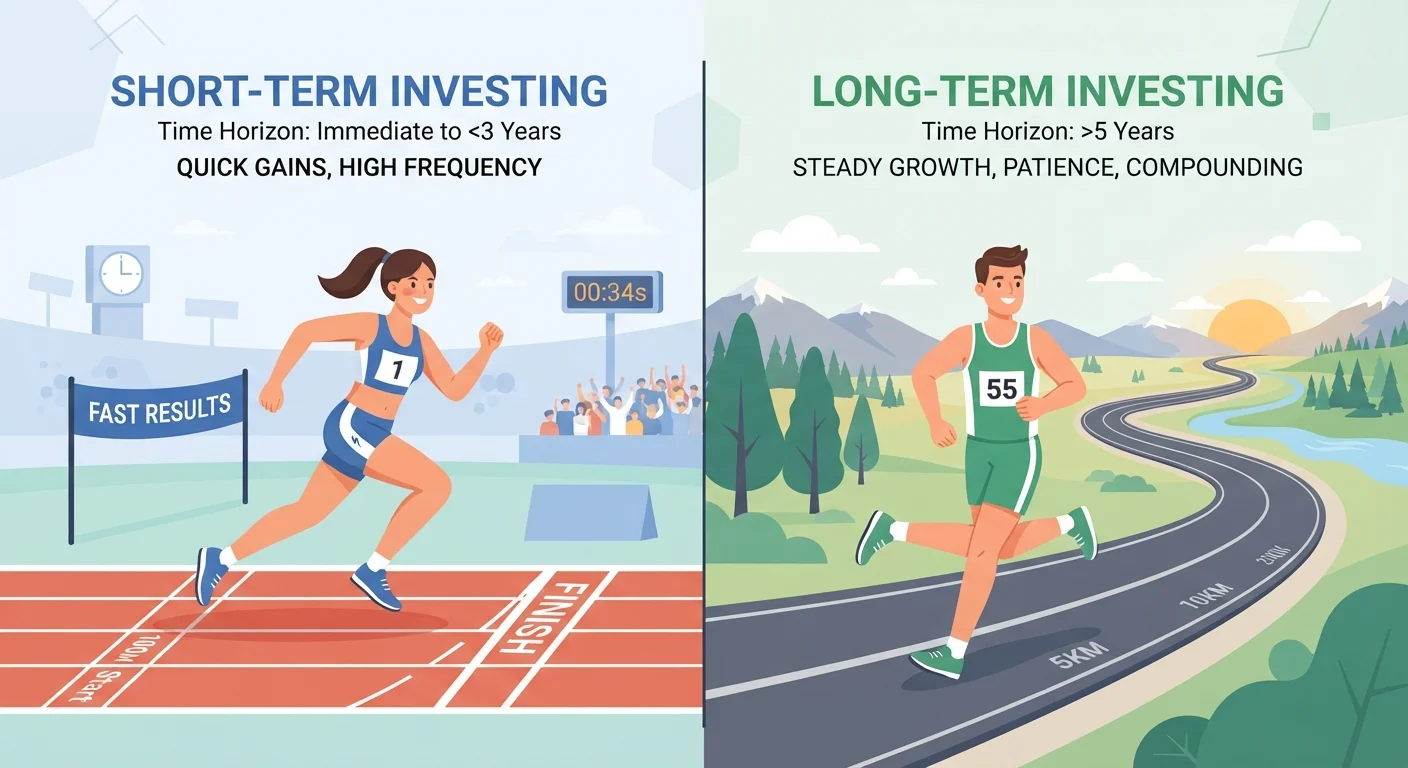
Why Time Horizon Is the Starting Point
Before deciding where to invest, you need to decide when you'll need the money back. This is your investing time horizon - the length of time between now and the point when you plan to use the funds. It's not a minor detail. It fundamentally determines how much risk is appropriate, what types of assets make sense, and how you should react when markets move.
Think of it this way: if you're saving for a vacation next year, you cannot afford to watch that money drop 30% in a market correction. But if you're building retirement savings for 25 years from now, a short-term market dip is a normal part of the journey - and historically, patient investors have been rewarded for staying the course.
Before going further, it helps to understand how your goals map to timelines. Our guide on categorising goals by time horizon walks through exactly that distinction.
Short-Term Investing: Protecting What You Have
Short-term investing typically covers a window of one to three years, though some definitions stretch to five. The defining priority is capital preservation - keeping the money you put in largely intact - combined with liquidity, meaning you can access it when you need it.
Because the timeline is short, there's little room to recover from significant losses. If markets fall sharply in year one and you need the money in year two, you may be forced to sell at a loss. This is why short-term money generally belongs in lower-volatility vehicles: high-yield savings accounts, money market accounts, short-duration bonds, or certificates of deposit (CDs). These instruments offer modest returns, but they don't expose your principal to the swings of the stock market.
The trade-off is straightforward: lower risk means lower potential return. Short-term strategies are not designed to build wealth - they're designed to protect it until you're ready to spend it.
Don't Invest Short-Term Money in Volatile Assets
One of the most damaging beginner errors is placing money you'll need within a year or two into stocks or similar volatile investments. If markets decline sharply before you need the funds, you may be forced to sell at a loss with no time to wait for recovery. Always ask yourself: 'When will I actually need this money?' before choosing where to put it.
For more on how saving and investing serve different purposes for different goals, see saving goals vs. investment goals.
Long-Term Investing: Letting Time Work for You
Long-term investing generally begins at a five-year horizon and extends to decades. The most common example is retirement savings. Here, the calculus shifts considerably: because you won't need the money soon, you can afford to ride out short-term volatility in exchange for potentially higher long-term growth.
Stocks - shares of ownership in publicly traded companies - have historically produced higher average returns than bonds or cash over long periods, though past performance does not guarantee future results and all investing involves risk of loss. The logic behind accepting that volatility is compounding: earning returns on your returns over time. The longer your money is invested, the more compounding can work in your favour. Even relatively modest annual returns can produce substantial growth over 20 or 30 years.
| Short-Term Investing | Long-Term Investing | |
|---|---|---|
| Typical horizon | 1-3 years (up to 5) | 5+ years (often decades) |
| Primary goal | Capital preservation | Wealth growth over time |
| Risk tolerance | Low - limited recovery time | Higher - time absorbs volatility |
| Common vehicles | Savings accounts, CDs, short bonds | Stocks, index funds, retirement accounts |
| Return potential | Modest, more predictable | Higher potential, less predictable short-term |
| Liquidity needs | High - access money soon | Low - money stays invested |
| Impact of market downturns | Severe - little time to recover | Manageable - time allows recovery |
Time is such a powerful factor that even a few years' delay can significantly affect outcomes. Our piece on the real cost of waiting to invest illustrates this with concrete examples.
Long-term investors also have more flexibility in how they invest - from growth-focused strategies to income-generating assets. That distinction is explored in our overview of growth vs. income investments.
Holding Both Horizons at Once
Most people aren't choosing between short-term and long-term investing - they need both, running in parallel. You might be building an emergency fund and saving for a car (short-term) while also contributing to a retirement account (long-term). The critical principle is keeping these pools of money separate and matched to their respective strategies.
Mixing up horizons is a common and costly mistake. Putting short-term money into volatile assets leaves you exposed to losses right before you need to spend. Conversely, keeping long-term money in low-return savings vehicles means missing years of potential growth.
A practical framework: map each goal to a timeline, then match the investment approach to that timeline. Our related guide on short-term vs. long-term financial goals offers a structured way to think through this.
This article is for general informational and educational purposes only. It does not constitute personalised financial, investment, tax, or legal advice. Investing involves risk, including the possible loss of principal. Please consult a qualified financial adviser before making decisions based on your individual circumstances.