
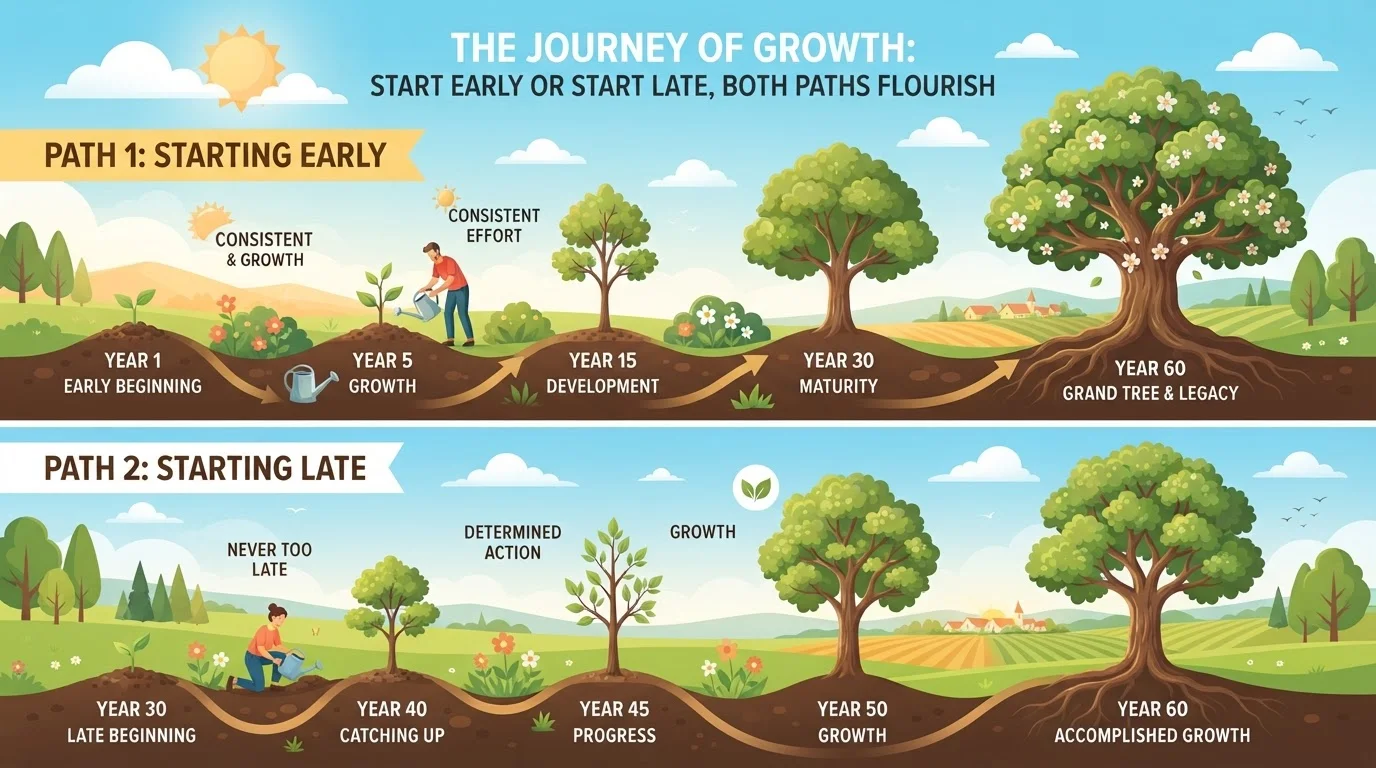
Why Time Is the Investor's Most Valuable Resource
Most people assume the key to building wealth through investing is picking the right assets or waiting for the right conditions. In reality, one of the most powerful factors is something you can't control after the fact: time.
When you invest, your money has the potential to earn returns. When those returns are reinvested, they can generate their own returns in future periods - a process called compound growth. The longer this cycle continues, the more dramatically it can accelerate. This is why a relatively small amount invested early can, over several decades, grow to a sum that dwarfs a much larger amount invested later.
Think of compounding like a snowball rolling downhill. It starts small, but as it picks up more snow - and that snow also picks up more snow - the mass grows faster and faster. Delay the start, and you don't just lose a few feet of slope. You lose the early accumulation that makes the later growth possible.
Before diving deeper, it's worth noting: building a savings foundation is a critical first step. Investing without an emergency fund or basic financial stability carries real risks.
What the Numbers Illustrate
To understand the cost of waiting, it helps to look at a simplified illustration. Consider two hypothetical investors - neither is a real person, and these figures are for educational purposes only. Actual returns will vary and are not guaranteed.
- Investor A begins contributing $200 per month at age 25 and stops at age 35 - just 10 years of contributions.
- Investor B begins contributing $200 per month at age 35 and continues until age 65 - a full 30 years.
Assuming both earn the same hypothetical average annual return, Investor A - who contributed for a third as long - may end up with a comparable or even larger balance by retirement age. The reason: their money had more time to compound.
This is not a promise of results. Markets fluctuate, returns are never guaranteed, and your outcome will depend on many personal factors. But the illustration captures a real mathematical principle - earlier money has more time to grow on itself.
10+ years
Head start that dramatically changes compound outcomes
Financial educators broadly illustrate that a decade of earlier investing can rival or exceed three decades of later contributions at the same rate, due to compounding dynamics.
~7%
Historical average annual U.S. stock market return (inflation-adjusted, approximate)
The S&P 500 has historically delivered roughly 7% average annual real returns over long periods, though past performance does not guarantee future results and returns vary widely year to year.
2x+
Potential difference in outcome from a 10-year delay
Simplified compound growth models commonly show that a 10-year delay in starting can result in a final balance less than half that of an earlier start, assuming equal contributions and return rates - for illustrative purposes only.
For a deeper look at how this plays out across retirement planning specifically, see how compound growth interacts with retirement milestones.
The Hidden Cost of Waiting for the 'Right Moment'
One of the most common reasons people delay investing is the belief that they should wait for better conditions - a market dip, a more stable economy, a higher income, or just more confidence. This instinct is understandable. But it often costs more than people realize.
Markets move unpredictably. Attempting to time an ideal entry point means sitting in cash while potential growth passes. Research consistently suggests that missing just a handful of the market's strongest trading days - often clustered around periods of high volatility - can significantly reduce long-term returns. You can't reliably predict those days in advance.
“The stock market is a device for transferring money from the impatient to the patient.”
— Warren Buffett, Chairman and CEO of Berkshire Hathaway, widely recognized long-term value investor
This doesn't mean ignoring risk or investing recklessly. It means recognizing that waiting has a price too - one that's easy to overlook because it's invisible. Unlike a market loss, the cost of not investing doesn't show up in your account. It simply never appears.
If you're weighing how early investment decisions connect to broader life trade-offs, our look at the tradeoffs of saving aggressively early in life offers useful context.
How to Think About Starting - Even Imperfectly
Perfection is not a prerequisite for starting. A modest, consistent investment habit begun now will almost always outperform a larger, optimized strategy that begins years later. The goal early on is less about choosing the ideal asset and more about establishing the habit and putting time to work.
A few principles worth keeping in mind:
- Consistency matters more than size. Regular contributions - even small ones - benefit from compounding over time.
- Time horizon shapes risk tolerance. Those with decades before they need the money can generally accept more short-term volatility. Short-term and long-term investing require different approaches.
- Starting beats waiting. An imperfect plan implemented today is generally more valuable than a perfect plan implemented five years from now.
Investing involves risk, including the possible loss of principal. This article is general financial education and is not a substitute for personalised advice. Speak with a qualified financial adviser to understand what approach fits your specific circumstances, goals, and risk tolerance.
This article is for informational and educational purposes only and does not constitute personalised financial, investment, tax, or legal advice. All investing involves risk, including possible loss of principal. Past performance does not guarantee future results. Consult a licensed financial professional before making investment decisions.