
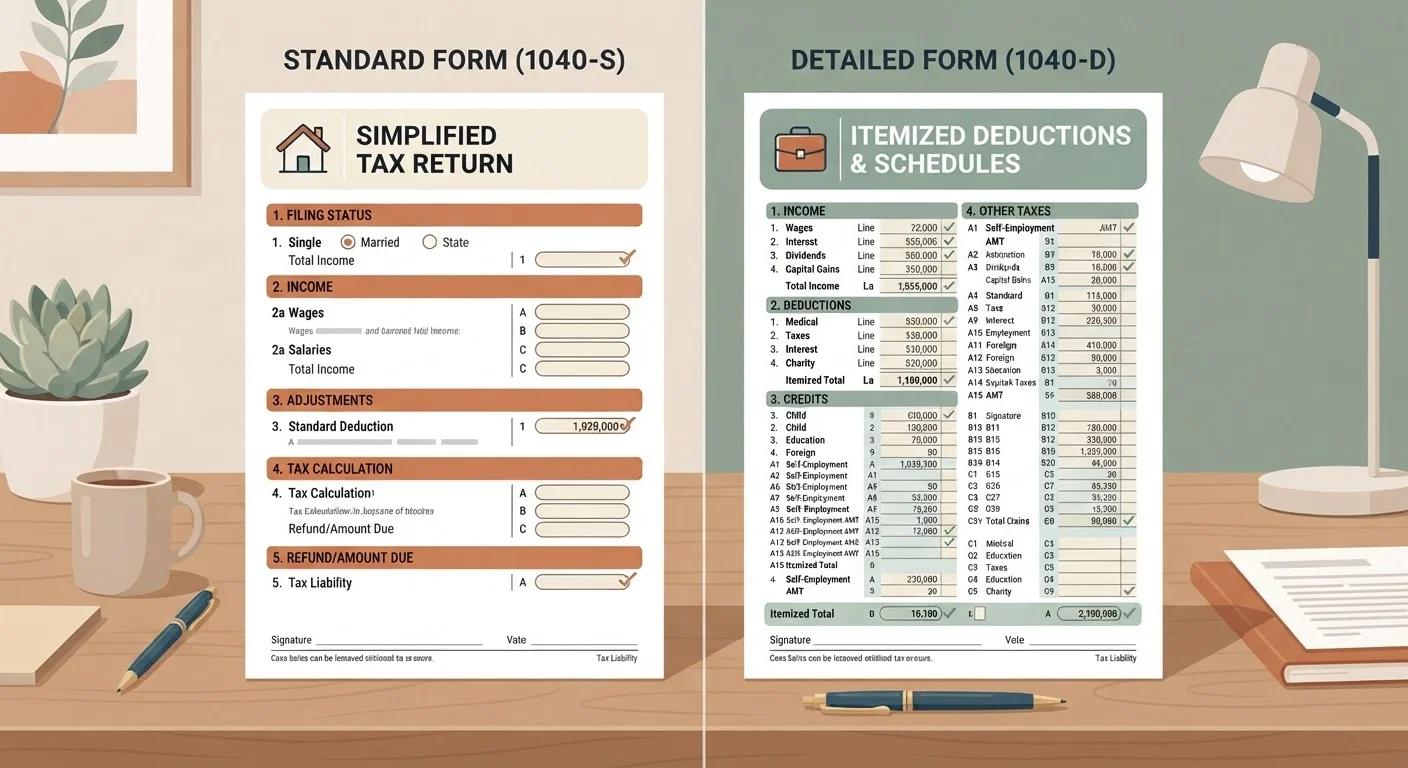
What Each Approach Actually Does
When you file a federal income tax return, you can reduce your taxable income by subtracting deductions. The IRS gives you two ways to do this: take the standard deduction - a fixed dollar amount set by Congress each year based on your filing status - or itemise, meaning you list out your actual qualifying expenses on Schedule A and deduct the total.
The standard deduction requires no receipts and no calculations beyond knowing your filing status. Itemising demands documentation: mortgage interest statements (Form 1098), records of state and local taxes paid, charitable contribution receipts, and medical expense totals, among others.
To understand how deductions differ from tax credits - a separate but equally important concept - see our guide on deductions vs. credits. For a deeper dive into just the standard deduction, this overview explains what it covers and who it helps most.
This article is for general informational purposes only and does not constitute personalised tax advice. Consult a qualified tax professional for guidance specific to your situation.
Head-to-Head: Key Differences at a Glance
The table below summarises the most important contrasts between both approaches so you can see the trade-offs clearly before reading further.
| Criterion | Standard Deduction | Itemising Deductions |
|---|---|---|
| How the amount is set | Fixed by IRS based on filing status | Sum of your actual qualifying expenses |
| Documentation required | None | Receipts, statements, and records for each expense |
| IRS form needed | No extra form | Schedule A attached to Form 1040 |
| Best when | Expenses are below the fixed threshold | Qualifying expenses exceed the standard amount |
| Complexity | Low - simple and fast | Higher - requires careful tracking |
| SALT deduction included | Not separately - built into flat amount | Yes, up to $10,000 cap |
| Mortgage interest deductible | No | Yes, within IRS limits |
| Who most commonly uses it | Majority of US tax filers | Homeowners, high earners, large donors |
One point worth emphasising: the standard deduction amount adjusts annually for inflation and varies by filing status. For the most current figures, always check the IRS website or consult a tax professional, as the numbers change each tax year.
When the Standard Deduction Wins
For the majority of US taxpayers, the standard deduction is the better choice - and has been even more so since the Tax Cuts and Jobs Act of 2017 roughly doubled the amounts across all filing statuses. If your deductible expenses simply don't add up to more than the flat amount, choosing the standard deduction puts more money back in your pocket with none of the paperwork overhead.
The standard deduction is particularly well-suited to renters (who can't deduct mortgage interest), filers in states with low or no income tax, and anyone whose charitable giving and medical costs fall within typical ranges. Importantly, you can still benefit from certain above-the-line deductions - such as student loan interest or contributions to a traditional IRA - even when you take the standard deduction. Learn more about those in our article on above-the-line deductions you can claim without itemising.
~90%
Share of filers taking the standard deduction
According to IRS Statistics of Income data, approximately nine in ten taxpayers now claim the standard deduction following the 2017 tax law changes.
$10,000
SALT deduction cap for itemisers
The Tax Cuts and Jobs Act of 2017 capped the state and local tax deduction at $10,000 per return, limiting itemising benefits for many high-tax-state residents.
7.5%
AGI threshold for medical expense deductions
Only unreimbursed medical costs exceeding 7.5% of your adjusted gross income are deductible when you itemise, per current IRS rules.
When Itemising Makes Financial Sense
Itemising pays off when your total qualifying expenses genuinely exceed your standard deduction threshold. The most common expenses that tip the scales include:
- Mortgage interest: Deductible on loans up to $750,000 (for mortgages originated after December 15, 2017).
- State and local taxes (SALT): Property taxes plus state income or sales taxes, capped at $10,000 combined per return.
- Charitable contributions: Cash and non-cash donations to qualifying organisations.
- Unreimbursed medical expenses: The portion exceeding 7.5% of your adjusted gross income.
The practical requirement is record-keeping. You need documentation for every line item, and you'll complete Schedule A when you file. If that sounds daunting, our article on itemising your deductions - when it makes sense and when it doesn't walks through the full process step by step.
One important rule: you cannot split the two methods. Whichever produces the larger deduction for your situation is the one to use - and you commit to it for the entire tax year. For a practical decision framework, see how filers decide between the two.
A Simple Way to Decide
Before you file, add up every expense that would qualify as an itemised deduction. Compare that total to the standard deduction for your filing status. If your qualifying expenses are higher, itemising likely reduces your tax bill more. If they're lower - or even close - the standard deduction is almost always simpler and just as effective.
A tax preparation tool or qualified tax professional can run both calculations side by side in minutes. The decision also intersects with broader financial planning: for example, the account types you use for investing can affect your taxable income and deduction strategy. Our guide on tax-advantaged accounts vs. standard investment accounts explains how account choice shapes your overall tax picture.
Whichever path you choose, understanding the mechanics puts you firmly in control of your own filing - and that confidence is worth more than any single deduction.
This article provides general financial education and is not a substitute for advice from a licensed tax professional or CPA. Tax rules change; verify current figures with the IRS or a qualified adviser before filing.