
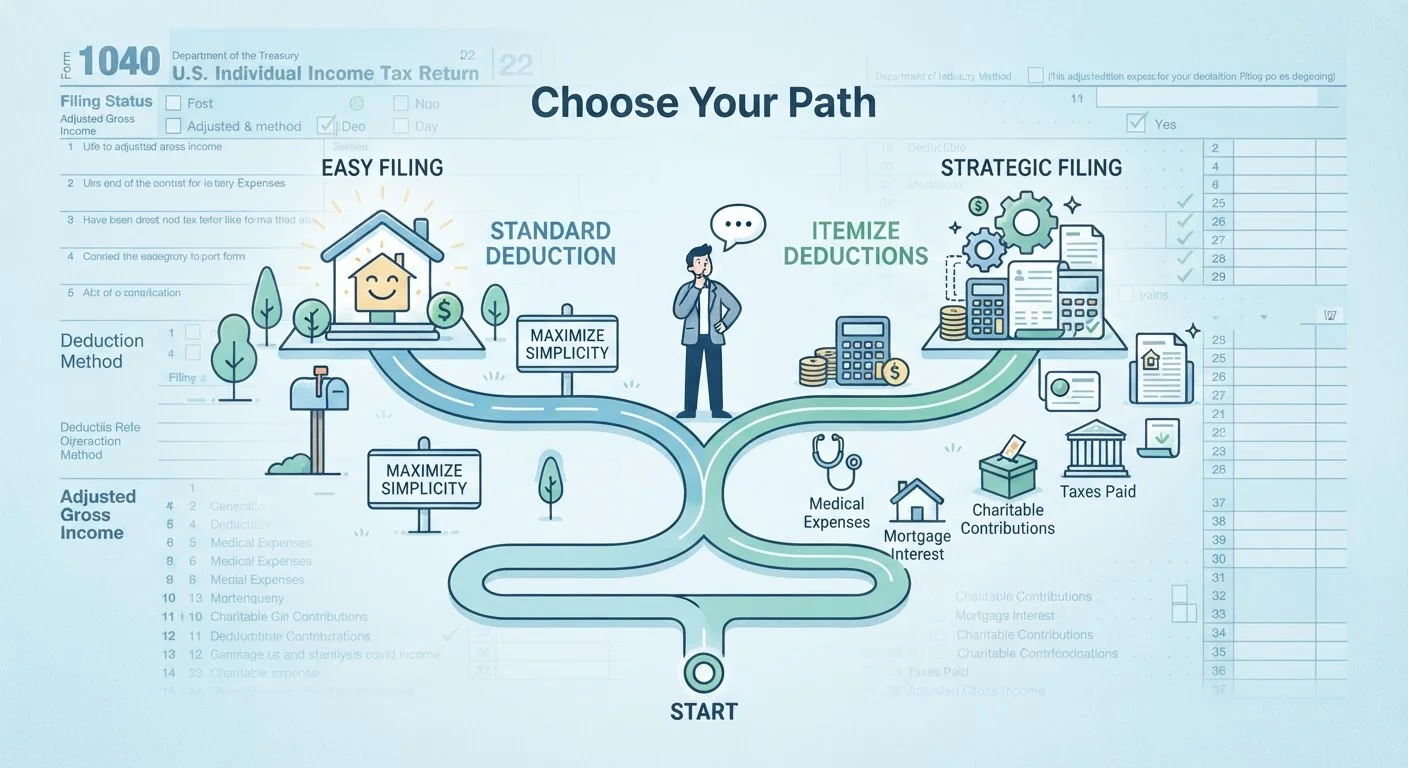
What Each Method Actually Does
When you file a federal income tax return, the IRS allows you to subtract a certain amount from your gross income before calculating what you owe. That subtraction comes in two forms: the standard deduction or itemised deductions. You apply one or the other - never both - to arrive at your taxable income.
The standard deduction is a flat dollar amount set by the IRS each year, adjusted for inflation. It varies by filing status. When you claim it, you don't need to track individual expenses or provide documentation - you simply enter the amount on your return and subtract it automatically.
Itemising means replacing that flat amount with a list of specific expenses the IRS permits - things like mortgage interest, state and local taxes (up to certain limits), and qualifying charitable contributions. If the total of those expenses exceeds your standard deduction, itemising produces a larger subtraction and a lower tax bill. If it doesn't, the standard deduction wins.
For a broader look at how deductions differ from tax credits, see Deductions vs. Credits: Two Ways to Lower Your Tax Bill.
Comparing the Two Approaches Side by Side
Before diving into which method might suit you, it helps to see how the two approaches stack up across the factors that matter most to filers.
| Standard Deduction | Itemising | |
|---|---|---|
| How the amount is set | Fixed IRS amount by filing status | Sum of qualifying individual expenses |
| Documentation required | None | Receipts, statements, and records for each item |
| Complexity | Very low - one line on your return | Moderate to high - Schedule A required |
| Best suited for | Renters, simpler finances | Homeowners, high-tax-state residents, large donors |
| Risk of error | Very low | Higher - missing or overstated items can trigger review |
| Availability | Nearly all filers qualify | All filers, but only worthwhile if expenses exceed standard amount |
As the table shows, the trade-off is essentially simplicity versus potential savings. The standard deduction asks nothing of you beyond knowing your filing status. Itemising demands organisation - receipts, mortgage statements, and records of donations - but can deliver a meaningfully larger deduction in the right circumstances.
When Itemising Makes Financial Sense
Itemising is worth considering when your deductible expenses are substantial. Common situations include:
- Homeownership: Mortgage interest on a primary or secondary residence is fully deductible (subject to loan-balance limits). For many homeowners, this single item can push total deductions well past the standard threshold.
- High state and local taxes (SALT): You can deduct up to $10,000 in combined state income taxes and property taxes. Residents of high-tax states often find this limit alone approaches or exceeds their standard deduction.
- Large charitable contributions: Cash donations to qualifying organizations are generally deductible up to 60% of your adjusted gross income. A significant gift in any given year can tip the scales toward itemising.
- Significant unreimbursed medical expenses: Medical costs exceeding 7.5% of your adjusted gross income may be deducted - a threshold that matters most in years with major health events.
For a thorough breakdown of what qualifies, see Itemising Your Deductions: When It Makes Sense and When It Doesn't.
A Simple Decision Process for Beginners
Choosing between the two methods doesn't require a tax professional for most people. Follow this straightforward process:
- Look up your standard deduction. The IRS publishes updated amounts each year by filing status. Single filers, married filing jointly, and heads of household each have a different figure.
- Add up your potential itemised deductions. Gather records of mortgage interest (Form 1098), property tax statements, state income tax paid, and any charitable donation receipts.
- Compare the two totals. If your itemised total is clearly higher, itemise. If it's close or lower, take the standard deduction.
- Check above-the-line deductions regardless. Certain deductions - student loan interest, contributions to a traditional IRA, self-employment taxes - reduce your income before you even choose between standard and itemised. These are worth claiming no matter which path you take. Learn more in Above-the-Line Deductions You Can Claim Without Itemising.
Run the Numbers Every Year
Your best method can change from year to year. Buying a home, paying off a mortgage, or making a one-time large donation can all shift the math. Spend five minutes tallying your potential itemised deductions before assuming the standard deduction is automatically right. Small changes in your financial life can occasionally make itemising worthwhile even if it wasn't the year before.
Most tax software performs this comparison automatically and selects the more favorable method. Even so, understanding the logic helps you recognize when your situation has changed - such as buying a home or making a large donation - and adjust accordingly.
This article is for general informational purposes only and does not constitute personalized tax advice. Tax rules change regularly, and individual circumstances vary. Consult a qualified tax professional for guidance specific to your situation.