
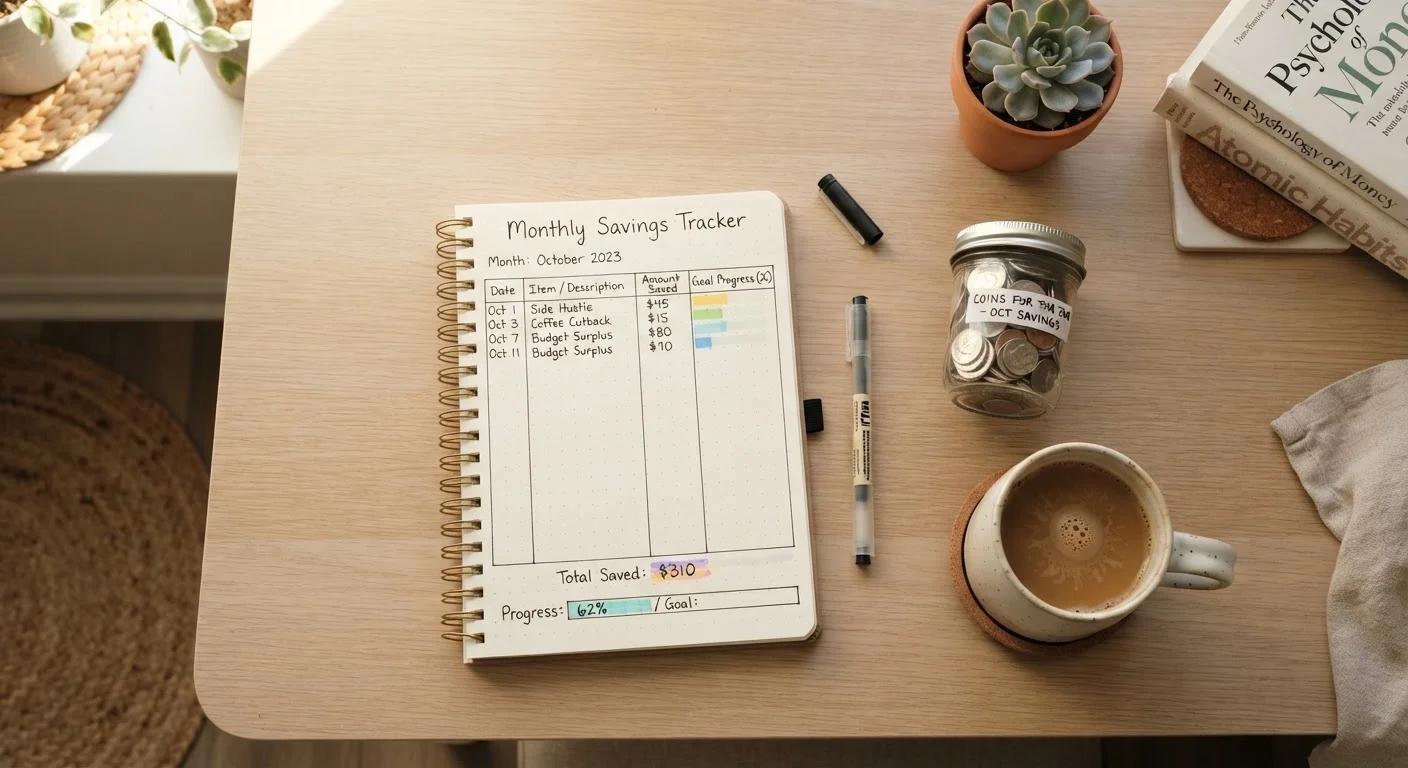
Why Your Monthly Saving Habits Matter More Than Your Income
It's easy to assume that saving is something you do once you earn enough. But research into long-term financial behaviour consistently points in a different direction: the habit itself - saving regularly, month after month - does more to build financial security than any single income jump.
That's not a feel-good platitude. It's a structural reality. Someone earning $40,000 a year who saves consistently will often end up in a stronger position than someone earning $80,000 who saves sporadically. The math of compounding rewards frequency and consistency, not just size. If you want a closer look at how that works, why small savings add up faster than you think walks through the real numbers.
The habits below work at any income level. Some are about systems. Some are about mindset. All of them are genuinely actionable - starting this month.
Automate a transfer on payday
When saving is manual, it competes with every other spending decision you make. Automating a transfer to a separate savings account on the day you get paid removes that friction entirely. The money moves before you have a chance to spend it.
Start with whatever amount feels sustainable - even $25 or $50 a month. The specific figure matters less than making the transfer automatic and consistent. You can always increase it later. For guidance on choosing between a set dollar amount and a percentage of your paycheck, see fixed vs. percentage-based saving targets.
Automation removes the daily decision to save - and that alone dramatically improves consistency.
Build a small emergency fund first
Before focusing on growth or investment goals, prioritise having a buffer for unexpected expenses. A commonly cited starting target is $500 to $1,000 - enough to cover a car repair or an unexpected medical bill without turning to a credit card.
This fund doesn't earn much. That's not the point. Its job is to prevent one bad month from derailing every other financial goal you've built. Once it's in place, the rest of your saving strategy gets dramatically more stable. For a broader look at building this foundation, our complete guide to smart saving covers it in depth.
A small emergency fund keeps one unexpected expense from unravelling months of saving progress.
Do a quick monthly money review
Set aside 15 minutes each month - same time, same day - to look at what came in and what went out. You don't need a complex spreadsheet. The goal is simply to notice patterns: Are you consistently overspending in one area? Did you save what you planned?
This habit keeps your saving targets grounded in reality rather than optimism. It also creates a natural moment to adjust your automatic transfer up or down based on what actually happened that month.
A monthly 15-minute review is often the difference between a saving plan that drifts and one that holds.
Separate your savings from your spending account
Keeping savings in the same account as your day-to-day spending makes it psychologically much harder to leave it alone. When funds are co-mingled, the number feels like available money - because it is.
Opening a separate account, even at the same bank, creates a small but meaningful barrier. Out of sight genuinely does mean out of mind for most people. The basics of saving money hub covers account structure as part of building solid saving foundations.
A separate savings account creates just enough distance to protect your balance from impulse spending.
Save windfalls before they disappear
Tax refunds, work bonuses, birthday money, and side gig payments have a way of vanishing without much to show for them. Making a habit of directing at least a portion of any unexpected income straight to savings - before it hits your checking account - captures money that would otherwise be absorbed into everyday spending.
You don't have to save all of it. Saving even 50% of a windfall while spending the rest guilt-free is a meaningful habit. Consistency here can meaningfully accelerate your progress, especially if income varies. saving money on a variable income explores this in more detail for irregular earners.
Directing even half of any windfall to savings before spending it builds progress faster than most people expect.
Link each saving goal to a specific purpose
Vague savings feel easier to raid. When your account is labelled "emergency fund" or "car repair" rather than just "savings," it's psychologically harder to dip into it for unrelated expenses. This is sometimes called mental accounting, and it works in your favour here.
Having named goals also makes saving feel less abstract. You're not just putting money aside - you're funding something real. the saving habits that tend to stick over time looks at how this kind of specificity supports long-term consistency.
Named, purposeful savings goals are significantly harder to raid than a generic savings balance.
Stack saving onto an existing habit
Habit stacking - linking a new behaviour to something you already do reliably - is one of the more practical tools from behavioural psychology. For saving, that might mean reviewing your spending balance every time you pay a recurring bill, or adding a small amount to savings every time you get a paycheck notification.
The existing habit acts as a reliable trigger, reducing how much mental effort the new behaviour requires. the habit stacking method applied to saving money walks through how to apply this technique practically.
Attaching saving to an existing routine makes it automatic rather than another task to remember.
Building a Saving Practice That Lasts
None of these habits require perfection. If you miss a month, you haven't failed - you've just identified a gap worth closing. The goal is a saving routine that fits your actual life, not an idealized version of it.
If you want a step-by-step approach to assembling these habits into a coherent monthly system, building your first monthly saving routine from scratch is a practical place to start. And once your basic habits are in place, retirement saving on any income can help you think about longer-term goals.
This article is for general informational purposes only and does not constitute personalised financial, tax, or investment advice. Consider speaking with a qualified financial professional about decisions specific to your situation.
Start smaller than you think you should
If you're unsure where to begin, err on the side of a smaller automatic transfer. A $30-a-month habit you maintain for a year does more than a $200-a-month plan you abandon after six weeks. Consistency compounds. You can always increase the amount once the habit feels natural.