
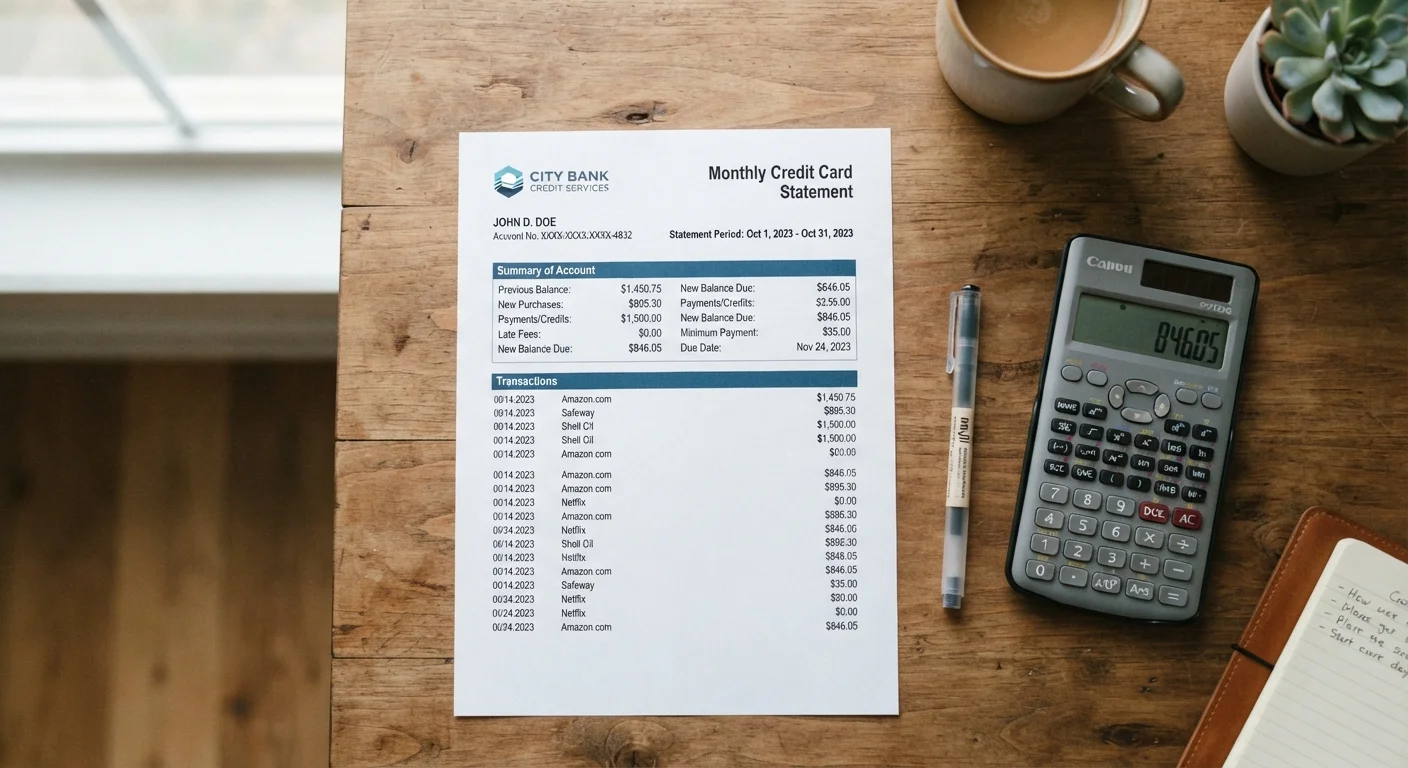
Why Your Credit Card Statement Deserves a Close Read
Many cardholders glance at the minimum payment due, pay it, and move on. That habit is understandable - statements can look dense and intimidating - but it leaves money and safety on the table. Your statement is actually one of the most information-rich documents your card issuer sends you, and reading it carefully each month is one of the simplest ways to protect your finances.
A careful monthly review helps you catch unauthorized charges before the dispute window closes, understand exactly what you owe and why, and track spending patterns that affect your budget. It also prevents surprises like unexpected fees. For a deeper look at charges that can appear without much warning, explore what credit card companies don't always make obvious.
If you are brand new to credit cards, it may also help to review what you're agreeing to when you apply before working through your first statement.
What you will need
How to Read Your Statement Step by Step
Every credit card statement in the US follows a broadly similar structure, shaped in part by consumer protection regulations. Once you know what each section is for, reading a statement takes only a few minutes. Work through the steps below with your most recent statement in hand.
Locate the account summary section
The top of every statement contains an account summary. This is your at-a-glance snapshot. Look for these four numbers:
- Previous balance: What you owed at the end of last billing cycle.
- Payments and credits: Any payments you made or refunds applied during this cycle.
- Purchases and fees: New charges added this cycle.
- New balance: Your current total owed.
Confirming that these numbers add up correctly is your first check - previous balance, minus payments, plus new charges, equals new balance.
Identify the payment information box
Federal law (the CARD Act of 2009) requires issuers to display a payment information box clearly on every statement. It must show:
- Minimum payment due and the payment due date
- A warning showing how long it will take - and how much interest you will pay - if you make only minimum payments
- The monthly payment needed to pay off the balance in 36 months
Read this box carefully. The minimum payment and the full statement balance are not the same thing, and the difference carries a real financial cost. For a plain-language explanation of key terms like APR and grace period, keep a reference handy.
Review every transaction in the activity section
The transaction activity section lists each charge and payment posted during the billing cycle, including the date, merchant name, and amount. Go through every line and ask:
- Do I recognize this merchant?
- Does the amount match my receipt or memory?
- Are there any duplicate charges?
- Are there fees I did not expect - annual fees, foreign transaction fees, cash advance fees?
For details on which fees can appear and what triggers them, see fees buried in credit card agreements. If you find an error or unrecognized charge, note the date and amount - you will need this to file a dispute.
Check your credit limit and available credit
Your statement will show your credit limit (the maximum you are authorized to borrow) and your available credit (how much remains). The difference between the two is your current balance.
Pay attention to how much of your limit you are using. This ratio - called your credit utilization rate - is one of the most influential factors in your credit score. Most financial guidance suggests keeping utilization below 30% of your total limit. For context on how this connects to your broader credit profile, see how to read your full credit report.
Note the statement closing date and billing cycle
Your statement covers a specific billing cycle - typically around 28 to 31 days. The closing date is the last day of that cycle, and it is when your balance is captured and your statement is generated. The payment due date is usually 21 to 25 days after the closing date - this gap is your grace period.
If you pay your full statement balance before the due date, no interest is charged on purchases made during that cycle. If you pay only part of it, interest applies to the remaining balance at your card's APR.
Dispute errors promptly and in writing
If you spot a charge you do not recognize or believe is incorrect, act quickly. Under the Fair Credit Billing Act (FCBA), you generally have 60 days from the statement date to dispute a billing error in writing. Steps to take:
- Contact your card issuer - most have an online dispute form or a dedicated phone line.
- Describe the charge clearly: date, amount, and merchant.
- Keep a record of every communication, including dates and reference numbers.
The issuer must acknowledge your dispute within 30 days and resolve it within two billing cycles (no more than 90 days) under FCBA rules. You are not required to pay the disputed amount while the investigation is open, though you must pay the undisputed portion of your bill.
Missing the Due Date Has Real Consequences
A late payment can trigger a late fee (often $25-$40) and may be reported to credit bureaus if it is 30 or more days overdue, which can meaningfully lower your credit score. Set up autopay for at least the minimum payment as a safety net. You can always pay more manually before the due date.
After completing your review, consider what your findings reveal about your spending habits. Patterns you notice - like fees that keep appearing or a consistently high balance - are useful signals. For a balanced look at the trade-offs that come with credit card use, see the trade-offs every new cardholder should understand. And to avoid the most common beginner mistakes, early missteps that make credit cards expensive is worth reading next.
Go Paperless for Faster Access
Most issuers let you view your statement online or in a mobile app the moment it is generated - days before a paper copy arrives. Logging in regularly also makes it easier to spot unfamiliar charges quickly, well within the dispute window.
This article is for general informational and educational purposes only and does not constitute personalized financial, legal, or credit advice. Consult a qualified financial professional for guidance specific to your situation.