
What Is Debt and Why Does It Matter?
Debt is money you borrow and agree to pay back, usually with interest. Nearly every adult in the U.S. carries some form of debt - from student loans to credit cards to car payments. The key question isn't whether you have debt, but whether you understand it and have a plan for it.
Left unmanaged, debt compounds quietly. Interest charges grow, minimum payments consume more of your budget, and stress builds. Managed deliberately, debt can be a tool - enabling education, homeownership, or business growth. The difference lies in knowledge and intention.
This guide walks you through every major concept so you can move from confusion to clarity. For a deeper dive into one of the most common debt traps, see our guide to credit cards and debt for first-timers.
Common Types of Debt Explained
Understanding what kind of debt you hold is the foundation of any repayment plan. Debt generally falls into two broad categories:
- Secured debt is backed by collateral - an asset the lender can claim if you stop paying. Mortgages and auto loans are the most common examples.
- Unsecured debt has no collateral. Credit cards, medical bills, and personal loans fall here. Because the lender takes on more risk, interest rates are typically higher.
Within those categories, you'll encounter:
- Revolving debt
- A credit line you can borrow against repeatedly, like a credit card or home equity line of credit. The balance changes each month based on spending and payments.
- Installment debt
- A fixed loan repaid in equal monthly payments over a set term - student loans, car loans, and mortgages work this way.
Knowing the type of debt you carry matters because each has different interest structures, repayment timelines, and consequences for missed payments. Explore more concepts in our Credit & Debt hub.
When comparing debts to prioritize, always use the APR (Annual Percentage Rate), not just the stated interest rate - APR includes fees and gives you the true cost of borrowing.
Many borrowers focus on the nominal rate and miss hidden costs embedded in fees, which can make a lower-rate loan more expensive than it appears.
Before adding any new credit account, calculate how it affects your average account age and utilization - both impact your credit score in ways that aren't always intuitive.
Opening a new account lowers your average credit age and can temporarily dip your score, a trade-off worth knowing before you act.
How Debt Affects Your Credit Score
Your credit score - most commonly a FICO® score ranging from 300 to 850 - is heavily influenced by how you manage debt. According to the Consumer Financial Protection Bureau (CFPB), two factors dominate: payment history (35% of your score) and amounts owed (30%).
Credit utilization - the percentage of your available revolving credit that you're using - is the most actionable piece of "amounts owed." Keeping utilization below 30% is a widely cited guideline; lower is generally better. For example, if your total credit card limit is $5,000, try to keep balances below $1,500.
Missing payments does serious, lasting damage. A single 30-day late payment can drop a good score significantly and remains on your credit report for up to seven years.
Carrying high balances on revolving accounts signals risk to lenders, while paying down installment loans steadily over time typically helps your score. You can learn responsible usage habits through our Credit Cards Basics hub.
Proven Repayment Strategies
Two evidence-backed frameworks help people with multiple debts decide which to tackle first:
The Avalanche Method
List your debts from highest to lowest interest rate. Put any extra money toward the highest-rate debt while paying minimums on the rest. Once the top debt is gone, roll that payment to the next. This approach minimizes total interest paid over time.
The Snowball Method
List debts from smallest to largest balance - ignoring interest rates. Pay off the smallest balance first, then roll that payment forward. Research published in the Journal of Marketing Research suggests the psychological wins from eliminating accounts can sustain motivation, making this effective for people who need early momentum.
Neither method is universally superior. Avalanche saves more money mathematically; snowball can be more motivating in practice. Choose the one you'll actually stick with. For context on how debt accumulates in the first place, our article on managing debt without letting it manage you is a useful companion read.
Building Your Personal Debt Repayment Plan
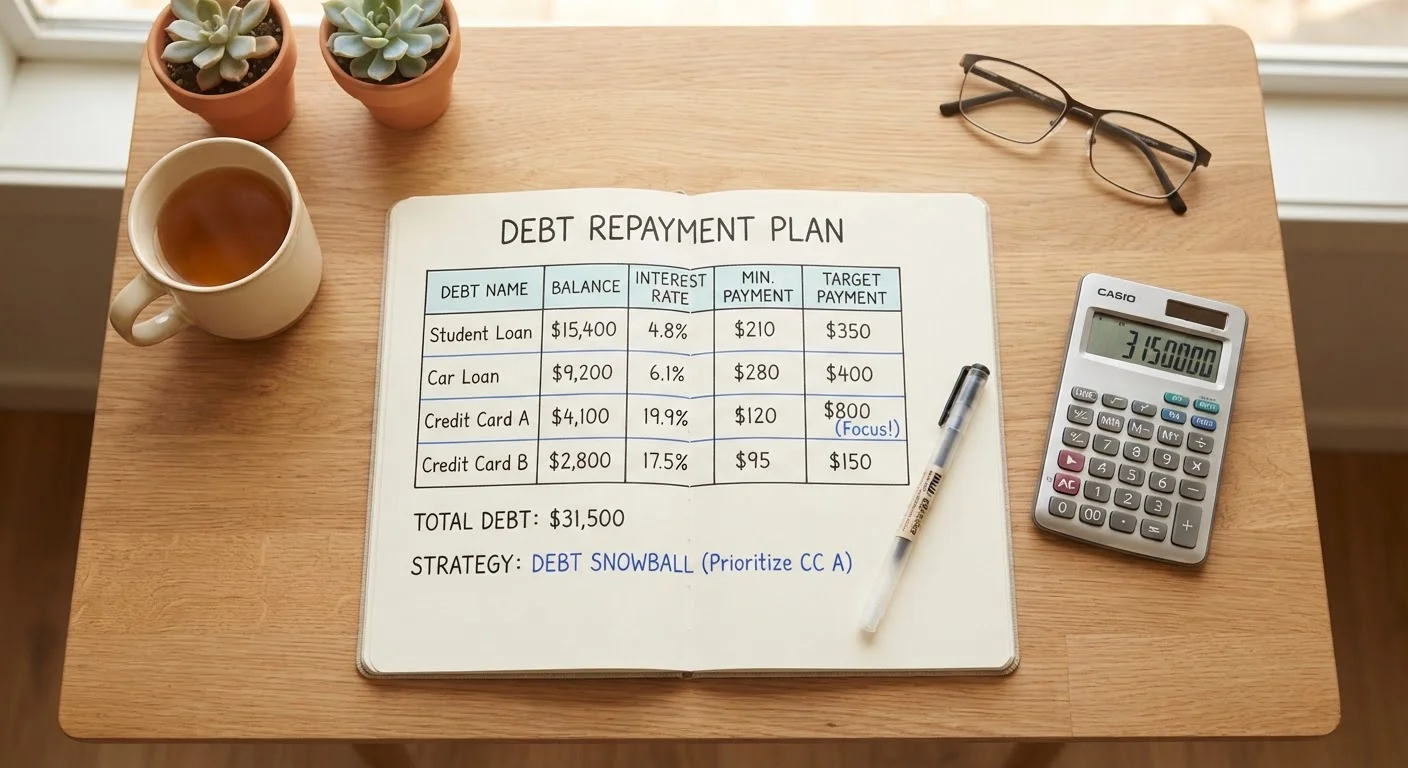
A plan doesn't need to be complicated to work. Use these steps:
- List every debt. Write down the creditor, balance, interest rate, and minimum monthly payment for each account.
- Know your numbers. Calculate your monthly take-home income and subtract essential expenses. The remainder is your potential repayment budget.
- Choose a strategy. Pick avalanche or snowball based on your temperament and financial situation.
- Set a target payoff date. Assign a realistic timeline to your highest-priority debt. Many free online calculators can model this for you.
- Automate minimums. Set up automatic minimum payments on all accounts to protect your payment history while you focus extra funds on your target debt.
- Review monthly. Adjust as income or expenses change. Progress, even slow progress, is worth tracking.
35%
Payment history's share of a FICO® score
According to FICO, payment history is the single largest factor in how your credit score is calculated.
$6,501
Average U.S. credit card balance per borrower
The Federal Reserve Bank of New York's 2023 household debt report found credit card balances reached record levels, highlighting widespread revolving debt.
30%
Recommended maximum credit utilization ratio
Financial educators and major credit bureaus consistently cite keeping utilization under 30% as a benchmark for protecting your credit score.
This article is for general informational and educational purposes only and does not constitute personalized financial, legal, or tax advice. Consult a licensed financial professional for guidance specific to your situation.
When to Seek Professional Help
Some debt situations benefit from expert guidance. If any of the following apply to you, consider reaching out:
- You cannot cover minimum payments on all accounts.
- Debt collectors are contacting you.
- You are considering bankruptcy.
- Stress from debt is affecting your health or relationships.
Nonprofit credit counseling agencies - many affiliated with the National Foundation for Credit Counseling (NFCC) - offer free or low-cost services including budget reviews and debt management plans (DMPs). A DMP consolidates multiple unsecured debts into a single monthly payment, often at a reduced interest rate negotiated with creditors.
Be cautious of for-profit debt settlement companies that promise to eliminate debt for a fraction of what you owe. The CFPB warns that these services often charge significant fees and can damage your credit while you wait for settlements to be negotiated.
There is no shame in asking for help - it is a practical, responsible step. Qualified counselors exist precisely for situations like yours.