
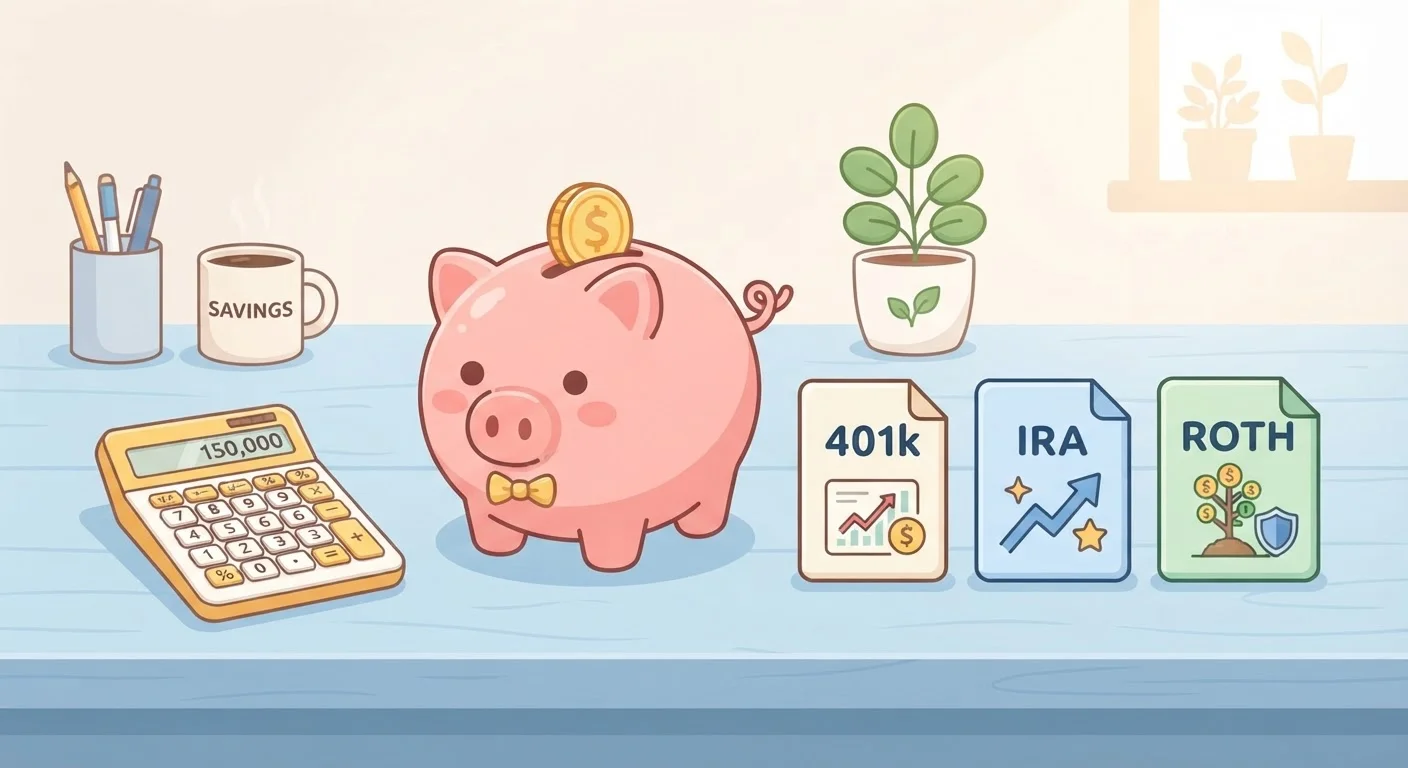
Why Retirement Accounts Matter
Most people will spend 20 or more years in retirement. Social Security alone typically replaces only a portion of pre-retirement income, so personal savings play a critical role. The good news: the U.S. tax code provides powerful incentives to save through dedicated retirement accounts - accounts designed specifically to help your money grow more efficiently over time.
Retirement accounts work by giving you either an upfront tax deduction on contributions or tax-free income in retirement (sometimes both). The money inside the account grows without being taxed each year - a feature known as tax-deferred or tax-free growth. Over decades, this can make a meaningful difference compared to saving in a regular taxable account.
If you're new to all of this, check out the common myths that hold new savers back - many first-timers are surprised to find the barriers are smaller than they expected.
What Is a 401(k)?
A 401(k) is a retirement savings account sponsored by your employer. You instruct your employer to deposit a portion of each paycheck directly into the account before you ever see that money - which makes saving automatic and consistent.
Key features of a 401(k) include:
- High contribution limits: For 2024, you can contribute up to $23,000 per year ($30,500 if you are 50 or older). Always confirm current limits at IRS.gov.
- Employer matching: Many employers match a percentage of what you contribute - this is essentially free money added to your account. Failing to contribute enough to capture the full match means leaving compensation on the table.
- Limited investment menu: Your investment choices are restricted to a list selected by your employer's plan, typically a range of mutual funds.
- Pre-tax contributions (Traditional 401(k)): Contributions reduce your taxable income today; you pay taxes when you withdraw the money in retirement.
Always Capture Your Employer Match First
If your employer offers a 401(k) match, contribute at least enough to receive the full match before directing savings elsewhere. Even a 50% match on 6% of your salary adds meaningful dollars to your retirement balance each year. Think of it as an immediate return on your contribution.
If your employer offers a match, prioritize contributing at least enough to capture it before directing savings elsewhere. It is one of the most straightforward ways to accelerate retirement savings.
What Is an IRA?
An IRA, or Individual Retirement Account, is an account you open yourself through a bank, brokerage, or other financial institution - completely independent of any employer. This makes IRAs especially valuable for self-employed individuals, part-time workers, or anyone who wants more investment flexibility.
For 2024, the IRA contribution limit is $7,000 per year ($8,000 if you are age 50 or older). Unlike a 401(k), you typically have a much broader selection of investments, including individual stocks, bonds, exchange-traded funds (ETFs), and mutual funds.
There are two main types of IRA: Traditional and Roth. The choice between them comes down primarily to how and when you want to pay taxes - covered in detail in the next section.
Ready to open one? The step-by-step IRA opening walkthrough breaks down the process from start to first contribution.
Tax-deferred growth
Your investments grow inside the account without being taxed each year. You only pay tax when you withdraw the money, usually in retirement.
Tax-free growth
Money in a Roth account grows without ever being taxed again, and qualified withdrawals in retirement are completely free of income tax.
Employer match
A contribution your employer adds to your 401(k) based on how much you contribute yourself - for example, matching 50 cents for every dollar you put in, up to a set limit.
Required Minimum Distribution (RMD)
The IRS requires you to withdraw a minimum amount from most retirement accounts each year once you reach a certain age, currently 73 for most account types.
Contribution limit
The maximum amount the IRS allows you to deposit into a retirement account in a given tax year. Limits differ by account type and are adjusted periodically.
Vesting
The schedule that determines when employer contributions to your 401(k) actually belong to you. You may need to stay with an employer for a set number of years before those funds are fully yours.
Target-date fund
A mutual fund that automatically shifts to a more conservative investment mix as you approach a specific retirement year, making it a hands-off option for beginners.
Traditional vs. Roth: The Tax Timing Choice
Both 401(k)s and IRAs come in two tax flavors: Traditional and Roth. The core difference is straightforward:
| Feature | Traditional | Roth |
|---|---|---|
| Contributions | Pre-tax (reduces income now) | After-tax (no deduction now) |
| Growth | Tax-deferred | Tax-free |
| Withdrawals in retirement | Taxed as ordinary income | Tax-free (if qualified) |
| Required Minimum Distributions | Yes, starting at age 73 | Roth IRA: No; Roth 401(k): Yes |
A simple rule of thumb: if you expect to be in a lower tax bracket in retirement than you are today, a Traditional account may save you more in taxes overall. If you expect to be in a higher bracket later, paying taxes now via a Roth often makes more sense. Many savers hedge by using both types.
Note that Roth IRA eligibility phases out at higher income levels - check current IRS thresholds before contributing.
How These Accounts Work Together
You are not limited to just one type of retirement account. Most working adults can contribute to a 401(k) and an IRA in the same tax year, letting you take advantage of both sets of benefits simultaneously.
A common starting framework many financial educators suggest:
- Contribute to your 401(k) up to the employer match.
- Open and max out a Roth IRA (if income eligible).
- Return to your 401(k) to contribute more, up to the annual limit.
This order is a general educational framework - not personalized advice. Your ideal approach depends on your income, tax situation, and financial goals. For a deeper comparison of these two account types, see 401(k) vs. IRA: choosing the right account.
Getting Started: Your Next Steps
Starting is the most important step. Even small, consistent contributions benefit enormously from decades of compounding growth. Here is a simple action plan:
- Check your workplace benefits: Ask HR whether your employer offers a 401(k) and whether there is a matching contribution.
- Enroll in your 401(k): Set a contribution rate - even 3-5% of your paycheck is a meaningful start.
- Open an IRA: If you want additional savings flexibility, open a Traditional or Roth IRA through a reputable financial institution.
- Review your investment choices: Most plans offer target-date funds, which automatically adjust your investment mix as you approach retirement - a simple starting point for beginners.
- Track your progress: Revisit your contributions annually and increase them when your income grows.
For a broader look at saving benchmarks over time, explore the Retirement Milestones hub and the Saving Strategies hub.
Unfamiliar with terms like vesting, rollover, or RMD? The Retirement Account Glossary explains every term you're likely to encounter.
This article is for general informational and educational purposes only. It is not personalized financial, tax, or investment advice. Tax rules and contribution limits change periodically - always verify current figures with the IRS or consult a qualified financial professional for guidance tailored to your individual circumstances.