
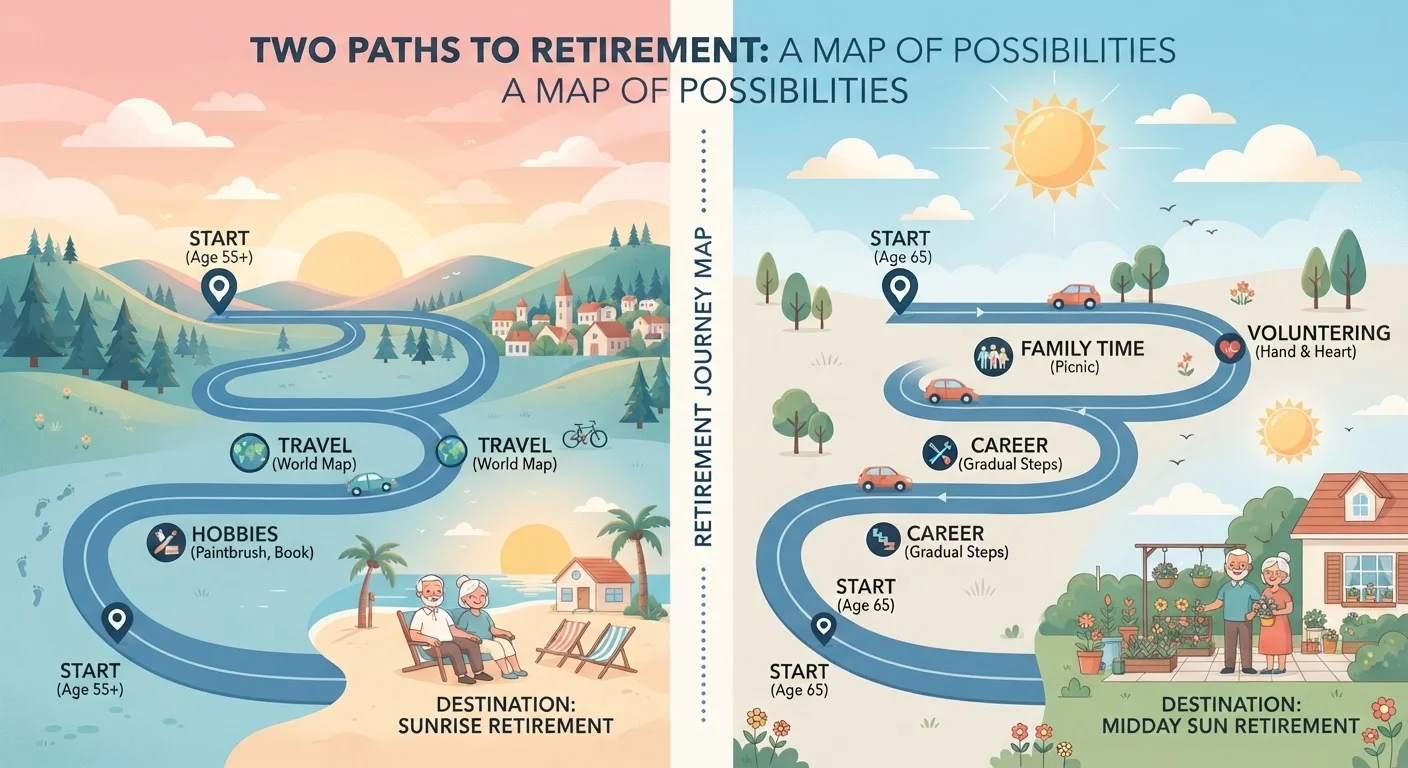
The Core Difference: When the Guardrails Kick In
Retirement isn't a single event - it's a series of financial thresholds tied to your age. The most consequential of these are set by the federal government and determine when you can access Social Security, Medicare, and retirement account funds without penalties.
If you retire before age 62, you enter a gap zone: no Social Security, no Medicare, and potential penalties if you tap most retirement accounts too early. You're entirely self-funded. If you retire at or after 62, you can begin accessing Social Security (though at a reduced rate) and eventually Medicare at 65. These aren't arbitrary numbers - they reflect when specific federal programs become available to you.
For a full map of these checkpoints, see Retirement Milestones Explained, which walks through each age-based threshold and why it matters.
| Criterion | Early Retirement (Before 62) | Standard Retirement (62-67+) |
|---|---|---|
| Social Security Access | Not available until age 62 | Available from age 62 (reduced) or FRA (full) |
| Medicare Eligibility | Must self-fund health coverage | Medicare begins at 65 |
| Retirement Account Access | Penalty applies before 59½ (some exceptions) | Penalty-free after 59½ |
| Required Nest Egg Size | Substantially larger (longer drawdown) | Typically smaller relative to shorter horizon |
| Healthcare Cost Burden | High - private insurance often required | Lower once Medicare begins at 65 |
| Planning Complexity | High - more gaps to bridge independently | Moderate - government programs reduce gaps |
What Changes: Income, Benefits, and Account Access
Social Security: The earliest you can claim Social Security retirement benefits is age 62 - but doing so permanently reduces your monthly payment compared to waiting until your full retirement age (FRA), which is 66 or 67 depending on your birth year. Waiting past FRA, up to age 70, increases your benefit further. Early retirees who leave work before 62 receive nothing from Social Security until they reach that threshold.
Medicare: Medicare eligibility begins at 65, full stop. Retiring before that means finding your own health coverage - through a spouse's employer plan, the ACA marketplace, or COBRA - which can be a significant ongoing cost.
Retirement Account Withdrawals: Most 401(k)s and IRAs charge a 10% early withdrawal penalty for money taken out before age 59½, on top of income taxes owed. Some exceptions exist (such as the IRS Rule of 55 for 401(k)s), but they're limited. Learn why age 59½ is such a significant number in how it shapes your access to savings.
Drawdown Length: Retiring at 50 could mean funding 40+ years of expenses. Standard retirees at 65 typically plan for 20-25 years. A longer retirement requires a proportionally larger portfolio and a more conservative withdrawal rate - often cited in planning discussions as around 3-4% annually, though this is a guideline, not a guarantee.
What Doesn't Change: The Fundamentals of Sound Planning
Whether you retire at 50 or 67, the underlying principles remain the same. You need a nest egg large enough to cover your expenses, a strategy for drawing it down sustainably, and a plan for healthcare costs. The math changes - but the discipline required doesn't.
Both timelines demand that you:
- Know your estimated annual expenses in retirement
- Understand which accounts you'll draw from and in what order (tax efficiency matters)
- Account for inflation eroding your purchasing power over time
- Plan for unexpected healthcare or long-term care costs
Early retirees face these challenges with fewer backup systems. Standard retirees have more government safety nets, but those alone are rarely enough. Start building your savings foundation now regardless of which timeline you're targeting.
It's also worth knowing that delaying retirement by even two years can meaningfully change your financial picture - an insight useful whether you're weighing early retirement or trying to optimize a standard one.
This article is for general informational and educational purposes only. It is not personalized financial, tax, or legal advice. Retirement decisions involve complex individual factors - consult a licensed financial adviser, tax professional, or attorney before making decisions about your own situation.