
Do You Need to File a Tax Return?
Not everyone is legally required to file a federal income tax return. Whether you must file depends primarily on your gross income (total income before any deductions), your filing status, and your age. The IRS updates income thresholds each year, so check the current IRS Publication 501 for the exact figures that apply to your situation.
That said, even when filing isn't technically required, it often makes sense to do so. You may be entitled to a refund of taxes withheld from your paycheck, or you may qualify for refundable credits - such as the Earned Income Tax Credit - that put money back in your pocket. For a broader picture of how income taxes work, visit our Tax Basics hub.
Common situations that require filing include: having wages above the standard deduction threshold for your status, earning self-employment income of $400 or more, or receiving certain types of unearned income such as dividends or capital gains above IRS limits.
Gather Your Documents First
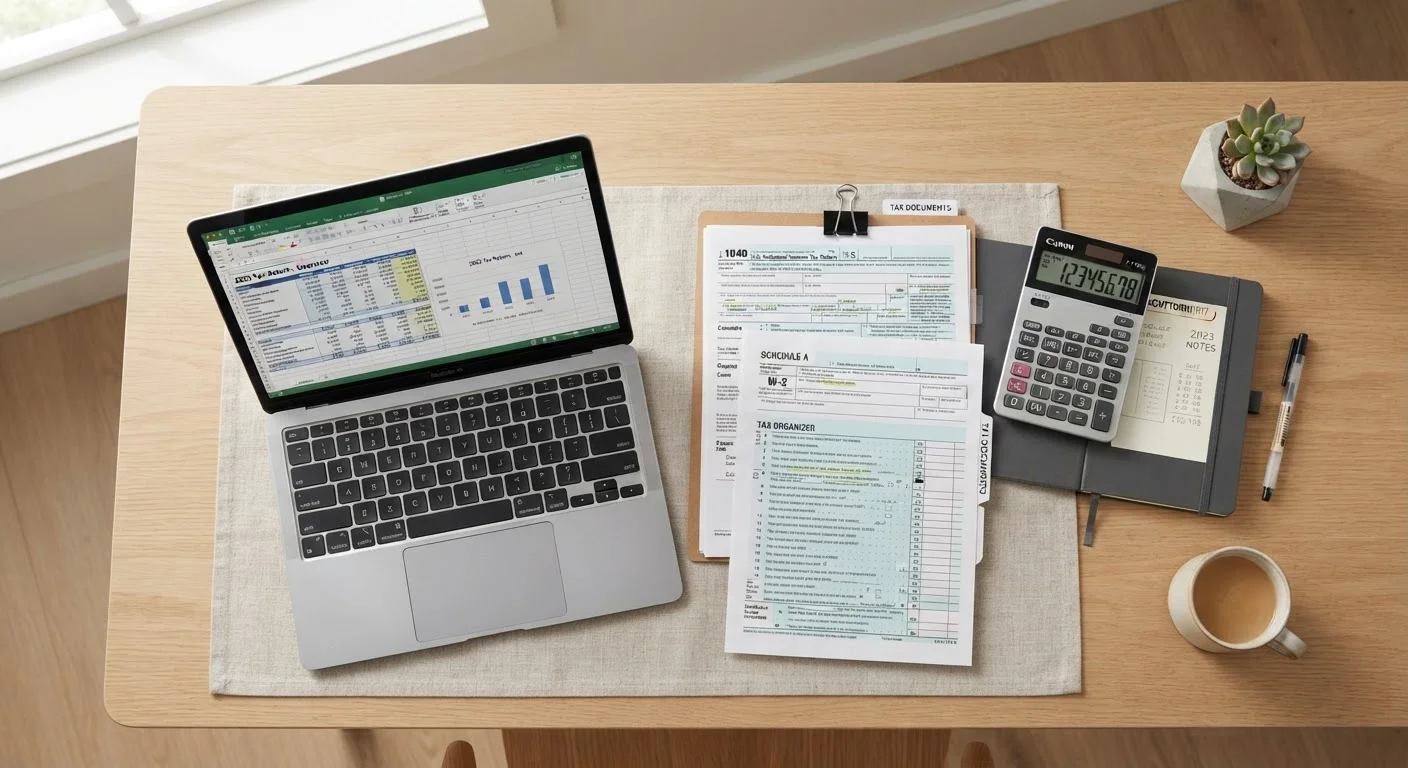
Before you open any tax software or form, gather every document that records income you received or payments you made during the tax year. Starting organized saves significant time and prevents the most common beginner mistake: missing income that triggers an IRS notice later.
- W-2: Sent by your employer; shows wages earned and taxes withheld.
- 1099 forms: Cover freelance income (1099-NEC), bank interest (1099-INT), dividends (1099-DIV), and more.
- 1098 forms: Report mortgage interest or student loan interest you paid - relevant if itemizing deductions.
- Social Security numbers: Yours, your spouse's, and any dependents'.
- Last year's tax return: Helpful for reference, especially your adjusted gross income (AGI), which some software uses to verify your identity.
Double-check your routing and account numbers when entering direct deposit information - a single digit error sends your refund to the wrong account and recovery can take months.
Incorrect bank details are one of the most preventable refund delays, yet they remain among the most common errors on beginner returns.
If you're unsure whether you're missing a 1099, log in to your bank, brokerage, or payment platform - most post tax documents electronically before the paper copies arrive.
Unreported income, even when it's accidental, can trigger an IRS CP2000 notice that requires a written response and potentially additional tax and interest.
Once collected, check that each employer or financial institution that should have sent a form actually did. Employers are required to mail W-2s by January 31 each year.
Choose Your Filing Method
You have three main options for filing your federal return: IRS Free File, paid tax software, or a tax professional. For most beginners with straightforward situations - a single W-2, standard deduction, no business income - free options are entirely adequate.
IRS Free File offers guided software at no cost to taxpayers below a certain income threshold (check IRS.gov for the current limit). If your income exceeds that threshold, the Free File Fillable Forms option remains available for those comfortable working with forms directly.
Volunteer Income Tax Assistance (VITA) is a free IRS-sponsored program staffed by certified volunteers who help people earning roughly $67,000 or less, persons with disabilities, and limited-English speakers.
If your situation involves self-employment, multiple income sources, or a life event like marriage or a new dependent, working with a professional may reduce errors and stress. Our article on self-filing vs. using a tax professional breaks down that decision in detail.
Complete Your Return: Step by Step
Whether you use software or paper forms, the return follows the same logical structure on Form 1040, the standard federal individual income tax return.
- Enter personal information: Name, address, Social Security number, and filing status (single, married filing jointly, head of household, etc.).
- Report all income: Enter wages from your W-2, then any additional income from 1099s or other sources. Software guides you through each income type line by line.
- Claim your deduction: Most beginners take the standard deduction - a fixed dollar amount the IRS allows you to subtract from income, no receipts required. Itemizing makes sense only when your qualifying expenses (mortgage interest, charitable contributions, state taxes) exceed the standard deduction. Our guide to deductions and credits for first-time taxpayers explains the most common options.
- Apply credits: Tax credits directly reduce the tax you owe - they are generally more valuable than deductions. Common ones include the Child Tax Credit and the Earned Income Tax Credit.
- Calculate what you owe or your refund: Compare the tax calculated on your taxable income against what was already withheld. The difference is either a refund or a balance due.
Review, Sign, and Submit
A careful review before submitting prevents the most common filing errors. Check that all Social Security numbers are correct, all income sources are included, and the bank account details for direct deposit are accurate.
E-File for Faster, Safer Processing
The IRS strongly encourages electronic filing because it reduces errors through built-in checks and confirms receipt within minutes. Paper returns lack these safeguards and can take significantly longer to process. If your refund is delayed with a paper return, there is no real-time tracking equivalent to the e-file experience.
When you're ready to submit, e-filing (electronic filing) is strongly recommended over mailing a paper return. It's faster, the IRS confirms receipt immediately, and refunds arrive much sooner - typically within 21 days when combined with direct deposit. Paper returns can take six weeks or longer to process.
You must sign your return - unsigned returns are not valid. When filing electronically, you'll sign using your prior-year AGI or an IRS-issued PIN as your electronic signature.
After You File: What to Expect
Once submitted, you can track your federal refund status at IRS.gov using the Where's My Refund? tool, available 24 hours after e-filing. You'll need your Social Security number, filing status, and the exact refund amount.
If you owe taxes, payment is due by the filing deadline - typically April 15 - even if you requested an extension to file. An extension grants more time to submit paperwork, not more time to pay without penalty.
After filing, retain copies of your completed return and all supporting documents for at least three years, which is the standard IRS audit lookback period for most returns. Store them securely - digitally or in a locked physical location.
If you discover a mistake after filing, don't panic. You can correct it by filing an amended return using Form 1040-X. For a detailed look at what the overall filing experience involves, see what actually happens when you file for the first time.
This article is for general informational and educational purposes only and does not constitute personalized tax, legal, or financial advice. Tax rules change periodically. Consult a qualified tax professional or refer to current IRS guidance for advice specific to your situation.