
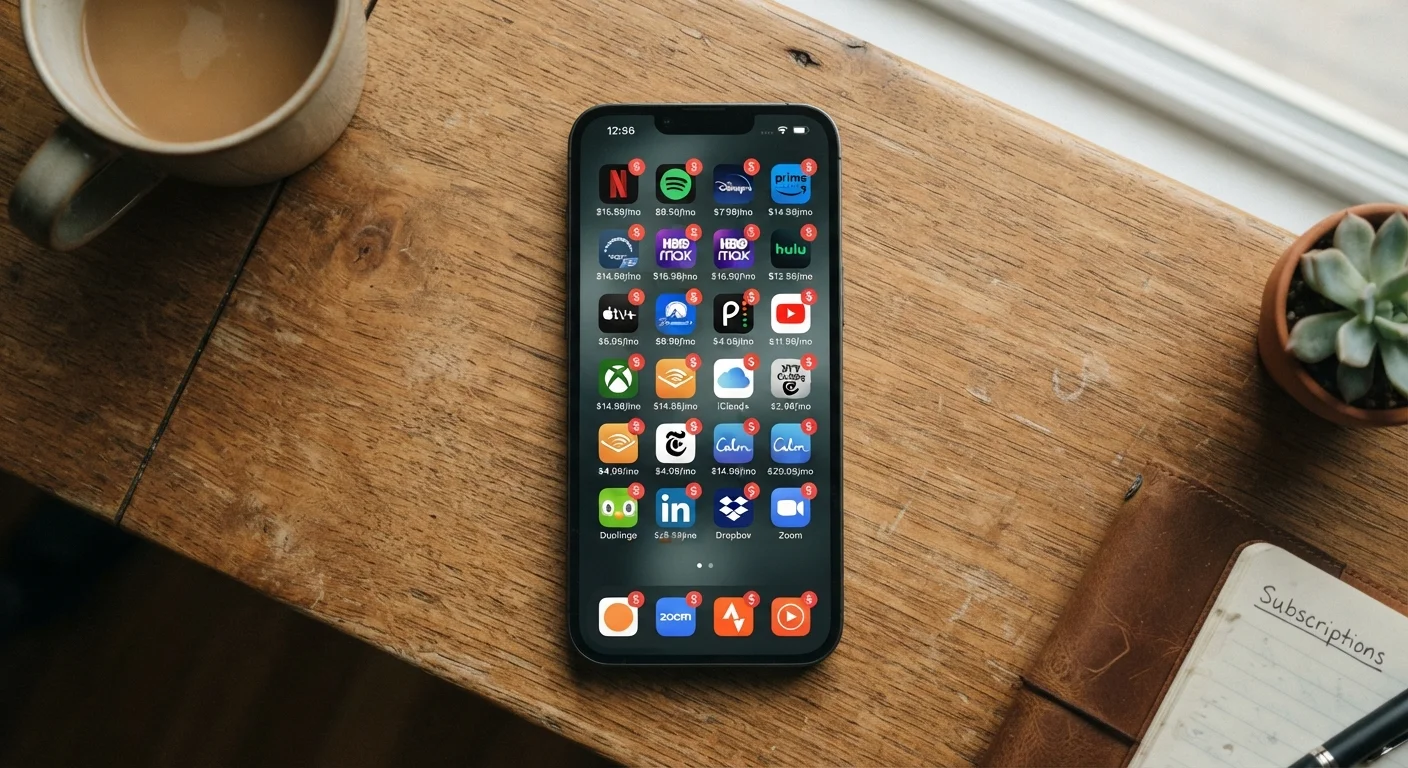
Why Small Charges Are So Easy to Overlook
A $9.99 charge doesn't feel alarming. Neither does $7.99, or $14.99. But add several of these together and they become a meaningful line item in your monthly budget - one that most people never formally account for.
The psychological pull is real: subscriptions are designed to feel frictionless. You sign up once, usually during a free trial, and the charge quietly repeats month after month. There's no invoice in the mail, no checkout moment that makes you consciously decide to spend money again. The payment just happens.
That invisibility is exactly what makes subscription creep so common. Research consistently shows that people underestimate the number of subscriptions they're paying for and the total they're spending. If you've never added yours up, the actual figure may surprise you.
This is part of a broader pattern worth understanding. Tracking where your money actually goes each month often reveals that the biggest surprises aren't large, obvious purchases - they're the steady drip of small, automated ones.
The Real Math Behind Monthly Fees
Let's put some numbers to it. Say you have the following subscriptions:
- Streaming service A: $15.99/month
- Streaming service B: $13.99/month
- Music app: $10.99/month
- Cloud storage: $2.99/month
- Fitness app: $9.99/month
- News site: $9.99/month
That's $63.94 per month - or $767.28 per year. If even two or three of those are services you barely use, you're paying hundreds of dollars annually for very little return.
Now consider what that money could do instead. Directed toward a high-yield savings account or used to pay down a credit card balance faster, those same dollars start building your financial future rather than quietly disappearing. The smart saving habits that make the biggest difference over time are often built from exactly these kinds of small, consistent reallocations.
$219/mo
Average estimated US consumer subscription spend
Research from subscription management studies suggests Americans spend an estimated $200-$240 per month on recurring services, often while guessing far lower.
4-5x
How much consumers underestimate their subscription total
Studies on consumer financial awareness have found that people routinely guess their monthly subscription spending at only a fraction of the actual amount charged.
$2,600+
Potential annual outlay on subscriptions
At average estimated spending levels, a US household could be paying more than $2,600 per year across all recurring subscription charges combined.
It's also worth noting that subscription fees, like investment fees, compound in their opportunity cost. Every dollar spent on a service you don't use is a dollar that isn't working for you. Keeping costs low matters across every area of your finances, not just investing.
How to Audit Your Subscriptions in Under an Hour
You don't need a special app or a financial background to do a subscription audit. Here's a straightforward process:
- Pull up three months of statements. Check your bank account and every credit card you use. Look for any charge that repeats at the same amount on a regular cycle.
- Make a list. Write down every recurring charge you find - the service name, the amount, and how often it bills. A simple spreadsheet or even a piece of paper works fine.
- Categorize honestly. For each subscription, ask yourself: Do I use this regularly? Do I get clear value from it? Would I sign up for it again today at this price?
- Cancel or downgrade anything that doesn't pass the test. Most cancellations can be done online in a few minutes. If you're unsure, set a 30-day reminder to reassess rather than letting it drift.
This process connects directly to the broader work of understanding your spending. Hidden costs that beginners underestimate often include exactly these kinds of recurring charges that never make it into a conscious budget.
Deciding What's Actually Worth Keeping
Not every subscription deserves to be cut. The goal isn't to eliminate all recurring spending - it's to make sure every charge is a deliberate choice, not an oversight.
A few questions that help:
- Frequency of use: Did you use this service at least once in the last 30 days? If it's been several months, that's a clear signal.
- Alternatives: Is there a free or lower-cost version that would meet your actual needs? Many apps offer free tiers that are more than sufficient for casual users.
- Overlap: Are you paying for two services that do essentially the same thing? Streaming libraries overlap more than people realize.
- Sharing opportunities: Some subscriptions allow multiple household members. If you're paying for individual accounts when a family plan costs less per person, that's worth reconfiguring.
Once you've decided what to keep, build those subscriptions into your formal monthly budget so they're visible and intentional. The basics of budgeting depend on having an accurate picture of your fixed recurring costs - and subscriptions belong in that picture.
This article is for general informational purposes only and does not constitute personalized financial advice. For guidance specific to your situation, consider speaking with a qualified financial professional.