
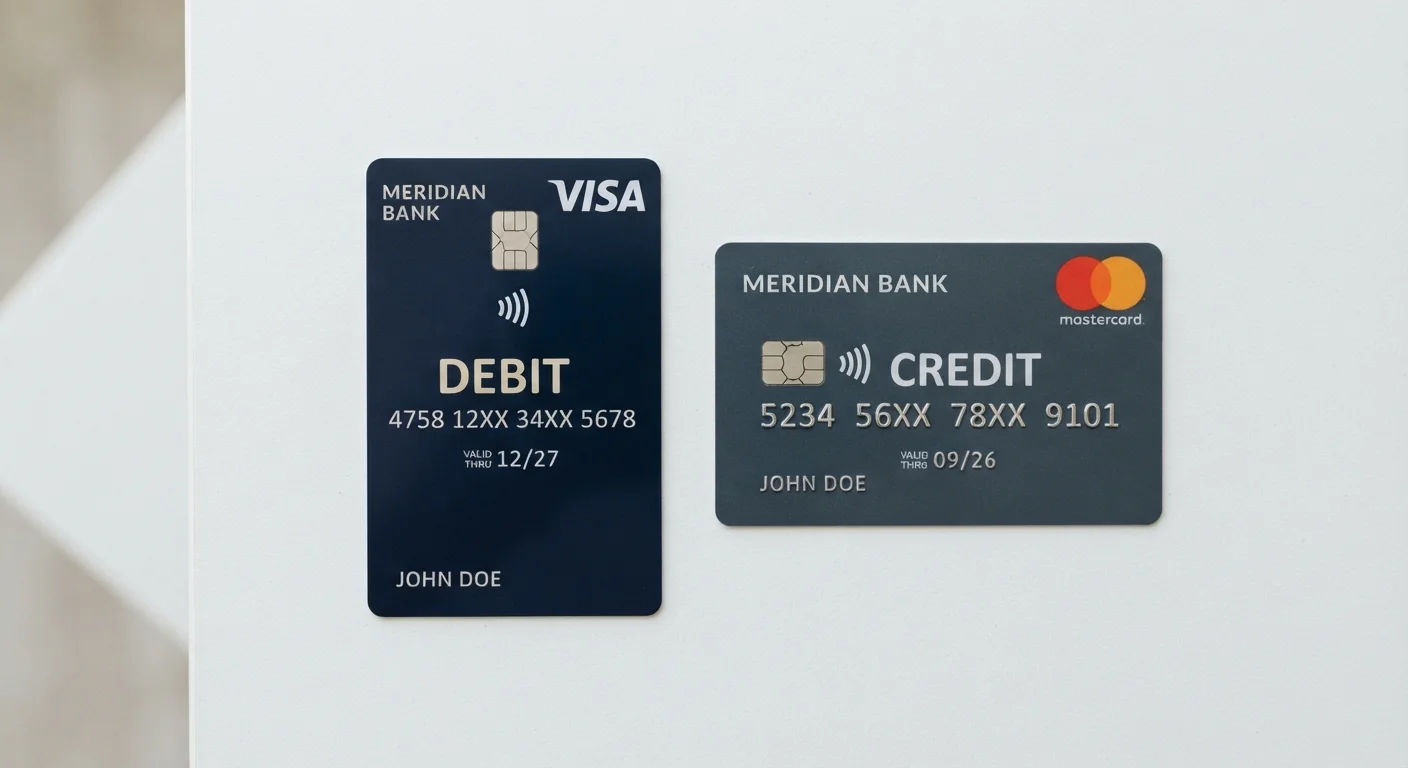
How Each Card Actually Works
At a glance, a debit card and a credit card look nearly identical. Same size, same chip, same tap-to-pay capability. The critical difference is invisible - it lives in where the money comes from.
When you pay with a debit card, funds leave your checking account almost immediately. You're spending money you already own. When you pay with a credit card, the card issuer (typically a bank) pays the merchant on your behalf. You then owe that amount back to the issuer, usually due in full at the end of a monthly billing cycle.
This distinction shapes everything else: your fraud exposure, your ability to build credit, and the consequences of not paying your balance. Understanding how different types of debt work is a useful foundation before choosing which card to rely on day-to-day.
| Criterion | Debit Card | Credit Card |
|---|---|---|
| Money source | Your checking account (immediately) | Issuer's credit line (repaid later) |
| Debt risk | None - limited to your balance | Yes, if balance isn't paid in full |
| Fraud liability (federal law) | $50-$500+ depending on report timing | Capped at $50; often $0 by policy |
| Builds credit history | No | Yes, reported to credit bureaus |
| Interest charges | None | Yes, if balance carried past due date |
| Overspending risk | Low - hard-limited by account balance | Higher - credit limit may exceed budget |
| Best for budgeting | Real-time balance tracking | Requires monthly bill management |
Fraud Protection: A Significant Legal Gap
This is where the practical difference matters most for beginners. U.S. federal law treats debit and credit card fraud very differently.
For credit cards, the Fair Credit Billing Act (FCBA) limits your liability for unauthorized charges to $50, and most major issuers extend this to $0. Critically, fraudulent charges are disputed before you pay - you never lose access to your own money during an investigation.
For debit cards, the Electronic Fund Transfer Act (EFTA) offers protection too, but the rules are time-sensitive. If you report fraud within two business days, your liability is limited to $50. Wait up to 60 days and it rises to $500. After 60 days, you could be responsible for the full amount stolen - and your bank account may be drained while you wait for a resolution.
The Consumer Financial Protection Bureau (CFPB) notes this timing distinction as a key reason why credit cards can be safer for everyday spending, particularly online transactions.
Report Debit Card Fraud Immediately
If you notice an unauthorized debit card charge, contact your bank the same day - not after the weekend. Under the EFTA, the two-business-day clock starts from when you discover the fraud, and waiting can dramatically increase your liability. Keep your bank's customer service number saved in your phone. Acting quickly is your most important protection.
Credit Building - Only One Card Does It
Debit cards are invisible to the credit bureaus. No matter how responsibly you use one, it will never appear on your credit report or influence your credit score.
Credit cards, by contrast, are reported monthly to the three major credit bureaus - Equifax, Experian, and TransUnion. Your payment history (whether you pay on time), your credit utilization (how much of your limit you use), and the age of your account all factor into your score. For beginners building credit from scratch, responsible credit card use is one of the most accessible tools available. For a deeper dive, our guide on credit cards and debt for first-timers explains exactly how interest accrues and what minimum payments really mean.
The trade-off: if you carry a balance past the due date, interest charges - often between 20% and 30% APR on many cards - begin accumulating. A $500 balance left unpaid for several months can grow significantly. If you're not yet confident you can pay in full each month, a debit card may be the lower-risk starting point while you build that discipline.
Which Should You Use - and When?
The honest answer is that many financially healthy adults use both - strategically. A credit card for everyday purchases (paid in full monthly) builds credit and maximizes fraud protection. A debit card keeps discretionary or high-risk spending tied directly to available funds.
If you're just starting out and uncertain about managing a credit card, consider a secured credit card as a low-risk entry point. Our comparison of secured vs. unsecured credit cards explains who each suits best. And before committing to a credit card, it's worth reading about the trade-offs every new cardholder should understand - genuine benefits sit alongside real risks.
Neither card is objectively superior. The right choice depends on your spending habits, your ability to pay balances on time, and your current financial goals. This article provides general educational information - for decisions specific to your situation, consider speaking with a certified financial counselor or adviser.
$50
Max credit card fraud liability under federal law
The Fair Credit Billing Act caps consumer liability at $50 for unauthorized credit card charges; most issuers voluntarily extend this to $0.
~30%
Typical high-end credit card APR range
The CFPB has reported that average credit card interest rates have risen significantly in recent years, making unpaid balances costly to carry.
35%
Payment history share of FICO credit score
According to FICO, payment history is the single largest factor in your credit score - making on-time credit card payments especially impactful.
This article is for general informational and educational purposes only. It is not personalized financial, legal, or tax advice. Please consult a qualified financial professional before making decisions based on your individual circumstances.