
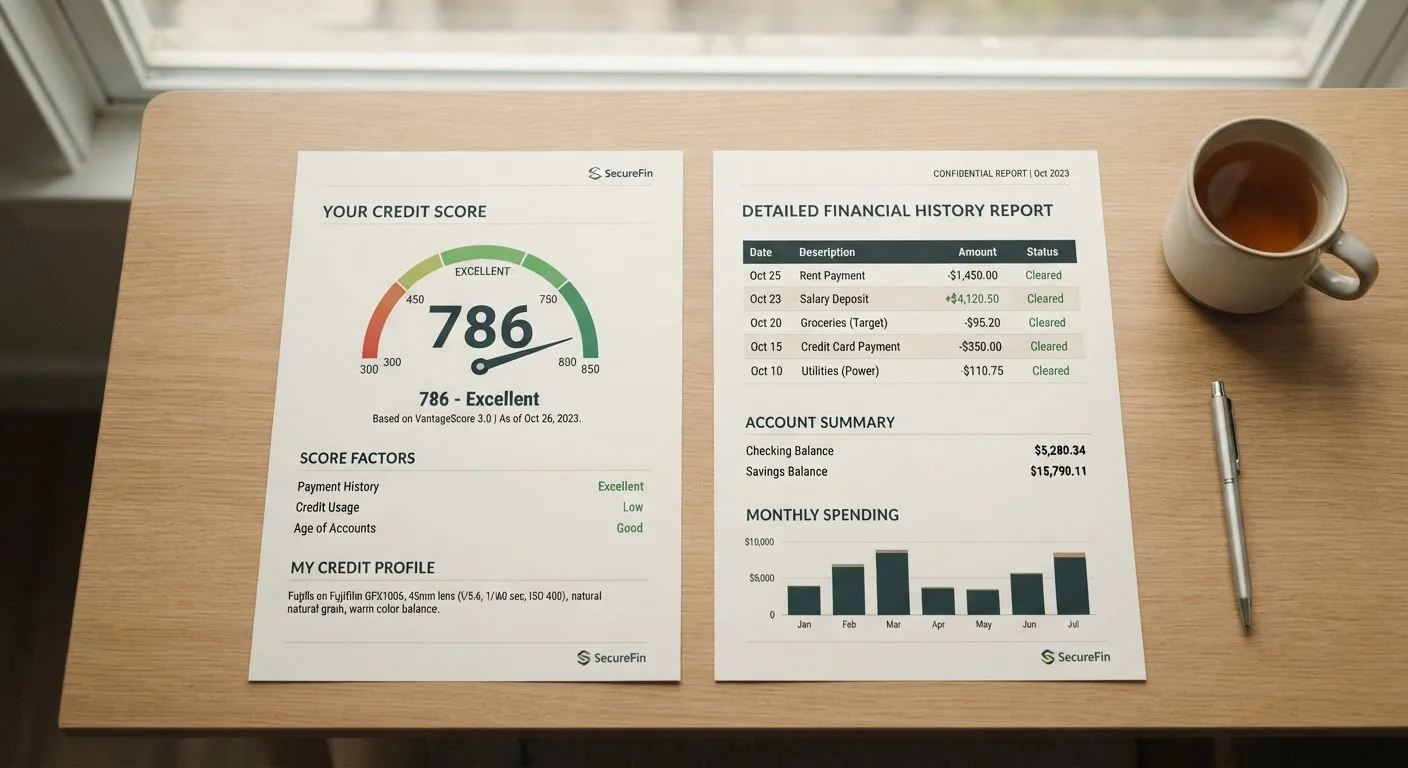
What Each One Actually Is
Many people use "credit score" and "credit report" interchangeably, but they are two distinct things that work together. Understanding both is a foundational step in managing your financial life. For a broader introduction, see what a credit score actually means.
Credit Report: Your Financial History
A credit report is a detailed written record compiled by a credit bureau (also called a credit reporting agency). The three major U.S. bureaus are Equifax, Experian, and TransUnion. Your report typically contains:
- Personal identifying information - name, address history, Social Security number
- Account history - every credit card, loan, and line of credit you've opened, including payment status and balances
- Public records - bankruptcies and certain civil judgments
- Hard inquiries - records of when lenders checked your credit after you applied for new credit
Think of it as your financial resume: it lists the facts but doesn't render a judgment on them.
Credit Score: Your Calculated Rating
A credit score is a three-digit number - typically ranging from 300 to 850 - generated by a mathematical model that analyzes the data in your credit report. It converts pages of history into a single, standardized figure lenders can quickly compare. The score itself does not live in your credit report; it is calculated fresh each time it is requested, using whatever data appears in your report at that moment.
How They Relate to Each Other
The simplest way to picture the relationship: your credit report is the raw data, and your credit score is the grade calculated from that data. No report means no score - the two are inseparable, even though they look very different.
| Criterion | Credit Score | Credit Report |
|---|---|---|
| Format | Single three-digit number | Multi-page detailed document |
| Who creates it | Scoring companies (e.g., FICO, VantageScore) | Credit bureaus (Equifax, Experian, TransUnion) |
| What it contains | A calculated rating of creditworthiness | Full account and payment history |
| How often it changes | Recalculated each time it's requested | Updated as lenders report new activity |
| Free access | Often via card issuers or apps | AnnualCreditReport.com (federally mandated) |
| Primary use | Quick risk assessment by lenders | Detailed review and error disputes |
Because the score flows from the report, any error in the report - a payment mistakenly marked late, an account that isn't yours - can drag your score down unfairly. That's why reviewing your report regularly matters just as much as checking your score. The Consumer Financial Protection Bureau (CFPB) recommends checking your report for errors at least once a year, and you can do so for free at AnnualCreditReport.com, the only site federally authorized for this purpose.
Different lenders may also pull your report from different bureaus, so your score can vary slightly depending on which bureau's data is used - and which scoring model is applied. FICO and VantageScore calculate scores differently, which can produce different numbers from the same report.
How to Access Both - and What to Do With Them
Knowing where to find each one removes a lot of the mystery.
Getting Your Credit Reports
Federal law - specifically the Fair Credit Reporting Act (FCRA) - entitles you to one free report from each of the three major bureaus every 12 months through AnnualCreditReport.com. Some consumers space these out (one bureau every four months) to monitor their credit year-round at no cost.
When you get your report, review it for: accounts you don't recognize, incorrect late payments, outdated negative items, and wrong personal information. If you find an error, you have the right to dispute it directly with the bureau that issued the report.
Getting Your Credit Score
Many credit card issuers and financial institutions now provide a free credit score through your online account or app. You can also access scores through certain non-profit credit counseling agencies. Checking your own score is a soft inquiry and does not affect your score in any way - a common misconception addressed in our article on credit score myths that trip up beginners.
Taking Action
Once you have both documents in hand, the path forward is straightforward: use the report to identify specific issues (high balances, missed payments, unknown accounts) and use the score to measure whether your corrective actions are moving the needle. Together, they give you a complete, actionable picture of your credit health. To explore the full landscape of credit and debt, browse our Credit & Debt hub for guides tailored to beginners.
This article is for general informational and educational purposes only. It does not constitute personalized financial, legal, or credit counseling advice. Consult a qualified financial professional or a HUD-approved housing counselor for guidance specific to your situation.