
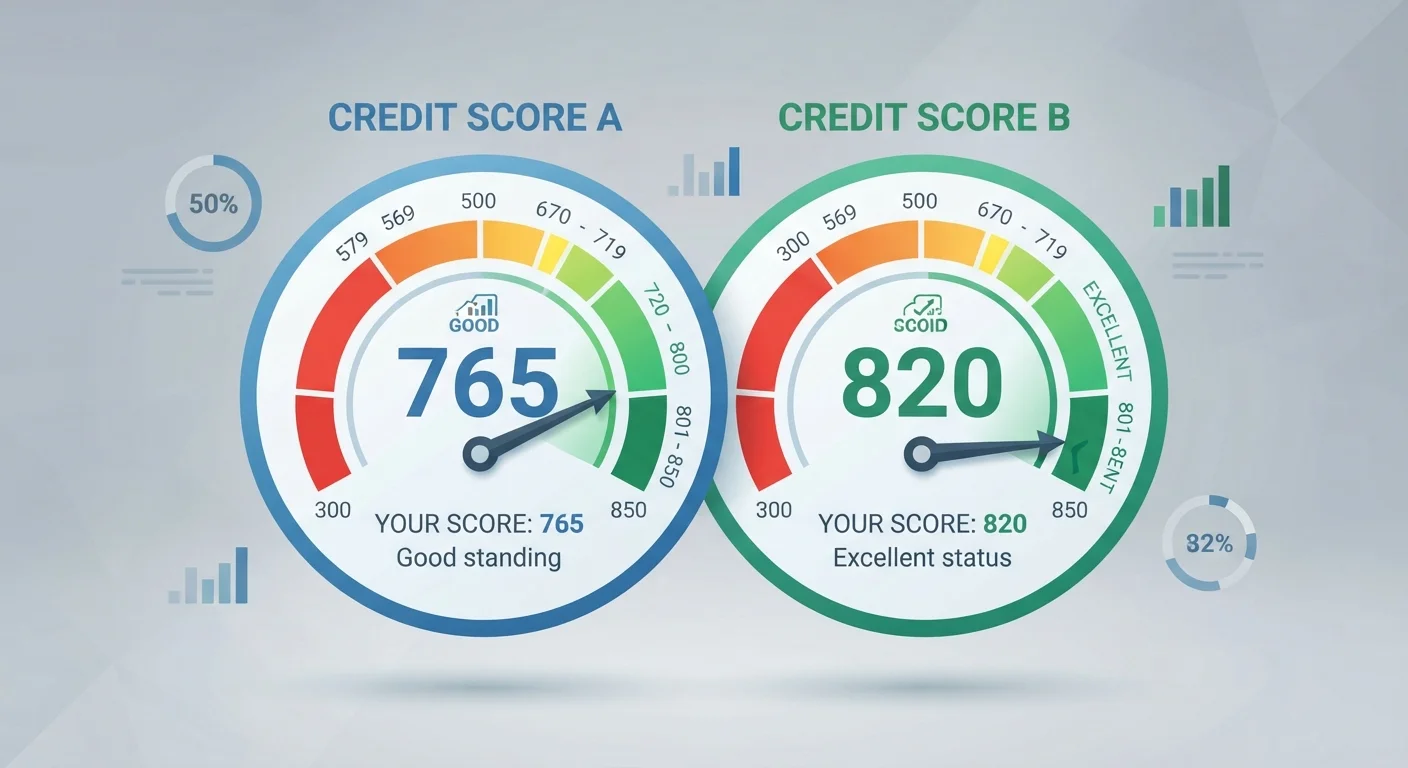
Two Scoring Models, One Credit Report
When you check your credit score online, you might notice the number shifts depending on where you look. That inconsistency is not an error - it usually reflects the fact that two different scoring models exist: the FICO Score and VantageScore. Both read the same underlying data from your credit report, but they interpret it using different formulas, which is why the results can vary.
If credit scores feel confusing already, our guide to what credit scores actually mean is a helpful starting point before diving into the comparison below.
Understanding the distinction matters because the score a lender pulls may not match the one your banking app shows you. Knowing which model is relevant in which context helps you make smarter decisions - without unnecessary anxiety.
Origins and Ownership
FICO stands for Fair Isaac Corporation, the company that created the original credit scoring model in 1989. It became the standard that lenders built their underwriting processes around, and it still dominates today. FICO regularly releases updated versions (such as FICO Score 8 and FICO Score 10), though many lenders continue using older versions for consistency.
VantageScore was launched in 2006 as a joint venture by the three major credit bureaus - Equifax, Experian, and TransUnion. The bureaus wanted a more consistent model they could offer across all three reporting agencies. VantageScore has also released multiple versions, with VantageScore 3.0 and 4.0 being the most widely used today.
| Criterion | FICO Score | VantageScore |
|---|---|---|
| Created by | Fair Isaac Corporation (1989) | Equifax, Experian & TransUnion (2006) |
| Score range | 300-850 | 300-850 |
| Minimum credit history needed | 6 months of history | 1 month of history |
| Lender adoption | ~90% of U.S. lending decisions | Growing, especially fintech & cards |
| Free score availability | Less common in free tools | Most free monitoring apps use this |
| Versions in use | FICO 8, FICO 9, FICO 10 (and older) | VantageScore 3.0 and 4.0 |
It is worth noting that your credit report - the raw data both models draw from - is separate from either score. For a clear breakdown of that distinction, see our article on credit scores vs. credit reports.
How the Two Models Weigh Credit Factors
Both FICO and VantageScore evaluate the same broad credit behaviors - payment history, amounts owed, length of credit history, new credit, and credit mix - but they assign different weights to each factor.
- Payment history is the single most important factor in both models, though FICO places slightly more emphasis on it.
- Credit utilization (how much of your available credit you're using) is heavily weighted in both. Keeping utilization below 30% is a widely cited guideline for maintaining healthy scores.
- Length of credit history matters more in FICO's formula. VantageScore places greater emphasis on recent credit behavior, which can benefit younger credit files.
- New credit inquiries affect both scores, but VantageScore treats multiple loan inquiries within a short window more leniently for certain loan types.
90%+
U.S. lending decisions using FICO
FICO reports its scores are used in more than 90% of credit decisions by top U.S. lenders.
1 month
Minimum history for VantageScore
VantageScore can generate a score with as little as one month of reported credit activity, per VantageScore's published methodology.
3
Credit bureaus behind VantageScore
Equifax, Experian, and TransUnion jointly developed VantageScore to provide a consistent cross-bureau scoring model.
One meaningful difference: VantageScore can score a consumer after just one month of credit activity and one account reported. FICO requires at least six months of history and an account reported within the last six months. This makes VantageScore more accessible for people who are just beginning to build credit.
For a deeper explanation of how these factors come together, visit our overview of credit score fundamentals.
Which Score Do Lenders Actually Use?
According to FICO, its scores are used in over 90% of U.S. lending decisions. Mortgage lenders in particular are required by most government-backed loan programs to use specific FICO versions - typically FICO Score 2, 4, and 5, depending on which bureau's report they pull.
VantageScore usage has grown, especially among credit card issuers, landlords, and utility companies. It is also the score most commonly displayed by free credit monitoring services and personal finance apps. That means the score you see for free online is often not the same one your mortgage lender will check.
Neither score is universally better or worse - they simply serve different contexts. The habits that build one score build the other: paying on time, keeping balances low, and avoiding unnecessary new credit applications all move both numbers in a positive direction.
This article is for general informational purposes only and does not constitute personalized financial or credit advice. For guidance specific to your situation, consult a qualified financial professional or a nonprofit credit counselor.