
How the Minimum Payment Math Works Against You
Imagine you carry a $3,000 balance on a credit card with an 20% annual percentage rate (APR). Your issuer sets your minimum payment at 2% of the balance, or $25 - whichever is greater. This month, your minimum might be around $60.
Here's the catch: at 20% APR, your monthly interest charge is roughly $50. That means only about $10 of your $60 minimum payment actually reduces what you owe. The rest goes straight to the lender as interest. As your balance slowly falls, so does your minimum payment - which means your repayment drags on even longer.
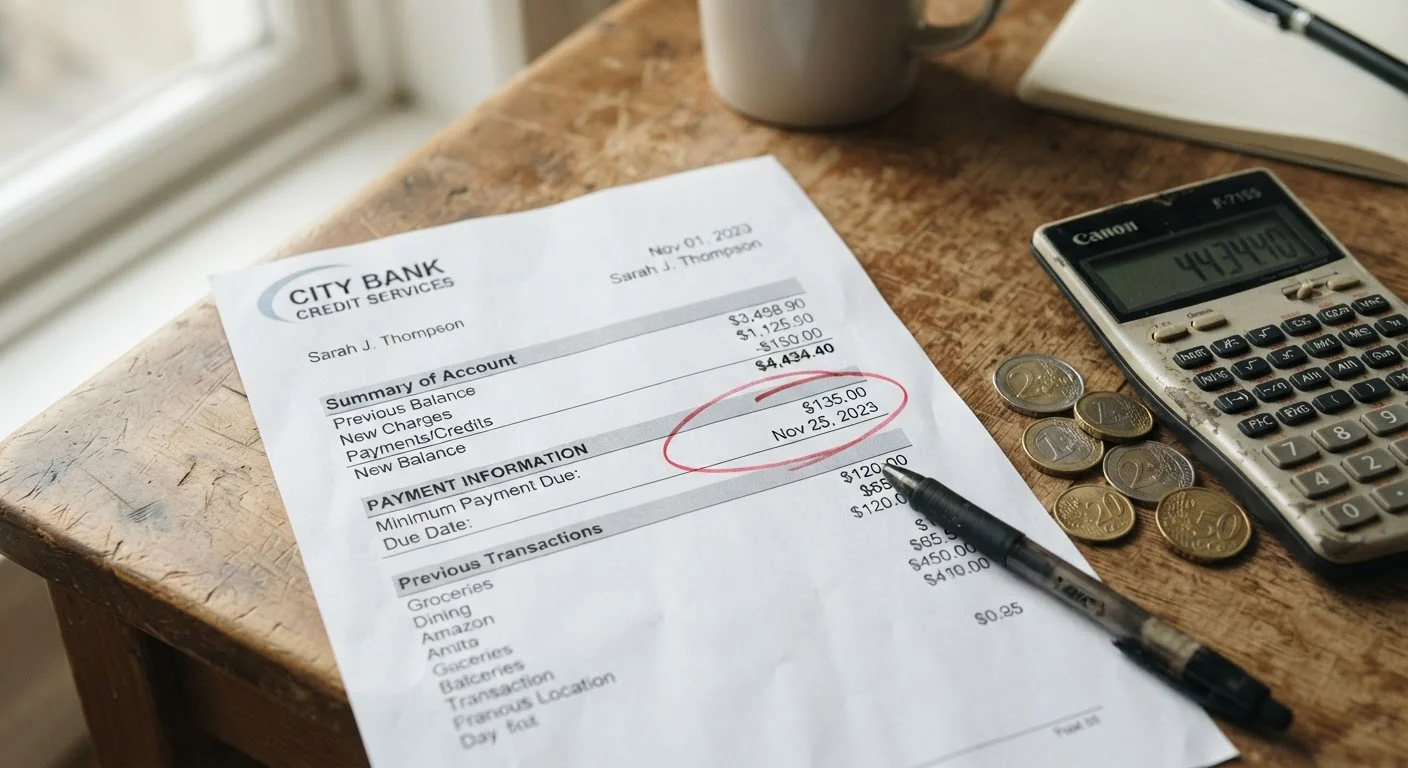
Federal law requires card issuers to include a minimum payment warning on every statement. This box shows you exactly how long minimum-only payments will take and what you'd pay in total. For a $3,000 balance at 20% APR, paying the minimum each month could take over 14 years and cost more than $3,000 in interest alone - essentially doubling the original debt.
14+ years
Estimated payoff time on $3,000 at 20% APR with minimums only
Illustrative calculation based on a 2% minimum payment structure and 20% APR - actual timelines vary by issuer terms.
~$50
Monthly interest on $3,000 at 20% APR
At 20% APR, roughly $50 of a $60 minimum payment goes to interest rather than reducing the principal balance.
1-3%
Typical minimum payment as a percentage of balance
Most major US credit card issuers set minimums at 1-3% of the outstanding balance or a flat dollar floor, whichever is greater.
Why Card Issuers Set Minimums So Low
Low minimums aren't designed primarily to help you - they're structured to keep accounts active and maximize the interest collected over time. The Consumer Financial Protection Bureau (CFPB) notes that minimum payment structures were historically set to keep customers borrowing rather than to help them become debt-free quickly.
This isn't a reason to distrust your card issuer, but it is a reason to understand the system clearly. The minimum is a floor, not a target. Meeting it keeps you out of default; exceeding it is what actually moves you toward freedom from the debt.
For a deeper look at the total cost breakdown, see why paying only the minimum on your credit card is so costly for a full breakdown of the numbers.
How to Break Out of the Minimum Payment Cycle
The path out starts with one decision: pay more than the minimum, every month, by any amount you can manage. Here's a practical framework to get started:
- Know your numbers. Find the payoff timeline on your statement. Seeing the actual years and dollars owed can be a powerful motivator.
- Build a budget. You can't find extra money for debt payments without knowing where your money currently goes. Building a simple monthly budget is the foundation of any debt repayment plan.
- Set a fixed payment amount. Instead of paying whatever the minimum is each month, pick a fixed dollar amount that is comfortably above it - and pay that consistently. This shortens your timeline significantly.
- Look for small expenses to redirect. Recurring charges - subscriptions, memberships, and apps - can quietly drain your budget. Auditing these regularly frees up cash for debt payoff.
- Automate what you can. Setting up automatic payments above the minimum reduces the risk of slipping back into minimum-only mode.
For habits that help you stay on track over the long haul, see the habits that make debt repayment sustainable long-term.
This article is for general informational purposes only and does not constitute personalized financial, legal, or tax advice. Please consult a qualified financial professional for guidance specific to your situation.