
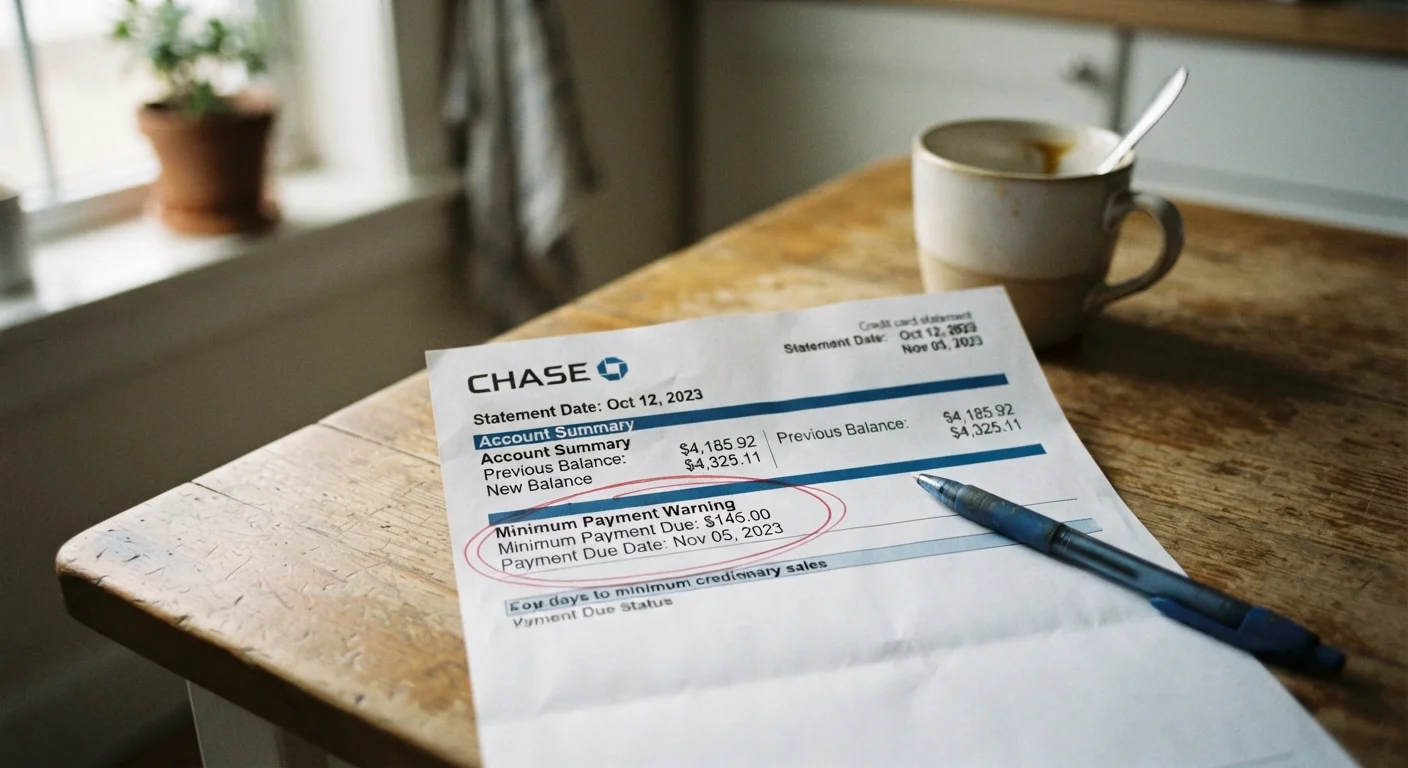
What the Minimum Payment Actually Covers
When your credit card statement arrives, the minimum payment is the smallest amount you can pay without triggering a late fee or default. For most cards, that's typically 1-2% of your outstanding balance or a fixed dollar amount - whichever is greater.
Here's the problem: at that rate, the bulk of your payment goes toward interest charges, not your actual debt. If your balance is $1,000 and your APR is 20%, you're being charged roughly $16-$17 in interest that month alone. A $25 minimum payment barely moves the needle on what you owe.
The math compounds quickly. As explained in our guide on how minimum payments extend debt for years, a balance paid at the minimum only can take well over a decade to clear - costing far more in interest than the original purchase.
This Is General Information, Not Personal Advice
This article explains how minimum credit card payments work in general terms. It is not personalized financial advice. Your situation depends on your specific interest rate, balance, income, and goals. For guidance tailored to your circumstances, consult a licensed financial professional.
Common Mistakes That Keep You Trapped
Most people who end up stuck in minimum-payment cycles aren't careless - they simply don't have a clear picture of how credit card interest works. These are the most common errors beginners make, and the practical steps to avoid each one.
Treating the minimum payment as the 'right' amount to pay each month.
Why it happens: Card issuers set minimum payments low - often 1-2% of the balance or a small flat fee - which can make them feel like a reasonable, intended target rather than a bare-minimum safety net.
Ignoring how daily interest compounds on an unpaid balance.
Why it happens: Most people think of interest as a monthly charge, but credit card interest typically accrues daily based on your average daily balance. This makes the real cost invisible until the next statement arrives.
Continuing to use the card while only paying the minimum.
Why it happens: When a card feels 'under control' because payments are on time, it's easy to keep spending. But new purchases add to the balance, and interest is charged on the growing total - not just the original amount.
Not having a payoff plan or timeline.
Why it happens: Without a concrete end date, debt can feel abstract and permanent - which actually discourages action. Many beginners simply pay what's due each month and hope the balance eventually disappears.
Misreading a low minimum as a sign the debt is manageable.
Why it happens: A $25 minimum on a $1,000 balance feels small, so the debt doesn't trigger alarm. But that low payment is largely covering interest - not reducing principal - which is exactly how balances linger for years.
For a broader look at the habits that prevent this cycle from starting, see our overview of simple behaviours that keep credit card debt from building up.
A Smarter Path Forward
Getting out of the minimum-payment trap doesn't require a dramatic financial overhaul. It starts with a clear-eyed look at your statement and one concrete decision: pay more than the minimum, even if only by a small amount.
20%+
Average credit card APR in the US
The Federal Reserve tracks average credit card interest rates, which have frequently exceeded 20% in recent years for accounts assessed interest.
10+ years
Estimated payoff time on minimum payments only
Consumer Financial Protection Bureau resources illustrate that a $1,000 balance at a typical APR, paid at minimums only, can take well over a decade to eliminate.
~$0.05
Daily interest cost per $100 at 20% APR
At a 20% annual rate, each $100 of unpaid balance accrues roughly five cents per day - compounding across the full balance every single day.
Two widely used strategies - the debt avalanche (paying off the highest-interest balance first) and the debt snowball (paying off the smallest balance first for momentum) - both outperform minimum-only payments. The right choice depends on your psychology and financial situation, not a single correct answer.
If you're newer to credit and want to avoid the traps that make cards expensive from the start, the early missteps that make credit cards costly article covers the full picture. And if you're already feeling stuck, why the minimum keeps you stuck breaks down what's actually happening to your balance each month.
Your next step today: find the payoff disclosure on your current credit card statement. It's required to be there by federal law. Read it, let the number sink in, and decide what you can add to this month's payment - even $10 or $20 makes a measurable difference over time.
This article is for general informational and educational purposes only. It does not constitute personalized financial, tax, or legal advice. Please consult a qualified financial professional for guidance specific to your circumstances.