
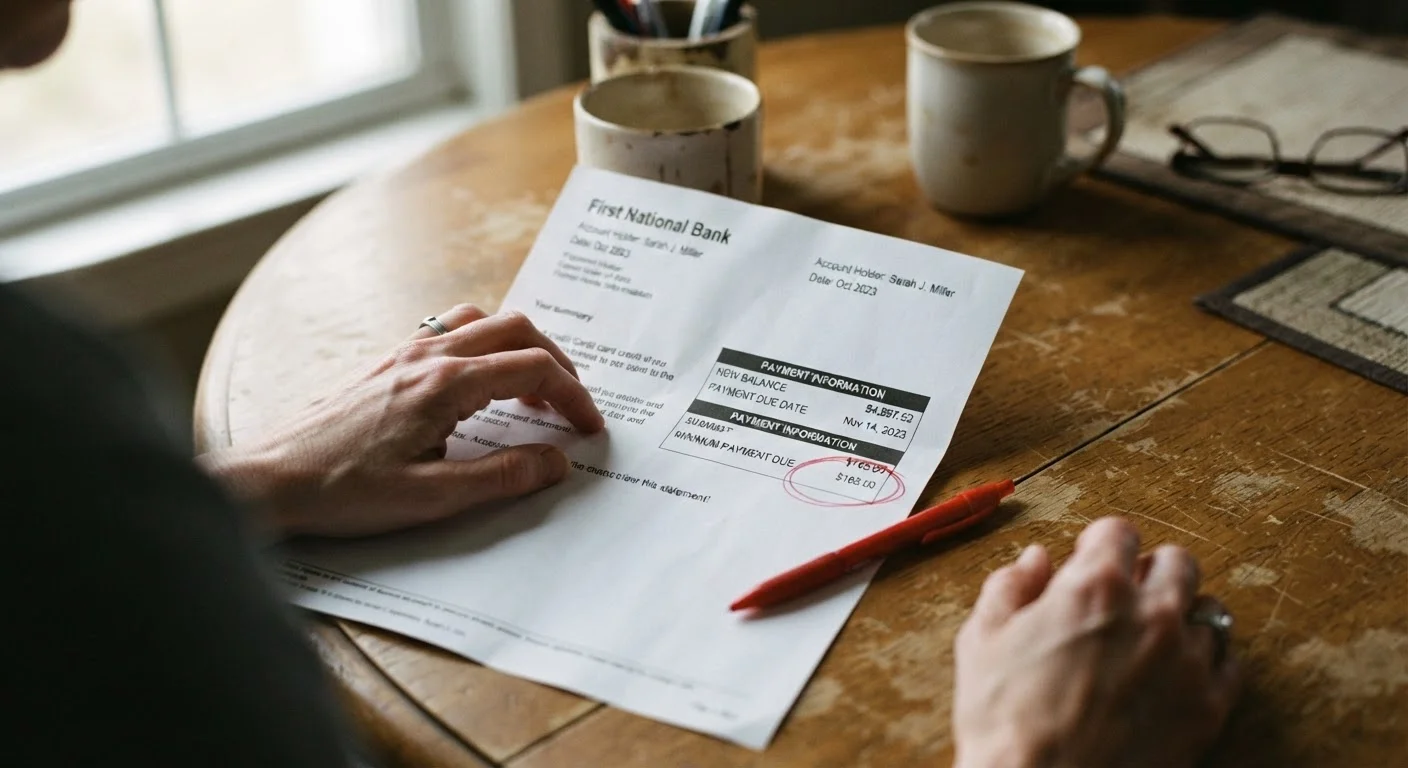
Why the Minimum Payment Feels Deceptively Manageable
Credit card issuers design minimum payments to be affordable - and that is precisely the problem. When a balance of $3,000 generates a minimum payment of $75, it feels manageable. What the statement does not emphasize is that at a 24% annual percentage rate (APR), interest on that balance is accumulating at roughly $2 per day.
The result is that your $75 payment may only reduce your principal by $15 or $20 after interest is deducted. At that pace, you could be paying on the same debt for a decade or more. The mechanics of how interest compounds explain why a balance that feels static can actually be growing quietly in the background.
This is not a design flaw - it is intentional. Lenders earn revenue from interest charges. Understanding this helps you reframe the minimum payment not as a goal, but as a floor.
The Numbers Behind Long-Term Minimum Payments
Consider a concrete illustration. Suppose you carry a $2,500 balance at 22% APR, and your issuer sets your minimum at 2% of the balance (roughly $50 to start). If you never add new charges and pay only the minimum each month, your repayment period could stretch beyond 15 years - and you could pay more in interest than the original balance itself.
22.8%
Average credit card interest rate in the U.S.
According to Federal Reserve data, average credit card rates have risen significantly in recent years, making carrying a balance increasingly costly.
15+ years
Potential repayment timeline on minimum-only payments
Consumer Financial Protection Bureau (CFPB) educational materials illustrate that a moderate balance paid at minimum levels can take well over a decade to clear.
Nearly 50%
U.S. cardholders who carry a balance month to month
Federal Reserve survey data indicates that roughly half of credit card holders do not pay their balance in full each month, leaving them exposed to interest charges.
Your monthly statement is legally required to include a minimum payment warning box showing exactly how long payoff would take and what the total interest cost would be. Many people glance past it. Reading it carefully - even once - can be a powerful motivator to pay more.
The structural trap of minimum-only payments is that as your balance slowly falls, so does your required minimum - which means you pay less each month, extending the timeline even further unless you deliberately keep your payment amount steady.
How Small Increases in Payment Make a Large Difference
You do not need to double your payment to see meaningful results. Increasing your monthly payment by even $30-$50 above the minimum can shave years off your repayment and save hundreds of dollars in interest. The math favors action: more of each dollar goes to principal, which reduces the balance on which interest is calculated next month.
A practical approach many people find useful is to set a fixed payment amount rather than paying whatever the minimum happens to be that month. If your minimum is $60, commit to paying $100 every month regardless. This counteracts the "shrinking minimum" trap and keeps your payoff on a predictable timeline.
Finding that extra $30-$50 often starts with a close look at your monthly expenses. The fundamentals of building a simple budget can help you identify spending categories where small cuts create room for larger debt payments. Similarly, reviewing recurring subscriptions - a category where costs accumulate invisibly - can surface money you did not realize was leaving your account each month.
Building Habits That Support Faster Repayment
Paying more than the minimum is as much a behavioral challenge as a financial one. Motivation tends to spike right after you read an article like this - and fade within weeks. Building reliable habits protects you from that dip.
Automating your payment at an amount above the minimum is one of the most effective moves available to you. It removes the decision from your to-do list every month. Pairing automation with a simple tracking system - even a note in your phone showing your current balance - reinforces the sense of progress that keeps people consistent.
For a broader framework of sustainable behaviors, the habits that prevent debt from spiralling offer practical, low-effort starting points. And for those thinking further ahead, long-term debt repayment habits address how to stay on course when motivation naturally dips.
This article is for general informational purposes only and does not constitute personalized financial, legal, or tax advice. Your situation is unique - consider speaking with a qualified financial professional before making significant decisions about debt repayment.