
How Daily Interest Actually Works
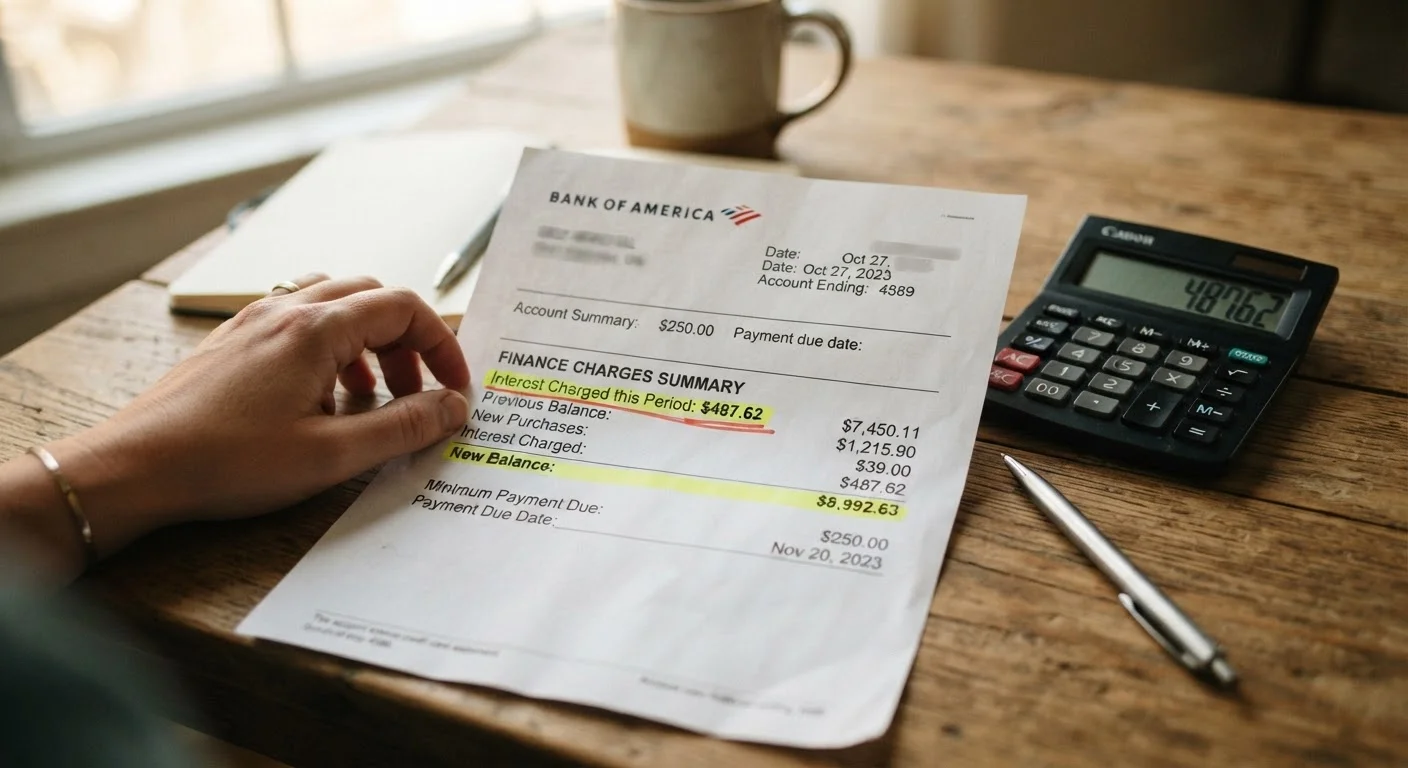
Most people assume credit card interest is a monthly fee. In reality, interest accrues every single day you carry a balance. Here's the mechanics in plain terms:
- Your APR is converted to a daily rate. Divide your APR by 365. A 24% APR becomes a daily periodic rate of roughly 0.066%.
- That rate is applied to your average daily balance. Each day, the issuer multiplies your outstanding balance by the daily rate. These small amounts add up across the billing cycle.
- Unpaid interest is added to your balance. If you don't pay in full, accrued interest joins your principal - and next month, interest is charged on that higher total.
This structure means a $1,000 balance at 24% APR costs about $20 in interest for a single month. That might sound modest, but if you're only making minimum payments, the balance barely shrinks - and the interest meter keeps running. Our explainer on how compound interest differs from simple interest shows exactly why this compounding effect matters so much over time.
20%+
Average credit card APR on balances carrying interest
Federal Reserve data has shown average rates on interest-assessed accounts frequently exceeding 20% in recent years.
0.066%
Daily interest rate at 24% APR
Dividing a 24% APR by 365 days shows how quickly even a modest daily rate accumulates across a full billing cycle.
~$20
Monthly interest cost on a $1,000 balance at 24% APR
A single month of carrying $1,000 at 24% APR generates roughly $20 in interest - before any new spending is added.
The Grace Period: Your Built-In Shield
Federal law requires card issuers to provide a grace period - generally at least 21 days from the statement closing date to the payment due date. During this window, no interest is charged on purchases, provided you paid your previous statement balance in full.
The critical catch: carry any balance from one month to the next and you lose the grace period entirely. New purchases begin accruing interest from the day they post, not from your due date. This is one of the most common early mistakes new cardholders make - they assume interest only applies to old debt, not to fresh spending.
Restoring your grace period requires paying the full statement balance for two consecutive billing cycles in some cases, depending on your card agreement. Always check your cardmember terms for the exact policy.
Why Even a Small Unpaid Balance Is Costly
Leaving $50 on your card at the end of the month might feel negligible. But the consequences extend beyond that $50:
- You lose the grace period, so new purchases immediately start accumulating interest.
- Interest is added to your balance, meaning next month's interest is calculated on a slightly larger amount.
- Behavioral drift is real. Research in consumer finance suggests that once people accept carrying a balance, the amount tends to grow rather than shrink over time.
These hidden costs are part of a broader pattern - the kind of creeping expense covered in our guide to costs beginners consistently underestimate. Interest charges on credit cards belong in the same category: easy to overlook, genuinely damaging over time.
For a broader view of the trade-offs credit cards present, including both the benefits and the risks, see the trade-offs every new cardholder should understand.
Practical Habits That Keep Interest at Zero
The most reliable way to avoid interest charges is straightforward: pay your full statement balance by the due date every billing cycle. This preserves the grace period, costs you nothing in interest, and still allows you to use the card freely throughout the month.
If paying in full isn't always possible, these habits limit the damage:
- Pay more than the minimum whenever you can. Every extra dollar reduces the balance on which interest compounds. Our related article explains why minimum-only payments keep you stuck for years.
- Track your running balance, not just the statement. Use your card's app to monitor spending in real time so the bill isn't a surprise.
- Treat the credit limit as a ceiling, not a target. Keeping utilization low protects both your budget and your credit score.
Understanding how interest works is the first step. Acting on that understanding - consistently paying in full - is what keeps credit cards a useful tool rather than an expensive habit.
This article is for general informational and educational purposes only and does not constitute personalized financial, legal, or tax advice. Consult a qualified financial professional before making decisions about your specific situation.