
The Core Difference: What Each Method Actually Calculates
Simple interest is calculated exclusively on your original deposit or loan amount - called the principal. The formula is straightforward: multiply your principal by the annual interest rate and the number of years.
For example: $1,000 deposited at 5% simple interest for 10 years earns $500 in interest ($1,000 × 0.05 × 10), leaving you with $1,500.
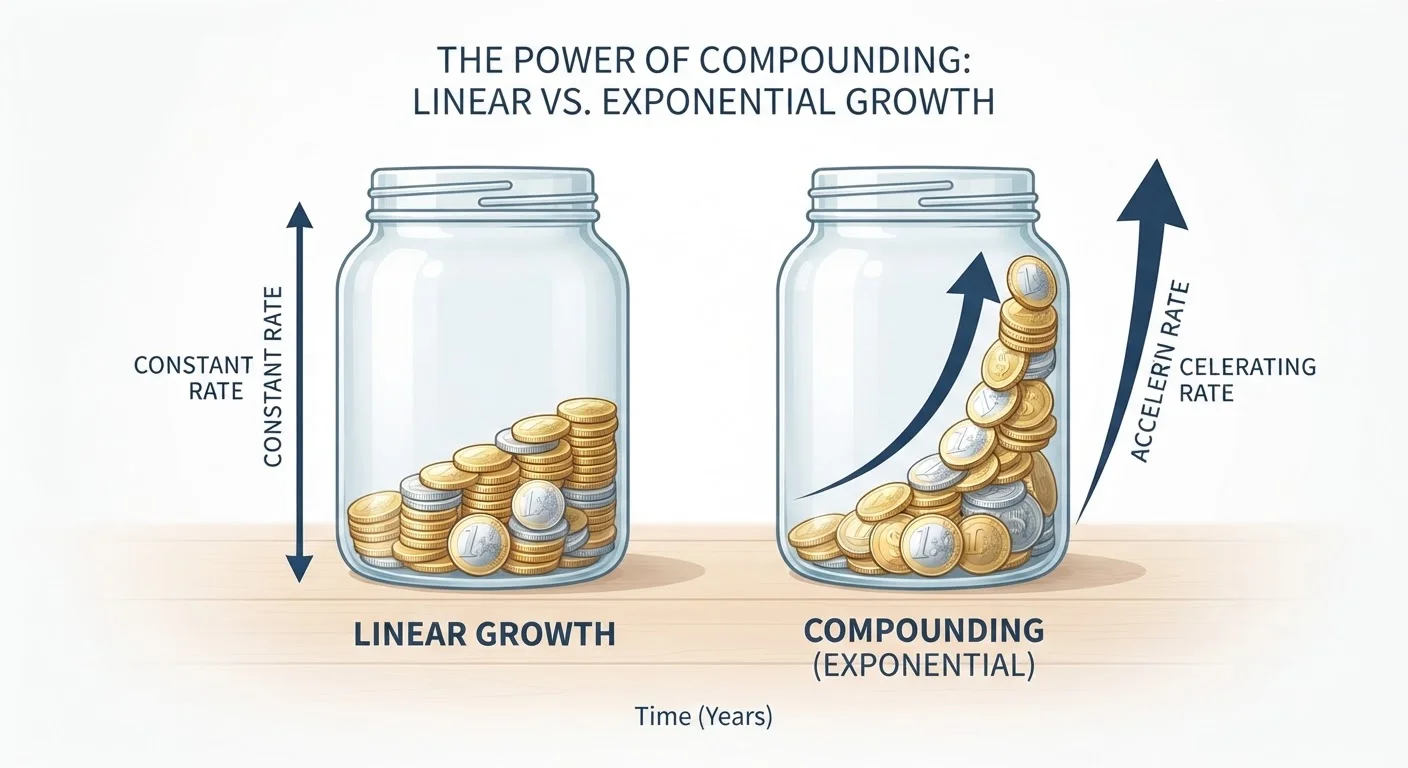
Compound interest, by contrast, calculates interest on your principal plus any interest you have already earned. Your interest earns interest. Using the same scenario at 5% compounded annually, after 10 years you'd have approximately $1,629 - over $129 more, without adding a single extra dollar.
That gap doesn't sound enormous at 10 years. Give it 30 years, and the same $1,000 grows to $4,322 with compounding versus $2,500 with simple interest. That's the compounding effect in action.
| Criterion | Simple Interest | Compound Interest |
|---|---|---|
| Calculated on | Principal only | Principal + accumulated interest |
| Growth pattern | Linear (straight line) | Exponential (accelerating curve) |
| $1,000 at 5% over 10 years | $1,500 | ~$1,629 |
| $1,000 at 5% over 30 years | $2,500 | ~$4,322 |
| Common use in savings | Rare in modern accounts | Standard in savings accounts |
| Common use in debt | Some personal loans, bonds | Credit cards, most mortgages |
| Predictability | Very easy to calculate | Requires knowing frequency |
This article provides general financial education and is not personalised investment or financial advice. Consult a qualified financial professional for guidance specific to your situation.
Compounding Frequency: Why It Pays to Read the Fine Print
Compound interest isn't one-size-fits-all. The rate at which your interest compounds - daily, monthly, quarterly, or annually - significantly affects how much you earn or owe.
A savings account compounding daily will outperform an identical account compounding annually, even at the same stated interest rate. Banks typically express this as the Annual Percentage Yield (APY), which already accounts for compounding frequency. When comparing savings products, APY is the number to watch - it gives you a true apples-to-apples comparison. For a deeper look at how savings account terms work, see our guide to savings account basics.
On the debt side, credit cards often compound interest daily. Carrying even a modest unpaid balance can cost you significantly more than you expect. To understand exactly how that plays out, learn how credit card interest compounds against you.
$4,322
Value of $1,000 compounded at 5% for 30 years
Compared to just $2,500 under simple interest - illustrating how compounding accelerates growth over long periods.
365x
Daily compounding cycles per year on many credit cards
Credit card balances typically compound daily, meaning unpaid interest begins accruing interest the very next day.
~73%
More wealth from compounding vs. simple interest over 30 years
At a 5% annual rate, $1,000 grows to $4,322 with annual compounding versus $2,500 with simple interest - a difference of roughly 73%.
Time: The Variable That Changes Everything
Compounding's real power comes from time. The longer money compounds, the more aggressively it grows - not in a straight line, but on an accelerating curve.
Starting early matters more than investing large amounts late. A person who begins saving at 25 and stops at 35 (investing for just 10 years) can end up with more money at retirement than someone who starts at 35 and invests for 30 straight years - assuming the same rate of return. That counterintuitive result is entirely due to the extra compounding time the early starter enjoys.
This is why financial educators emphasize starting as soon as possible, even with small amounts. Waiting even five years to begin saving can cost you tens of thousands of dollars in foregone compound growth by retirement. For a fuller picture of how compounding intersects with retirement planning, see how compound growth interacts with retirement milestones.
Want to go deeper on the mechanics? Compound growth explained without the jargon walks through exactly how consistency and time combine to build long-term wealth.