
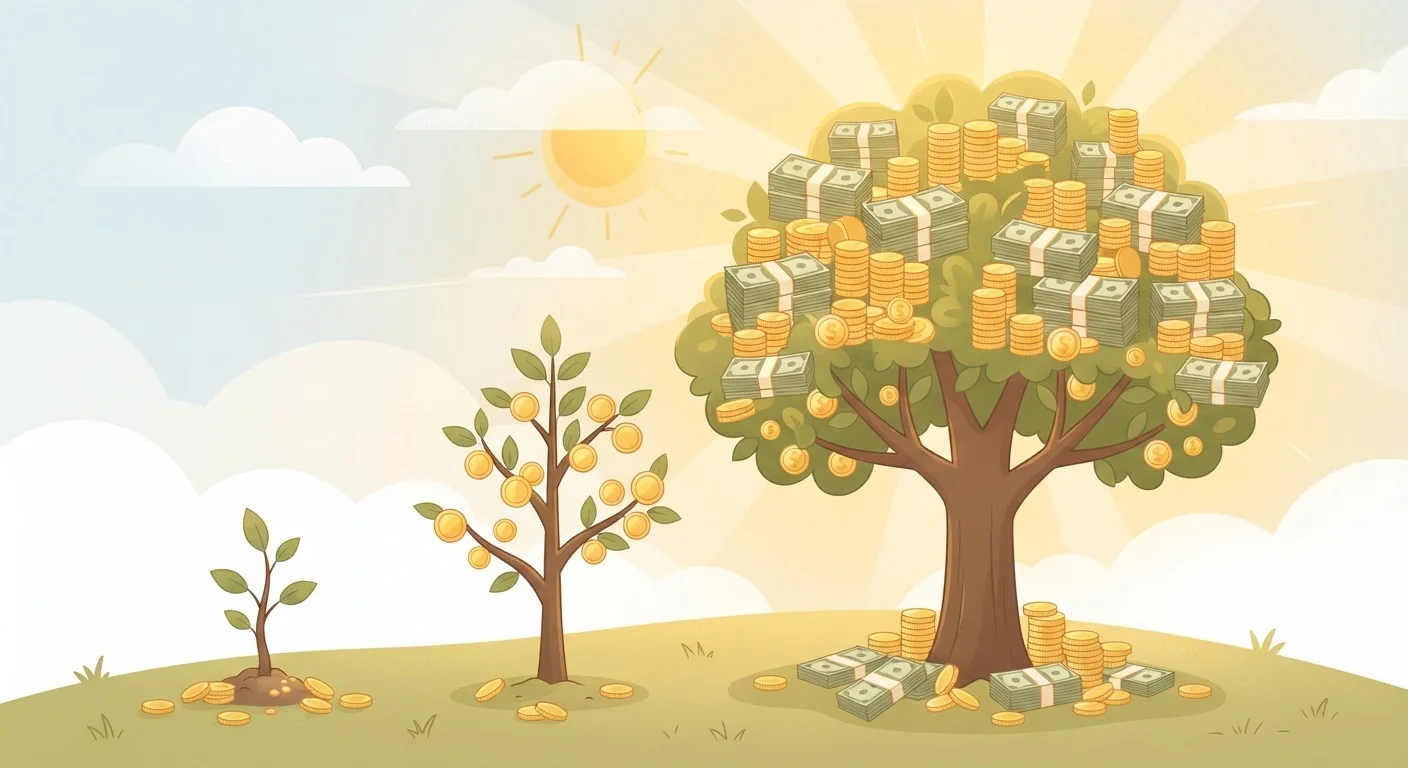
The Core Idea: Growth on Top of Growth
Imagine you plant $1,000 in a savings account that earns 7% per year. After year one, you have $1,070. In year two, you earn 7% not just on your original $1,000 - but on the full $1,070. That extra $4.90 may seem insignificant, but this is exactly how compounding begins.
Each year, your base grows a little larger, and the next year's return is calculated on that larger base. Over 30 years, that original $1,000 - with no additional contributions - could grow to roughly $7,600. You didn't add a single dollar after the first deposit. Time did the work.
This is the engine behind retirement saving. For a fuller picture of how money grows through different mechanisms, see The Beginner's Map to How Money Grows Over Time.
~$76,000
Growth of $1,000 over 40 years at 7%
Illustrative calculation assuming 7% annual compound growth with no additional contributions - showing how time amplifies a single initial deposit.
10 years
Typical head start that transforms retirement outcomes
Financial educators widely cite a decade-long head start as one of the most impactful variables in long-term retirement accumulation, all else being equal.
1%
Annual fee difference that can cost tens of thousands
A 1 percentage point difference in annual fund fees, compounded over 30 years, can reduce a retirement balance by a substantial margin according to general compounding mathematics.
Why Starting Early Matters More Than Amount
The most counterintuitive truth about compound growth is that when you start often outweighs how much you contribute. Consider two people: one begins saving $100 per month at age 25, the other waits until 35 and contributes $200 per month. Assuming a consistent 7% annual return, the person who started at 25 - contributing half as much each month - is likely to end up with more at retirement age.
This happens because compounding needs time to accelerate. In the early years, gains look modest. But in later decades, the same percentage return is applied to a much larger base, producing dramatically larger dollar amounts.
This is also why retirement planning experts consistently emphasize starting as soon as possible - even before you feel financially ready. A small contribution at 25 can do more work than a larger one at 40. See how this connects to long-term planning in our article on compound growth and retirement milestones.
How to Put Compound Growth to Work
You don't need a large income to benefit from compounding. Here are practical steps anyone can take:
- Open a tax-advantaged account. A 401(k) through your employer or an IRA you open independently both allow your investments to grow without being taxed each year. This lets compounding work uninterrupted. Explore the basics in our Retirement Accounts hub.
- Contribute consistently. Even $25 or $50 per paycheck builds meaningful momentum over decades. Consistency matters more than size.
- Reinvest returns automatically. Most retirement accounts do this by default - dividends and gains are reinvested rather than paid out, keeping the compounding cycle intact.
- Avoid unnecessary withdrawals. Taking money out early breaks the compounding chain and often triggers taxes and penalties.
If you're curious why even tiny amounts accumulate meaningfully, Why Small Savings Add Up Faster Than You Think explains the math behind it.
Start With Whatever You Have
You don't need to wait until you can afford a "meaningful" contribution. Even $20 or $30 per month invested consistently in a tax-advantaged account begins building the compounding foundation. Increasing contributions over time as your income grows is a smart, sustainable strategy. The most important step is simply starting.
When Compounding Slows - and What to Watch For
Compounding doesn't guarantee growth - it amplifies whatever return your investments produce. If your retirement account is heavily invested in very low-yield options, compounding still occurs, but on a much smaller base growth each year. Inflation can also erode real gains if your returns don't outpace rising prices.
Fees are another silent drag. An expense ratio of 1% versus 0.1% might seem trivial, but over 30 years, it can reduce your final balance by a significant margin - because those fees reduce the base on which future compounding builds.
If your account isn't growing the way you expected, our article Why Your Retirement Savings Aren't Growing the Way You Expected covers the most common reasons and what to examine.
This article is for general informational purposes only and does not constitute personalized financial, investment, or tax advice. Please consult a qualified financial advisor or tax professional for guidance specific to your situation.