
What Each Approach Actually Involves
Before choosing a tool, it helps to understand what each one genuinely asks of you day to day.
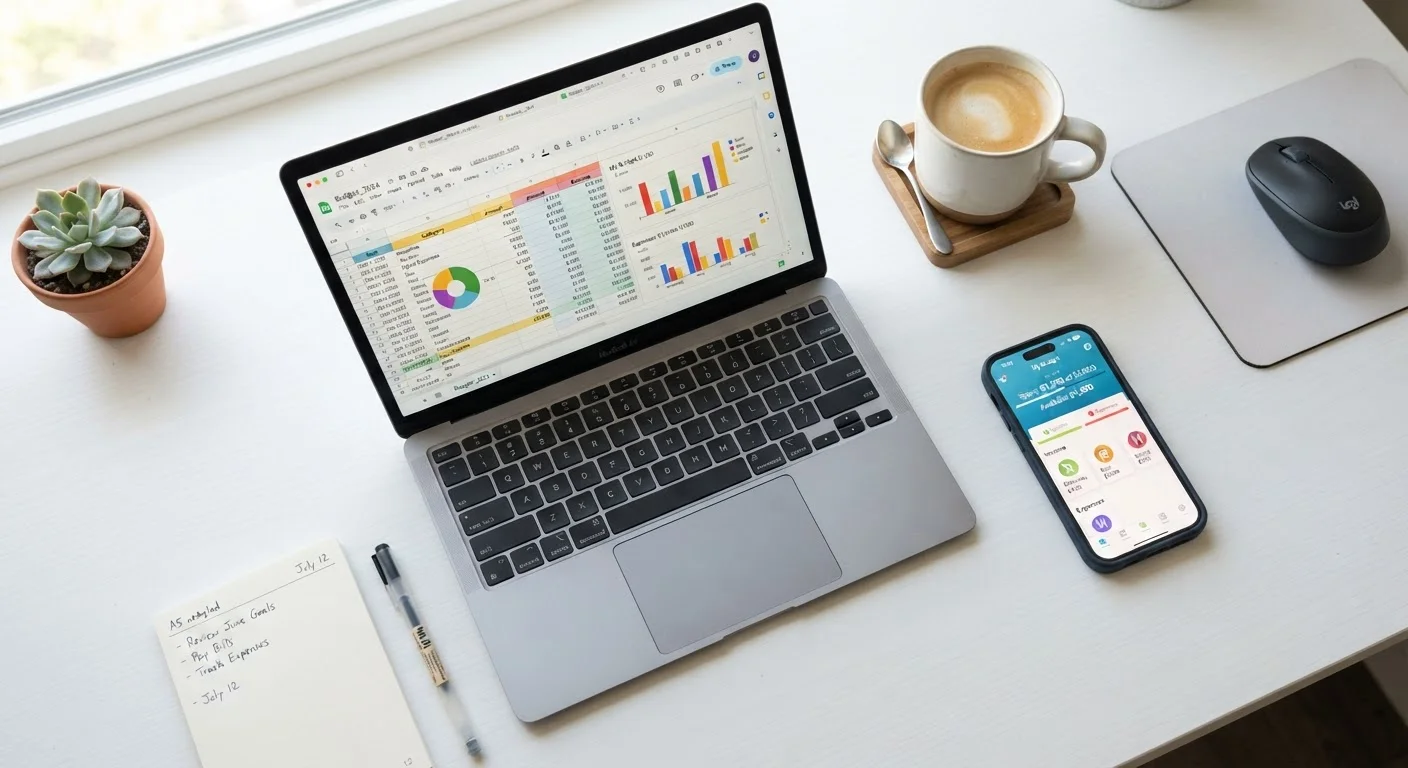
Spreadsheet tracking means creating or downloading a file - in a program like Google Sheets or Microsoft Excel - and manually entering your income, expenses, savings contributions, and goal milestones. You control every row, column, and formula. That flexibility is powerful, but it means the spreadsheet only stays accurate if you keep updating it. Miss a week of entries and the data becomes unreliable.
Budgeting apps (a broad category of software tools designed to track personal finances) typically connect directly to your bank and credit card accounts. Transactions are pulled in automatically and sorted into spending categories. Many apps also let you set savings goals and show visual progress bars so you can see at a glance how close you are to a target.
For a broader overview of how goal monitoring fits into a complete financial plan, see the beginner's guide to monitoring financial goals.
| Criterion | Spreadsheet | Budgeting App |
|---|---|---|
| Setup time | Moderate to high | Low to moderate |
| Data entry | Manual, ongoing | Largely automated |
| Customization | Unlimited | Limited by app design |
| Data privacy | Stays on your device | Shared with app servers |
| Cost | Free or low-cost | Free tiers; paid plans vary |
| Visual dashboards | Build your own | Built-in charts and graphs |
| Best for beginners? | If comfortable with spreadsheets | Generally easier to start |
Key Trade-Offs to Weigh
Both methods have genuine strengths - and real limitations worth knowing before you commit.
Control vs. Convenience
Spreadsheets give you near-unlimited control. You can track any metric you want, in any format you want. The trade-off is time: building and maintaining a useful spreadsheet takes consistent effort. Apps prioritize convenience. Setup is fast and automation handles most data entry, but you work within the boundaries the app's designers set. If an app doesn't support a spending category you care about, your options are limited.
Privacy vs. Connectivity
When you link a budgeting app to your bank account, that data passes through the app provider's servers. Reputable apps use encryption and security standards, but some users prefer not to share login credentials with a third party. A locally saved spreadsheet keeps all data on your own device - though that also means no automatic sync across devices unless you use a cloud storage service.
Learning Curve
Apps are generally faster to start using. A spreadsheet, particularly a custom one, requires some comfort with formulas and layout design. Free templates are widely available and can reduce the setup time significantly if you're not starting from scratch. If you're also thinking about how budgeting methods compare more broadly, our article on envelope budgeting vs. digital spending trackers covers a related set of trade-offs.
Making the Choice - and Sticking With It
The most important factor isn't which tool is technically superior - it's which one you'll actually use consistently. A half-filled spreadsheet and an app you stopped opening after two weeks will both fail to help you reach your goals.
A practical approach: try your preferred method for 30 days with a commitment to update or check it at least once a week. If it feels like a chore you keep avoiding, that's useful information. You can switch, simplify, or even combine both - for example, using an app for day-to-day tracking and a spreadsheet for quarterly goal reviews.
Whatever you choose, tracking progress without obsessing over every dollar is a healthy principle to keep in mind. The goal is awareness and gradual improvement, not perfection.
If your income, expenses, or goals change significantly - a new job, a big purchase, a new savings target - revisit your tracking method. The right tool at one stage of your financial journey might not be the right tool at the next.
This article is for general informational and educational purposes only. It does not constitute personalised financial advice. Consider speaking with a qualified financial professional about decisions specific to your situation.