
What Risk Tolerance Really Means
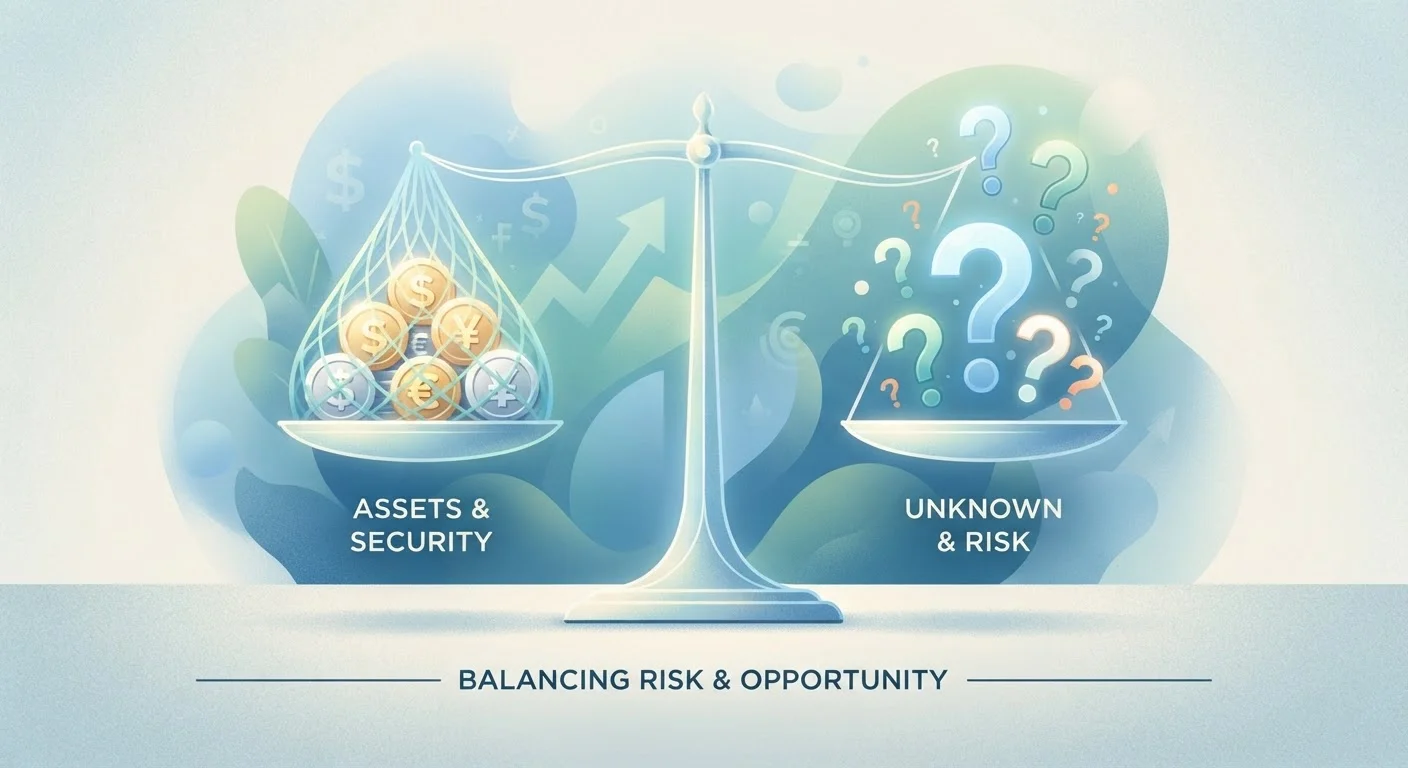
When people first start investing, the phrase "risk tolerance" can sound like financial jargon designed to intimidate. In practice, it answers one straightforward question: how much uncertainty can you handle without making decisions you'll later regret?
That question has two layers. The first is emotional - how do you respond when you watch the value of your money fall, even temporarily? The second is practical - if your portfolio dropped significantly, would it genuinely set back your financial life, or would you have the time and resources to recover?
Both layers matter. Someone might feel emotionally unbothered by market swings but be in a financial position where a large loss would be genuinely harmful. Someone else might have a very stable financial situation but still feel deep stress watching account balances dip. Knowing which factors apply to you is the starting point for building a portfolio you can actually stick with.
Risk Tolerance vs. Risk Capacity: Know Both
These two concepts are related but distinct. Risk tolerance is psychological - it's how you feel about uncertainty. Risk capacity is financial - it's how much loss your actual situation can absorb. A complete self-assessment looks at both. Even if you feel calm about volatility, your capacity for risk may be limited by factors like short timelines or high debt. Neither number is good or bad on its own; together they guide smarter portfolio decisions.
The Key Factors That Shape Your Tolerance
Risk tolerance isn't fixed - it's the product of several overlapping factors that are worth examining honestly:
- Time horizon: How long until you'll need this money? Someone saving for retirement 30 years away can typically weather more volatility than someone who needs funds in three years. Markets have historically recovered from downturns, but recovery takes time.
- Income and financial stability: A stable income and a solid emergency fund create a financial cushion. If your livelihood is uncertain, taking on more investment risk may amplify that stress rather than help.
- Existing savings and debt: High-interest debt or thin savings can make investment losses much more consequential. Addressing those first is often the more financially sound approach.
- Emotional response to loss: This is harder to quantify but just as real. Research consistently shows that people feel the pain of losses more acutely than the pleasure of equivalent gains - a concept known as loss aversion. Knowing this about yourself isn't a weakness; it's useful data.
Before putting money into any investment, it's worth thinking through these questions carefully. See our questions to consider before investing for a structured way to work through them.
~20%
Average investor return gap vs. fund returns
Research by Morningstar has consistently found that individual investors earn less than the funds they invest in, largely due to poorly timed buying and selling driven by emotional reactions to volatility.
2x
How much more painful losses feel than equivalent gains
Behavioral economists Daniel Kahneman and Amos Tversky's research on loss aversion found that losses feel roughly twice as impactful as equivalent gains - a core reason why knowing your emotional risk threshold matters.
Why Misalignment Creates Real Problems
When a portfolio doesn't match a person's risk tolerance, the consequences tend to show up at exactly the wrong time - during a market downturn. An investor who took on more risk than they could genuinely handle often feels compelled to sell when prices are falling, locking in losses and missing the eventual recovery.
This is one of the most common and costly mistakes new investors make - not because they chose the wrong assets, but because they chose assets that didn't match how they'd actually behave under pressure.
The solution isn't to push yourself toward more or less risk than is natural. It's to build a portfolio that reflects your honest self-assessment. A more conservative portfolio that you stay invested in through volatility will typically outperform an aggressive one you abandon at the first sign of trouble.
Once you understand your tolerance, spreading your investments across different assets is one of the most practical tools for managing risk at whatever level suits you.
Putting It Into Practice
Assessing risk tolerance doesn't require a formal quiz, though many brokerage platforms offer them as a starting point. A more honest approach starts with a few direct questions:
- If my portfolio dropped 20% next month, would I sell, hold, or consider buying more?
- Do I have at least three to six months of expenses in a liquid emergency fund, separate from investments?
- Am I investing money I won't need for at least five years?
- Does the idea of market fluctuation keep me up at night, or is it something I can accept intellectually?
Your answers will point you toward a general range - conservative, moderate, or growth-oriented - which shapes how you divide your money across different types of assets. Understanding how different investment types work together is a natural next step: learn how mixing asset types manages risk.
Risk tolerance isn't a permanent label. Revisit it when your income, goals, or life circumstances shift. The goal is a portfolio that works with your real life - not against it.
This article is for informational and educational purposes only and does not constitute personalized financial, investment, or tax advice. Consult a licensed financial professional before making decisions about your own investments.