
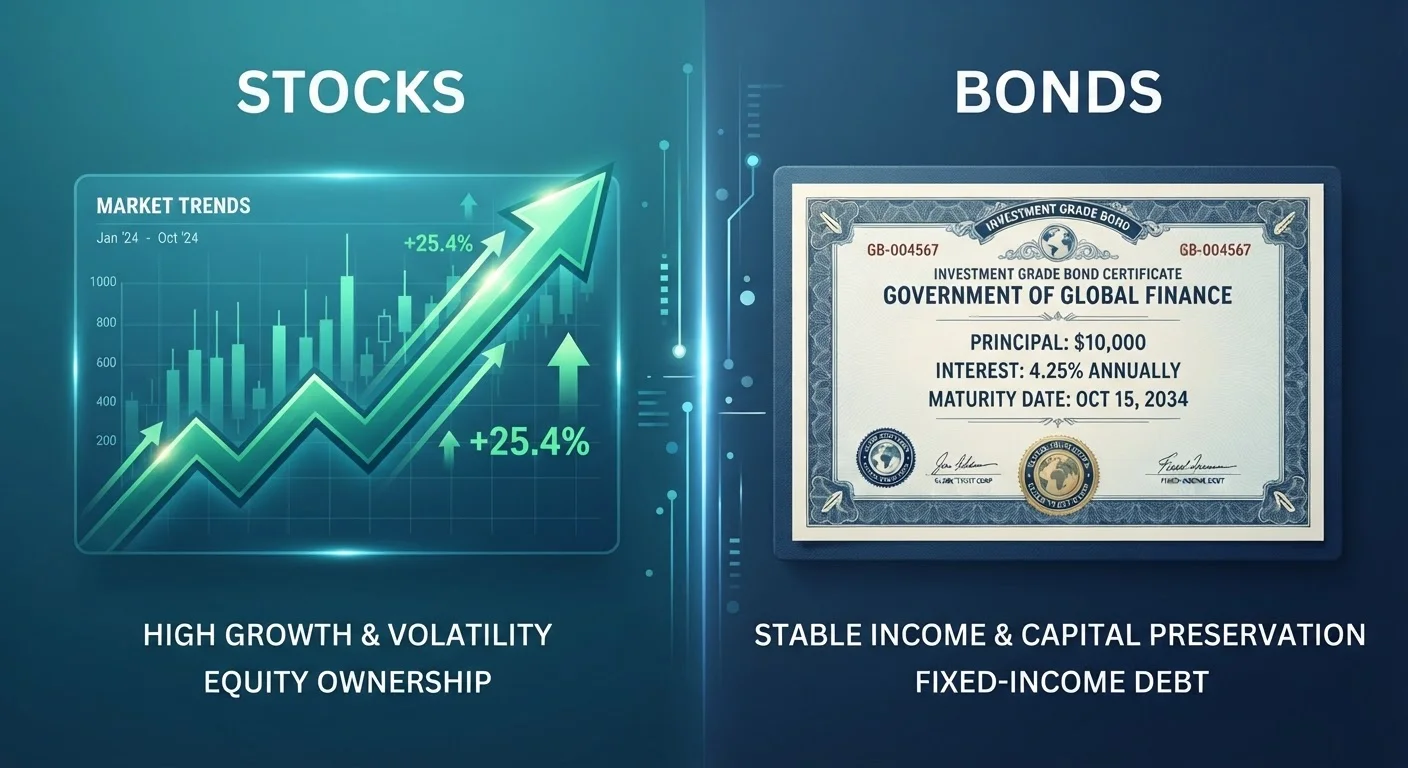
What Are Stocks and Bonds, Really?
Before you put a single dollar into any investment, it helps to understand what you're actually buying. Stocks and bonds are the two foundational building blocks of most investment portfolios - and they work in fundamentally different ways.
A stock (also called an equity) is a small ownership stake in a company. When you buy a share of stock, you become a part-owner of that business. If the company grows and becomes more profitable, your shares typically increase in value. If it struggles, your shares can fall - sometimes significantly. There are no guaranteed returns. For a deeper look at how risk and potential reward are always linked, see our explainer on risk and return.
A bond is a loan. When you buy a bond, you're lending money to a government, municipality, or corporation for a fixed period. In return, the borrower agrees to pay you regular interest (called a coupon) and return your original amount (called the principal) when the bond matures. The income is more predictable, but the growth potential is limited. Our bonds explainer walks through exactly how that process works.
The Core Trade-Off: Growth vs. Stability
The essential tension between stocks and bonds comes down to one principle: higher potential return generally requires accepting higher risk. This isn't a flaw in the system - it's the mechanism that drives it. Understanding how investing works helps clarify why this relationship is central to every financial decision you'll make.
| Criterion | Stocks | Bonds |
|---|---|---|
| What you own | Partial ownership in a company | A loan to a government or company |
| Return source | Price appreciation and dividends | Regular interest (coupon) payments |
| Return potential | Higher (historically) | Lower, but more predictable |
| Risk level | Higher - prices can fall sharply | Lower - but not risk-free |
| Income regularity | Variable; dividends not guaranteed | Fixed schedule; more reliable |
| Best time horizon | Long term (10+ years) | Short to medium term |
| Volatility | High - frequent price swings | Moderate - less dramatic swings |
Stocks have historically outpaced bonds over long periods, but that outperformance comes with volatility - meaning your account balance can swing dramatically in the short term. Bond prices also move (they generally rise when interest rates fall, and fall when rates rise), but those swings are typically smaller than stock market fluctuations.
The key insight for new investors: neither asset class is universally superior. They serve different roles depending on your goals, timeline, and risk tolerance. Many portfolios hold both, using a mix of growth and income investments to pursue multiple objectives simultaneously.
How Time Horizon Changes Everything
One of the most important factors in the stocks-versus-bonds decision isn't the investments themselves - it's when you'll need the money.
If your goal is 20 or 30 years away (like retirement), short-term market drops matter less because your portfolio has time to recover. Historically, longer time horizons have tended to smooth out stock market volatility - though past performance does not guarantee future results, and all investing involves risk of loss.
If you need the money in two or three years, a sharp market decline right before that deadline could be devastating. In that scenario, the predictability of bonds becomes genuinely valuable, even if the returns are lower.
A common teaching framework: younger investors with decades ahead often hold a larger percentage in stocks, then gradually shift toward bonds as their goal approaches. This isn't a rule - it's a principle to discuss with a qualified financial adviser, who can assess your actual situation. Think of it like adjusting your car's speed as you approach a destination: you don't brake at the start of the trip, but you do slow down as you get closer.
This article is for general educational purposes only and does not constitute personalised financial, investment, tax, or legal advice. Please consult a licensed financial adviser before making investment decisions.