
What Each Framework Actually Means
When people ask "Am I saving enough for retirement?", they usually get one of two types of answers - and those answers reflect two fundamentally different ways of thinking about financial readiness.
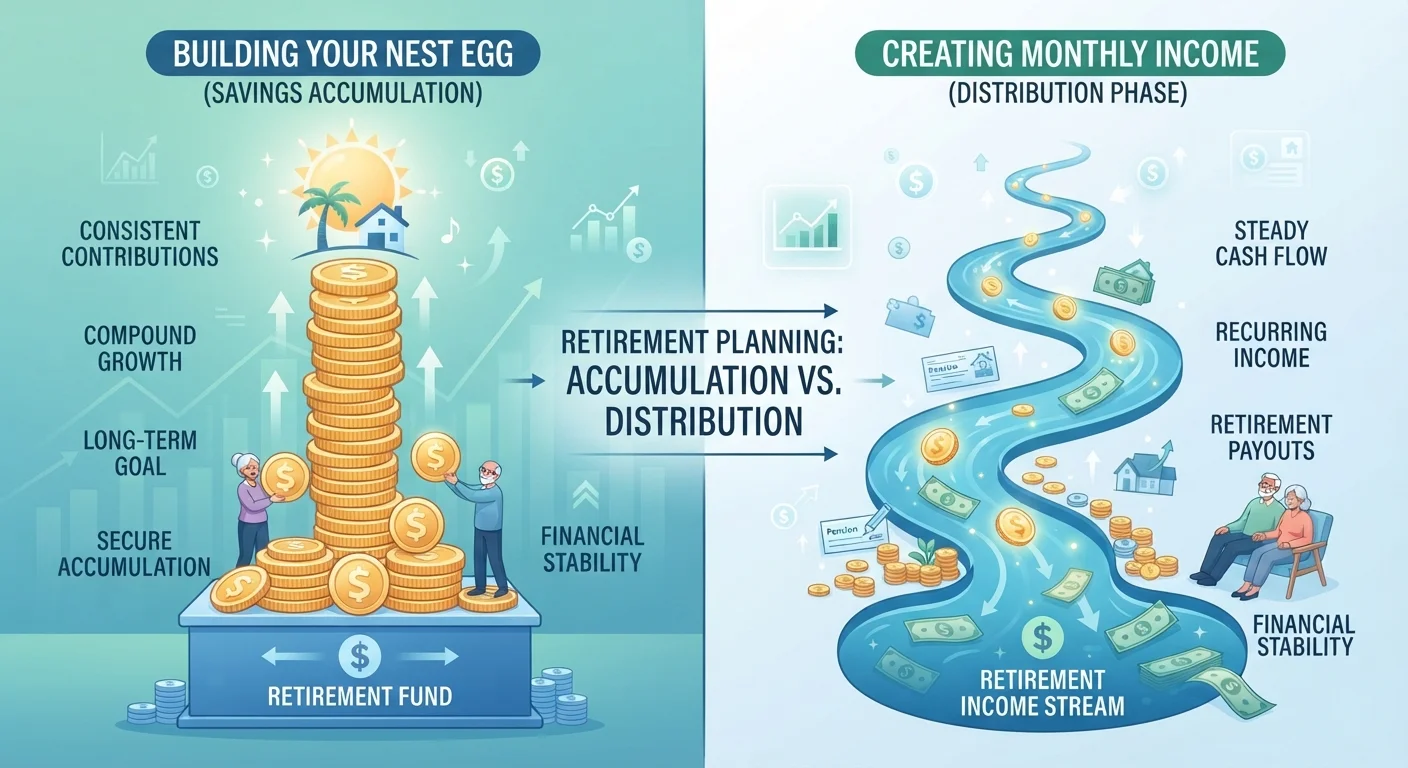
The nest egg approach frames retirement readiness as a savings accumulation target. A common rule of thumb, for example, suggests saving roughly 10 to 12 times your pre-retirement annual salary by the time you stop working. The idea is that you build a large pool of invested assets during your working years, then draw it down - typically following a withdrawal rate guideline - across your retirement. Progress is measured in dollars saved relative to your income. See age-based savings benchmarks for commonly cited reference points at different career stages.
The income floor approach reframes the question entirely. Instead of asking "How much have I saved?", it asks "How much guaranteed monthly income will I have?" The goal is to identify income sources - Social Security, a pension, or an annuity - that reliably cover your essential living costs: housing, food, healthcare, and utilities. Anything above that floor can come from discretionary savings or investments. The floor itself doesn't disappear if markets drop.
Neither framework is universally right. They measure different things and suit different planning personalities and life stages. Understanding retirement milestones across your 20s through 60s can help clarify which lens is most useful at a given moment.
How the Two Approaches Compare Side by Side
Placing these frameworks side by side reveals where each one shines - and where it has blind spots.
| Criterion | Nest Egg Approach | Income Floor Approach |
|---|---|---|
| Core question | How much have I saved in total? | How much guaranteed income will I receive monthly? |
| Key metric | Total portfolio balance vs. income multiple | Monthly guaranteed income vs. essential expenses |
| Market risk exposure | High - balance fluctuates with markets | Low for floor income; investments above floor still vary |
| Main income sources | Investment portfolio (401k, IRA, brokerage) | Social Security, pensions, annuities |
| Ease of tracking progress | Easy - visible in account dashboards | Requires projections and benefit estimates |
| Best planning phase | Early to mid-career accumulation phase | Pre-retirement and retirement distribution phase |
| Flexibility in retirement | High - can adjust spending and withdrawals | Lower for floor portion; predictable by design |
The nest egg model is intuitive for early-career savers because savings balances are easy to track in a 401(k) or IRA dashboard. Its weakness is volatility: a portfolio worth $1 million at age 64 might be worth $750,000 at age 65 after a market correction, which directly threatens your ability to fund retirement as planned.
The income floor model handles that volatility concern more gracefully - guaranteed income doesn't shrink when stock prices fall. Its challenge is that building an income floor beyond Social Security often requires deliberate financial decisions, such as delaying Social Security to increase your monthly benefit, or evaluating annuity products. These decisions carry their own complexities and trade-offs worth discussing with a licensed financial professional.
For a deeper look at how your saving method affects long-term outcomes, see lump-sum vs. monthly contribution strategies.
Using Both Frameworks Together
In practice, the most resilient retirement plans tend to draw on both ways of thinking. Here's how that can work at different life stages:
- In your 20s and 30s: Focus primarily on the nest egg framework. Set savings rate targets - whether a fixed dollar amount or a percentage of income - and automate contributions. See fixed vs. percentage-based saving targets for guidance on which method suits your situation.
- In your 40s: Start mapping your future income floor. Estimate your projected Social Security benefit (available through the Social Security Administration's online tools), and check whether your employer offers any pension or defined-benefit plan.
- In your 50s and beyond: Stress-test both frameworks together. Ask: Does my projected nest egg support my planned withdrawal rate? And separately: Does my income floor cover essential expenses even if I draw nothing from savings for a year or two?
If you're just getting started regardless of your income level, this guide to starting retirement saving walks through the foundational steps without assuming a high salary or prior investment knowledge.
Social Security Is Already Part of Your Income Floor
Many people overlook that Social Security is the foundation of an income floor strategy. The age at which you claim benefits significantly affects your monthly payment - claiming later generally increases the monthly amount. The Social Security Administration provides free online tools to estimate your projected benefit based on your earnings record. Factoring this in early makes the income floor framework much more concrete and actionable.
This article is for general informational and educational purposes only and does not constitute personalized financial, tax, or investment advice. Retirement planning involves many individual variables. Consult a qualified financial adviser or retirement planning professional before making decisions about your own circumstances.