
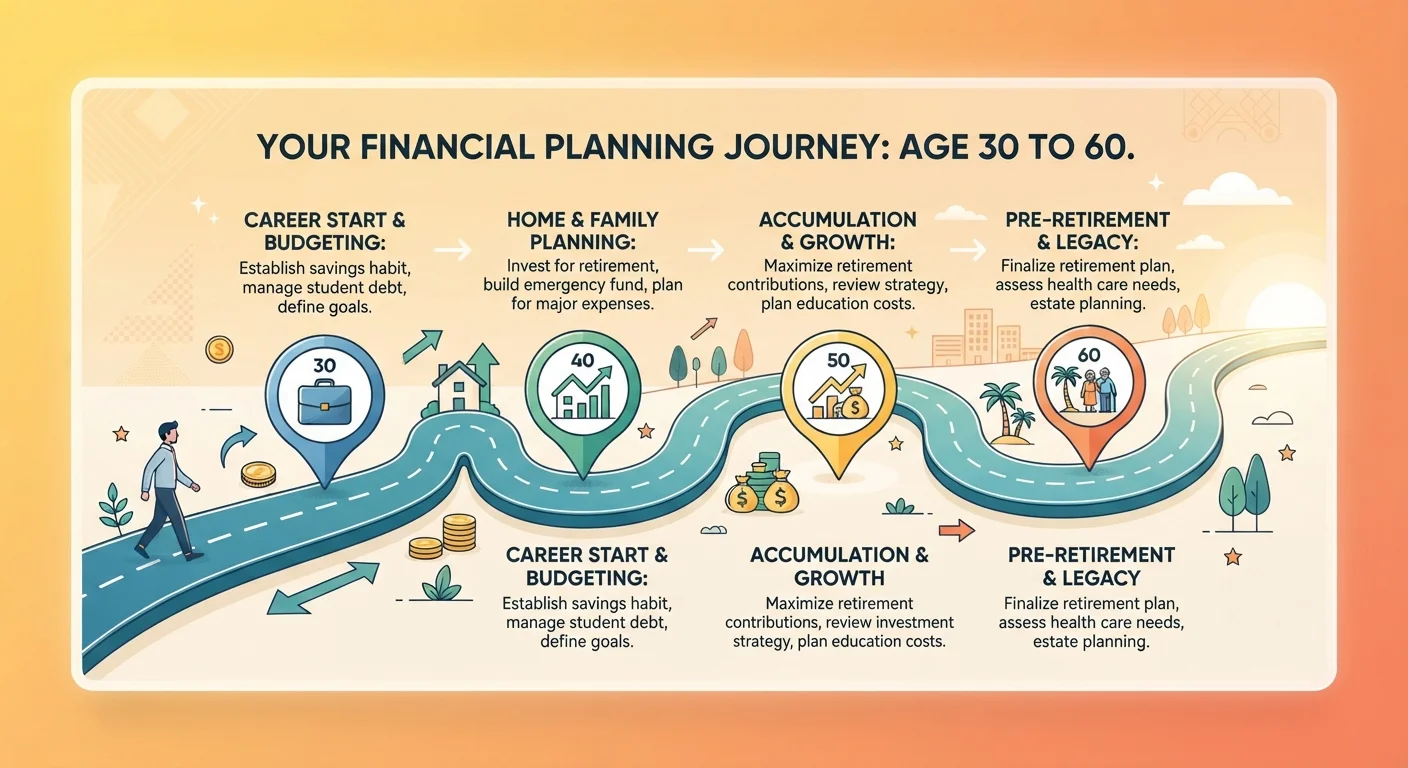
What Are Retirement Savings Benchmarks?
Retirement savings benchmarks are guideposts - commonly expressed as multiples of your annual income - that give you a rough sense of whether your nest egg is growing on pace. They are general rules of thumb, not precise formulas, and they come from widely used frameworks developed by major financial institutions and retirement researchers.
The most frequently cited benchmarks use a simple ratio: saved amount ÷ current annual gross income. For example, if you earn $60,000 a year and have $60,000 saved, your ratio is 1×. The goal is for that multiple to grow steadily as you age.
| Common benchmark at age 30 | 1× annual income saved (Widely cited retirement planning guideline) |
| Common benchmark at age 40 | 3× annual income saved (Widely cited retirement planning guideline) |
| Common benchmark at age 50 | 6× annual income saved (Widely cited retirement planning guideline) |
| Full-retirement target (age 67) | 10× annual income saved (Widely cited retirement planning guideline) |
| Age catch-up contributions begin | 50 years old (IRS eligibility rule for eligible retirement accounts) |
| Benchmark assumption: retirement age | Approximately age 67 (Standard assumption used in most benchmark frameworks) |
These benchmarks assume you plan to retire around age 67, maintain a lifestyle similar to your working years, and that your savings will be invested in a diversified portfolio across tax-advantaged accounts. Learn more about the accounts that power this growth in our retirement accounts overview.
This article is for general educational purposes only and does not constitute personalized financial, investment, or tax advice. Consult a qualified financial professional for guidance specific to your situation.
Age-by-Age Benchmark Reference
The table below summarizes commonly cited savings-to-income targets at key ages. These figures are drawn from widely referenced retirement planning frameworks and should be treated as starting points for reflection, not hard rules.
| Age | Savings Target (× Annual Income) | What It Signals |
|---|---|---|
| 30 | 1× | Foundation-building phase is on track |
| 35 | 2× | Compounding beginning to contribute meaningfully |
| 40 | 3× | Mid-career momentum is building |
| 45 | 4× | Halfway check - gaps become more visible |
| 50 | 6× | Catch-up contributions become available |
| 55 | 7× | Pre-retirement stretch - savings rate matters most |
| 60 | 8-9× | Final approach - income replacement planning begins |
| 67 | 10× | Common full-retirement target |
For a deeper look at what each decade requires strategically, see our decade-by-decade retirement checkpoint guide.
Why These Benchmarks Have Limits
A savings multiple tied to income is a useful shorthand, but it can't account for the full picture of your financial life. Several factors can shift your target meaningfully:
- Expected retirement age: Retiring at 60 instead of 67 requires a larger balance to fund more years of withdrawals.
- Social Security income: Higher lifetime earners may rely less on savings; lower earners often receive Social Security that replaces a higher share of pre-retirement income.
- Spending habits: If you live well below your income, you may need a smaller multiple. Higher spenders need more.
- Health and longevity: Longer life expectancy means more years of spending - and higher potential healthcare costs.
- Pension or other income: A defined-benefit pension reduces how much personal savings you need.
Two useful frameworks for thinking about how much is enough are explored in Nest Egg vs. Income Floor, which compares lump-sum targets against monthly income goals.
Practical Steps If You're Behind
Falling short of a benchmark at any age is common - and it is not a reason to panic. The key is understanding your options and acting on them consistently.
- Increase your contribution rate gradually. Even a 1-2% bump in 401(k) deferrals compounded over years can close a meaningful gap.
- Use tax-advantaged accounts fully. Review annual contribution limits for 401(k)s and IRAs - these are updated periodically by the IRS. Our contribution limits reference guide covers current figures.
- Take advantage of catch-up contributions at 50. Once you turn 50, you can contribute additional amounts beyond standard annual limits to eligible accounts. See what the age-50 catch-up actually allows for specifics.
- Reduce high-interest debt. Carrying expensive debt limits how much you can direct toward savings each month.
- Review your investment allocation. At younger ages, a more growth-oriented mix is typical; as retirement nears, many investors gradually shift toward more stability. Discuss appropriate allocation with a qualified adviser.
For broader strategies that hold up across career stages, explore saving strategies across every decade.
Savings-to-income ratio
The amount you have saved for retirement divided by your current annual gross income. A ratio of 3× means you have saved three times your yearly earnings.
Catch-up contribution
An additional amount workers aged 50 and older are permitted to contribute to eligible retirement accounts, above the standard annual limit set by the IRS.
Tax-advantaged account
A retirement savings account - such as a 401(k) or IRA - that offers tax benefits, either deferring taxes until withdrawal (traditional) or allowing tax-free growth (Roth).
Income replacement rate
The percentage of your pre-retirement income that your retirement savings and other income sources (like Social Security) are expected to cover during retirement.
Defined-benefit pension
An employer-sponsored retirement plan that promises a specific monthly payment in retirement, typically based on years of service and final salary, rather than depending on investment returns.
Compound growth
The process by which investment returns are reinvested to generate their own returns over time, meaning even modest savings can grow substantially given a long enough time horizon.