
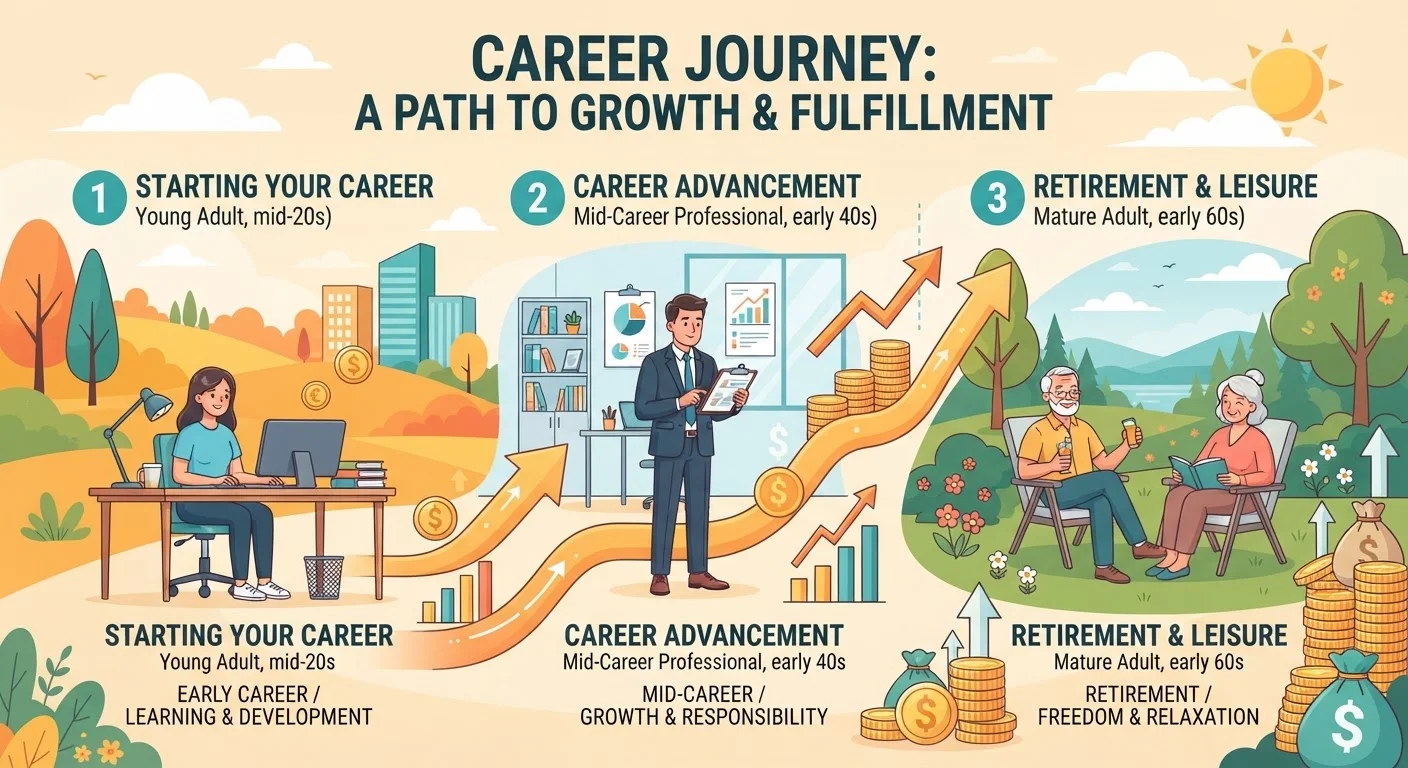
Why One-Size Saving Advice Fails Most People
Generic retirement advice - "save 15% of your income" - sounds simple until life gets complicated. A 24-year-old earning $32,000 a year and a 48-year-old earning $95,000 share the same ultimate goal but face completely different constraints, tax situations, and time horizons. Treating them identically sets both up to feel like they're failing.
The good news: effective retirement saving is less about hitting a magic number right now and more about applying the right strategy for your current decade. As your income, obligations, and timeline shift, your approach should shift with them. See how these shifts connect to broader retirement milestones that apply at every age.
If your employer offers a 401(k) match, treat capturing that match as your very first financial priority - even before paying down low-interest debt. It's an immediate, guaranteed return on your contribution.
An employer match of 50 cents per dollar up to 6% of salary effectively represents a 50% return on that portion of savings before any market growth - a benefit no investment can reliably replicate.
When you get a raise, increase your retirement contribution the same month - before the extra money settles into your regular spending pattern. Even a 1% bump compounds meaningfully over decades.
Behavioral research consistently shows that people adapt quickly to new income levels. Redirecting a raise before it's absorbed into lifestyle spending is one of the highest-leverage habits a saver can build.
Your 20s: Build the Habit Before the Balance
In your 20s, time is your most valuable financial asset - more valuable than the actual dollar amount you save. Thanks to compound growth (earning returns on your returns over time), even modest contributions made early can grow substantially over a 40-year horizon. This is not a guarantee of specific returns, but it is how the math of long-term investing generally works.
Priority actions in your 20s:
- Enroll in your employer's 401(k) - at minimum, contribute enough to capture any employer match. Leaving a match on the table is forgoing part of your compensation.
- Open a Roth IRA if your income qualifies. Contributions are made with after-tax dollars, and qualified withdrawals in retirement are tax-free - a meaningful advantage when you're likely in a lower tax bracket now than you will be later.
- Automate contributions so saving happens before you spend. Even $50 per paycheck builds a lasting habit.
Don't let "I can't afford much" stop you entirely. For a deeper look at the tradeoffs of pushing hard early, see what aggressive saving does and doesn't deliver.
Your 30s and 40s: Accelerate Without Overextending
These decades often bring higher income alongside higher expenses - mortgages, childcare, student loans. The temptation is to postpone saving until things settle down. They rarely do. Instead, the goal is to direct income growth toward retirement before lifestyle inflation absorbs it.
Key moves in your 30s and 40s:
- Increase contributions with every raise. Routing even half of each pay increase into your 401(k) or IRA is a sustainable way to accelerate without feeling deprived.
- Review your investment allocation. With 20 to 30 years until retirement, many people can afford to hold a meaningful portion of their portfolio in growth-oriented assets, though all investing carries risk and past performance does not guarantee future results. Consult a licensed financial adviser about what allocation fits your situation.
- Maximize tax-advantaged accounts. For 2024, the 401(k) employee contribution limit is $23,000, and the IRA limit is $7,000. Contributing as close to these limits as your budget allows reduces your taxable income now (traditional accounts) or protects future withdrawals from tax (Roth accounts).
For structured checkpoints to benchmark your progress, decade-by-decade checkpoints offer a useful reference.
Your 50s and 60s: Shift From Accumulation to Protection
Once you cross 50, the IRS grants catch-up contributions - an additional $7,500 per year on top of the standard 401(k) limit (as of 2024), and an extra $1,000 for IRAs. If you've saved less than you'd like, these provisions offer a meaningful way to close the gap in the final stretch.
This decade also calls for a gradual mindset shift: from growing your savings to protecting and organizing them.
- Model your Social Security benefit. The age at which you claim - anywhere from 62 to 70 - significantly affects your monthly benefit. Delaying even two years can shift your outlook significantly.
- Review account beneficiaries and estate documents. These details matter and are easy to overlook during accumulation years.
- Develop a withdrawal strategy. Understanding which accounts to draw from first - and in what order - can meaningfully affect how long your savings last and what you owe in taxes. A fee-only financial planner can help you map this out.
Principles That Work at Every Age
Regardless of your decade, a handful of practices consistently support long-term saving success:
- Automate everything you can.
- Contributions that happen automatically don't require willpower. Set them and revisit annually.
- Avoid early withdrawals.
- Withdrawing from a 401(k) or IRA before age 59½ typically triggers income taxes plus a 10% penalty. Exceptions exist, but this should be a last resort.
- Revisit your plan when life changes.
- A new job, marriage, or income disruption all warrant a fresh look. See how to adapt your plan when life shifts.
- Track against benchmarks - loosely.
- Common rules of thumb suggest having roughly one times your salary saved by 30, three times by 40, and six times by 50. These are guides, not mandates. Savings benchmarks by age can provide helpful context without causing undue alarm.
Making It Work on Any Income
Lower incomes don't disqualify anyone from saving for retirement - they simply call for more creativity. The Saver's Credit (formally the Retirement Savings Contributions Credit) allows eligible lower-income earners to claim a tax credit of 10% to 50% of contributions up to $2,000 ($4,000 for married couples filing jointly), depending on income and filing status. This directly reduces what you owe in taxes, making every dollar saved worth more.
Even $25 per paycheck is a start. The habit and the account matter as much as the amount early on. For practical guidance on building contribution habits that stick, retirement account habits that support long-term saving covers evidence-informed approaches at any income level.
The most important step is always the next one - whether that's enrolling in a 401(k) for the first time, increasing a contribution by 1%, or finally opening an IRA you've been putting off.
This article is for general informational and educational purposes only. It does not constitute personalized financial, tax, investment, or legal advice. Tax rules and contribution limits are subject to change; verify current figures with the IRS or a qualified professional. Please consult a licensed financial adviser, tax professional, or attorney before making decisions specific to your own circumstances.