
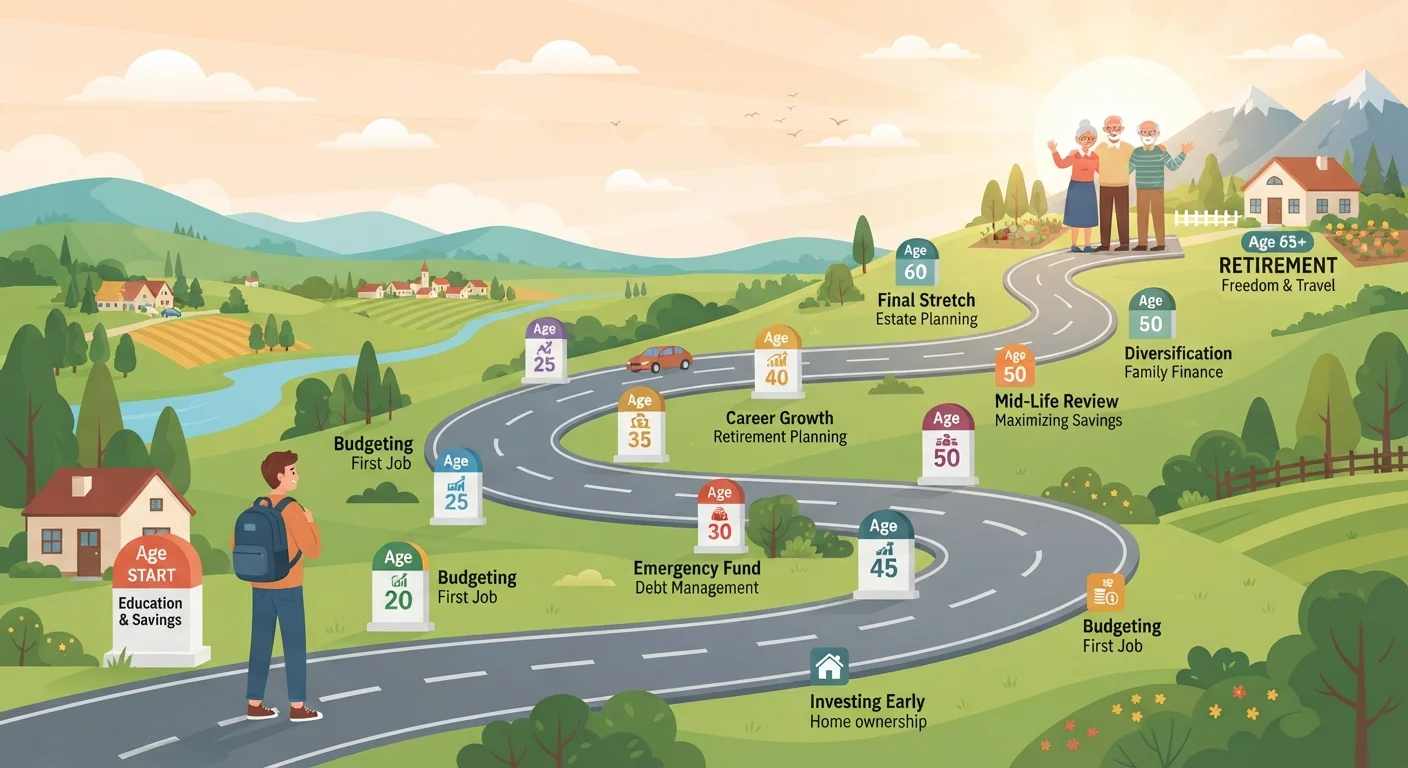
Why Retirement Milestones Matter
Retirement can feel impossibly distant when you're just starting your career. But the choices you make in your first years of work - how much you save, which accounts you open, whether you capture your employer's match - set a trajectory that's difficult to reverse later.
Think of retirement milestones as checkpoints on a long road trip. Miss one and you're not necessarily lost, but you may need extra effort to get back on course. Understanding each checkpoint in advance means you can plan proactively rather than scramble reactively.
This guide walks you through the critical moments - by age and by life stage - that shape whether you arrive at retirement financially prepared. For a detailed breakdown of specific benchmarks, see Retirement Milestones Explained. The accounts that power these milestones are covered in our Retirement Accounts hub.
This article is general financial education, not personalized advice. For guidance specific to your situation, consult a qualified financial adviser or tax professional.
Your 20s: Starting the Clock
The single most powerful retirement action available in your 20s is simply starting. Time is the fuel that makes compound growth work - and every year you delay is a year that fuel goes unburned. See how compounding interacts with retirement milestones for a deeper look at why early contributions carry outsized weight.
First job: Enroll in your employer's 401(k)
If your employer offers a 401(k) - a tax-advantaged workplace retirement account - enroll as soon as you're eligible. At minimum, contribute enough to capture any employer match. A match is essentially additional compensation; not taking it means leaving part of your pay on the table.
Open a Roth IRA if you qualify
A Roth IRA allows after-tax contributions that grow tax-free, and qualified withdrawals in retirement are also tax-free. Income limits apply, so check current IRS guidelines. Contributing even small amounts consistently in your 20s can result in significant balances decades later - past performance in any market cannot guarantee future results, but the math of compounding over 40-plus years is well established.
A general benchmark many financial planners reference: aim to save the equivalent of your annual salary by age 30. This is a guideline, not a guarantee of any specific outcome.
Increase your 401(k) contribution rate by 1% every time you get a raise. Because the increase is small and your take-home pay is already going up, you're unlikely to notice the difference in your budget.
Behavioral finance research consistently shows that automatic, incremental increases have a dramatic long-term impact on retirement balances because they reduce the psychological friction of saving more.
Before your 60th birthday, request a Social Security Statement at SSA.gov to see your projected benefit at different claiming ages - this lets you factor it into your broader retirement income plan years in advance.
Social Security can represent a substantial portion of retirement income for many Americans, and claiming decisions are largely irreversible, making early awareness essential for informed planning.
Your 30s: Building Momentum
Your 30s often bring higher income alongside competing financial demands: mortgages, family expenses, student loans. The key is maintaining retirement contributions even as other priorities grow.
Savings benchmark
A commonly cited rule of thumb is to have roughly three times your annual salary saved by age 40. This is a rough target - individual circumstances vary widely - but it offers a useful gut-check.
Review your investment allocation
Most workplace plans offer a range of investment options. In your 30s, you generally have a long enough time horizon to weather market volatility, which is why many financial professionals suggest a higher allocation toward stocks relative to bonds at this stage. However, every person's risk tolerance is different. For practical saving strategies that support milestone progress, visit our Saving Strategies hub.
Don't overlook the milestones that are easy to miss. Some of the most consequential checkpoints are quiet ones - like not increasing your contribution rate after a raise.
Your 40s and 50s: Accelerating Toward the Finish
These decades are when retirement shifts from abstract to concrete. You can see it on the horizon. Your strategy should shift from simply contributing to optimizing.
Age 50: Catch-up contributions begin
The IRS allows workers aged 50 and older to contribute additional amounts to 401(k)s and IRAs beyond the standard annual limits. For 2024, the 401(k) catch-up contribution was $7,500 on top of the $23,000 standard limit. IRA catch-up was an extra $1,000 above the $7,000 standard limit. Always verify current limits at IRS.gov, as they adjust periodically.
Benchmarks for your 50s
Common planning benchmarks suggest having six to eight times your annual salary saved by your late 50s. Gaps at this stage are not insurmountable but do require deliberate action - whether that means increasing contributions, adjusting expected retirement age, or planning to reduce expenses in retirement.
For a structured view of what each decade demands, see Mapping Your Retirement Journey: Decade-by-Decade Checkpoints.
Key Age-Based Rules You Should Know
Beyond savings targets, specific ages trigger important legal and tax rules that affect your retirement accounts.
| Age | Milestone |
|---|---|
| 50 | Catch-up contributions allowed for 401(k) and IRA |
| 59½ | Penalty-free withdrawals from most retirement accounts begin |
| 62 | Earliest age to claim Social Security (reduced benefit) |
| 65 | Medicare eligibility begins |
| 67 | Full Social Security retirement age for those born 1960 or later |
| 70 | Maximum Social Security benefit if delayed; also when delayed credits stop accruing |
| 73 | Required Minimum Distributions (RMDs) begin for most retirement accounts |
Each of these rules has nuances - a tax professional or financial adviser can help you understand how they interact with your specific accounts and income.
RMD Rules Have Changed - Stay Current
The SECURE 2.0 Act, signed in 2022, pushed the Required Minimum Distribution starting age from 72 to 73, with a further change to age 75 scheduled for 2033. Roth IRAs held in your own name are not subject to RMDs during your lifetime under current law, though inherited Roth IRAs follow different rules. Tax law changes frequently, so verify current rules at IRS.gov or with a tax professional.
From Final Paycheck to Retirement Income
The transition from earning to drawing down savings is one of the most complex financial shifts you'll make. Two decisions carry especially high stakes.
When to claim Social Security
You can claim Social Security as early as age 62, but doing so permanently reduces your monthly benefit - by as much as 30% compared to waiting until your full retirement age. Delaying beyond full retirement age increases your benefit by roughly 8% per year until age 70. The right claiming age depends on your health, other income sources, and personal circumstances. A financial adviser can model different scenarios.
Building a sustainable withdrawal strategy
One widely discussed guideline - sometimes called the 4% rule - suggests withdrawing roughly 4% of your portfolio in the first year of retirement, then adjusting for inflation annually. This is a starting-point framework, not a guarantee. Actual sustainability depends on market conditions, your spending, and how long you live. Sequence of returns risk - the danger of large portfolio losses early in retirement - is a real concern worth discussing with a professional.
For a practical checklist of actions to take in the years leading up to retirement, see Your Retirement Readiness Checklist for Each Decade of Your Life.
This article is for general informational and educational purposes only. It is not personalized financial, tax, or legal advice. Consult a licensed financial adviser, accountant, or attorney before making decisions about your own retirement planning.