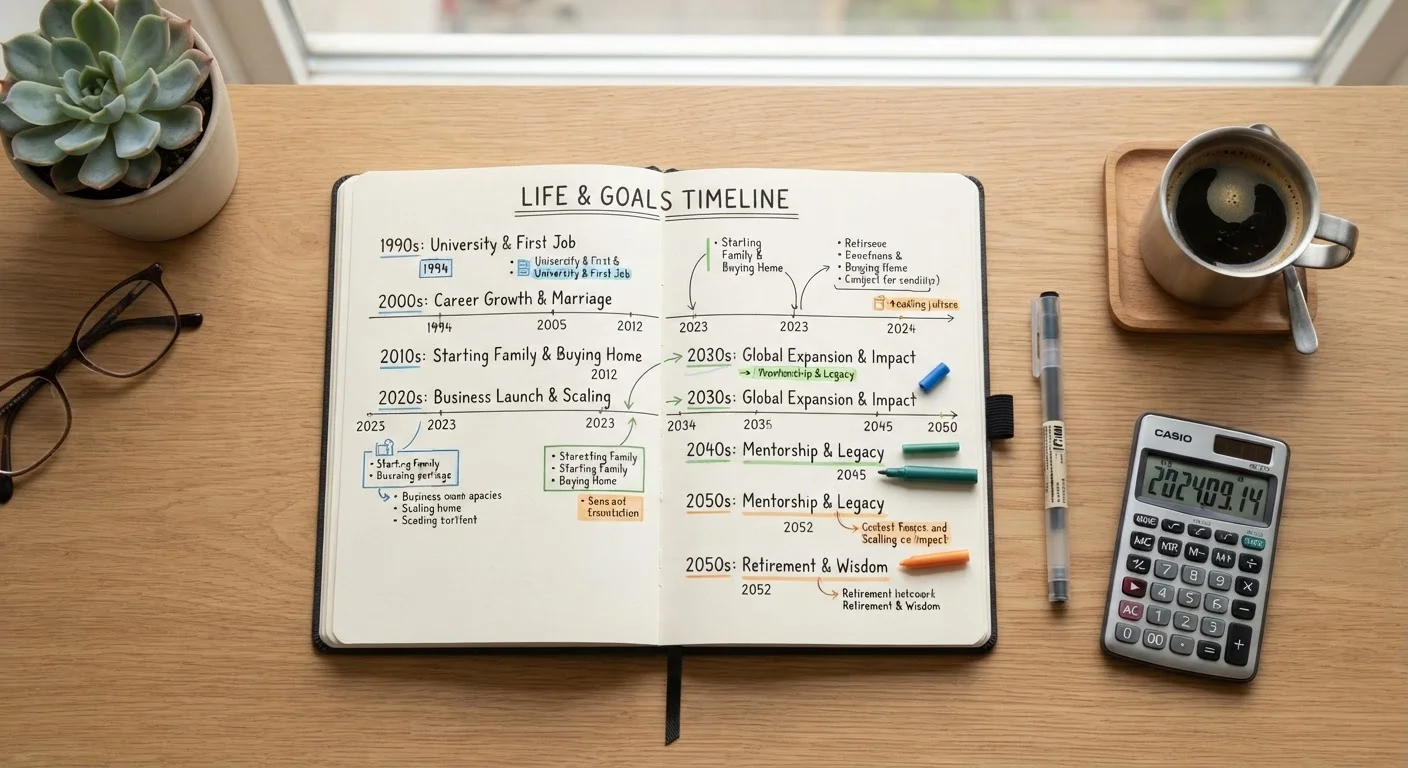
Starting retirement contributions in your 20s, even small ones, produces outsized long-term results due to compounding.
Each decade brings specific financial tasks - missing them creates gaps that become harder to close later.
Tax-advantaged accounts like 401(k)s and IRAs are foundational tools at every stage of your career.
Catch-up contributions become available at age 50 and can meaningfully accelerate late-stage saving.
A qualified financial adviser can help tailor these general steps to your personal situation.
A practical, decade-by-decade checklist of the financial and planning actions that move you closer to a stable retirement.
Why a Decade-by-Decade Approach Works
Retirement can feel like a problem for future you - until suddenly it isn't. The most reliable way to arrive at retirement with financial stability is to treat each decade of your working life as a distinct planning phase with its own concrete goals.
This checklist walks through the key actions for your 20s, 30s, 40s, and 50s, plus the final stretch in your 60s. Think of it as a self-audit: check off what you've already done and identify the gaps worth addressing next. For a deeper look at the ages and savings targets that mark real progress, see our retirement milestones guide.
These steps are general financial education, not personalized advice. Your situation is unique - always consult a licensed financial professional before making major decisions.
Your 20s - Build the Foundation
Enroll in your employer's 401(k) plan and contribute at least enough to capture any employer match offered.Must
Open a Roth IRA if you qualify based on your income, and contribute regularly - even small amounts benefit from decades of potential compounding.Must
Build a starter emergency fund of three to six months of essential expenses so unexpected costs don't force you to raid retirement accounts.Must
Create a simple budget that explicitly carves out a retirement saving line item each month.Should
Learn the basic difference between traditional (pre-tax) and Roth (after-tax) retirement accounts so you can choose what fits your current tax situation.Should
Your 30s - Build Momentum
Increase your retirement contribution rate whenever your income rises, targeting at least 10-15% of gross income over time.Must
Review and update beneficiary designations on all retirement accounts after major life events such as marriage, divorce, or the birth of a child.Must
Roll over any old 401(k) accounts from previous employers into your current plan or an IRA to keep investments consolidated and manageable.Should
Review your investment allocation inside retirement accounts and rebalance if your mix has drifted significantly from your target.Should
Begin a basic estate plan - at minimum, a will and durable power of attorney.Nice to have
Your 40s - Accelerate and Protect
Maximize annual contributions to your 401(k) and IRA if your income and budget allow, taking full advantage of the IRS annual limits.Must
Run a retirement income projection - many employer plan portals include free calculators - to estimate whether your current path meets your target.Must
Evaluate whether your investment allocation still reflects your time horizon; many people gradually shift toward a more balanced mix as retirement draws closer.Should
Address high-interest debt aggressively, as carrying it into retirement significantly reduces financial flexibility.Should
Explore whether a Health Savings Account (HSA) is available to you - it offers triple tax advantages and can help cover healthcare costs in retirement.Nice to have
Your 50s - Use Every Catch-Up Tool Available
Begin making catch-up contributions to your 401(k) and IRA once you turn 50 - the IRS allows additional annual contributions beyond standard limits.Must
Request a Social Security statement from the SSA to review your projected benefit amounts at different claiming ages.Must
Create a written retirement income plan that maps out expected sources - Social Security, retirement accounts, any pension - against estimated expenses.Must
Consider meeting with a fee-only financial planner to stress-test your retirement plan and identify blind spots.Should
Your 60s - Transition and Finalize
Decide on your Social Security claiming strategy - claiming earlier reduces monthly benefits, while delaying past full retirement age increases them.Must
Understand Required Minimum Distributions (RMDs): traditional 401(k)s and IRAs generally require withdrawals beginning at age 73 under current rules.Must
Plan for healthcare coverage between retirement and Medicare eligibility at age 65 if you intend to retire before that age.Must
Review and update your estate plan, including beneficiaries, will, and any trust arrangements.Should
Tools That Support Your Planning at Every Stage
Working through this checklist is easier when you have the right resources in place. None of these require significant upfront cost - most are free or available through your employer.
Required
Employer 401(k) Portal
Manage contributions, review investment options, and track your balance - typically provided free by your employer's plan administrator.
Required
IRA Account (Traditional or Roth)
A tax-advantaged individual retirement account you open independently to supplement workplace savings.
Required
Social Security Statement (SSA.gov)
Review your projected Social Security benefit at various claiming ages, based on your actual earnings history.
Optional
Retirement Income Calculator
Estimate how long your savings may last in retirement given different withdrawal rates and return assumptions.
Optional
Health Savings Account (HSA)
A triple-tax-advantaged account for those enrolled in a qualifying high-deductible health plan, useful for funding retirement healthcare costs.
Optional
Fee-Only Financial Planner
A licensed professional who charges a flat or hourly fee (not commissions) to review your full financial picture and retirement plan.
Once you've identified your tools, run through this checklist annually alongside a broader financial self-audit. Our annual retirement saving health check is a practical companion to revisit every year. And if you want to understand how saving strategies should shift as your income and responsibilities evolve, explore saving strategies across every decade for a complementary perspective.
This article is for general informational and educational purposes only. It does not constitute personalized financial, tax, investment, or legal advice. Contribution limits, tax rules, and program details are subject to change. Consult a qualified financial adviser, tax professional, or attorney regarding decisions specific to your circumstances.
The content on this site is for informational purposes only and is not a substitute for professional advice. Always consult a qualified professional for guidance specific to your situation.