
The Core Difference: When You Pay Taxes
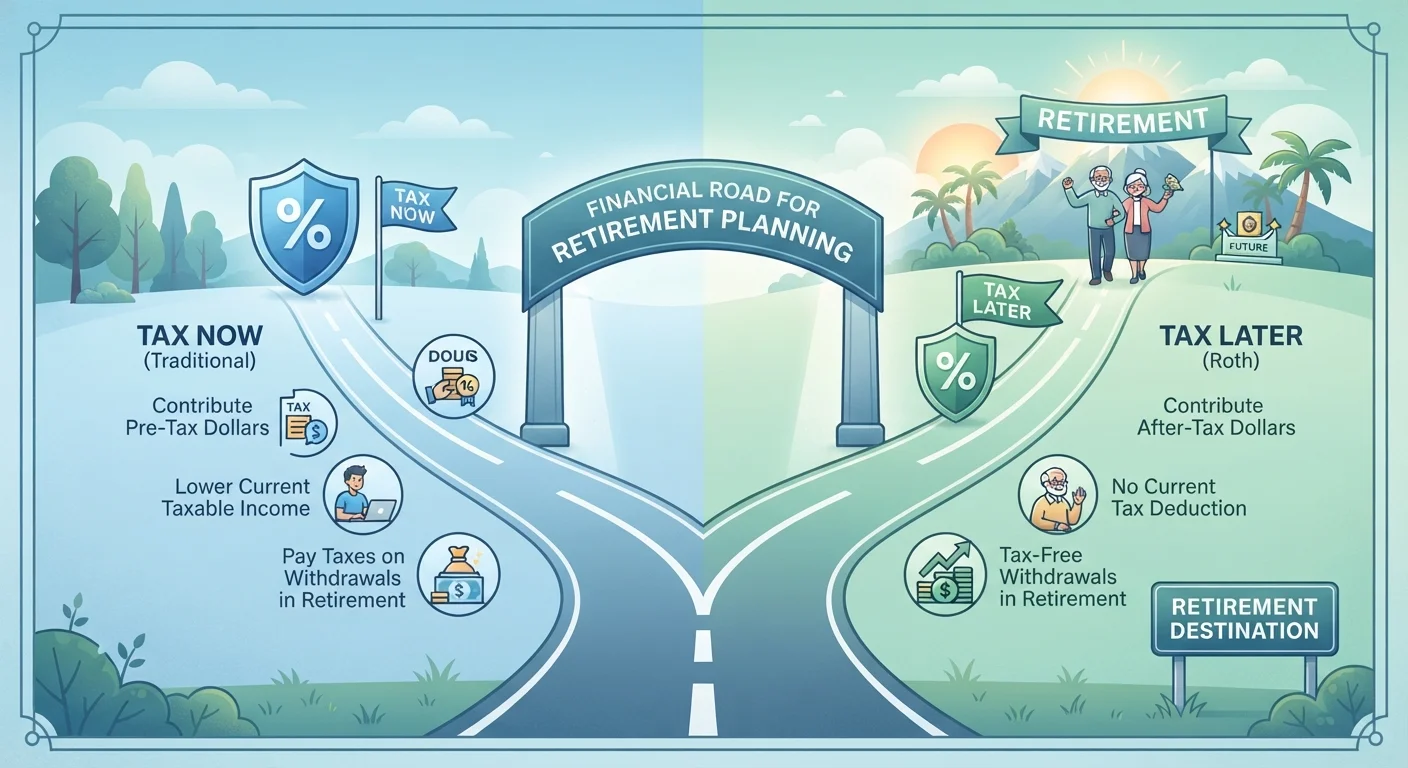
Every retirement contribution eventually meets the IRS - the question is when. Traditional pre-tax contributions let you skip taxes now and pay later. Roth contributions flip that: you pay taxes now and skip them in retirement.
Traditional (pre-tax): Money goes into your account before income tax is applied. This lowers your taxable income for the current year, giving you an immediate tax benefit. When you make withdrawals in retirement, the full amount - contributions and growth - is taxed as ordinary income.
Roth (after-tax): You contribute money you've already paid income tax on. There is no upfront tax deduction. In return, qualified withdrawals in retirement - including all investment growth - are completely tax-free under current IRS rules.
For a deeper look at how these account structures work, see Retirement Accounts Explained.
How to Think About Your Tax Bracket
The most useful question to ask yourself is: Will I pay a higher tax rate now, or in retirement? This guides nearly every Roth vs. traditional decision.
- If your tax rate is lower now than you expect in retirement - paying taxes today (Roth) locks in the cheaper rate. Every dollar of future growth is then yours tax-free.
- If your tax rate is higher now than you expect in retirement - deferring taxes (traditional) makes sense. You save more on taxes today and pay less when you withdraw at a presumably lower rate later.
- If you're unsure - contributing to both types hedges against uncertainty. You'll have taxable and tax-free income sources available in retirement, giving you flexibility.
| Feature | Traditional (Pre-Tax) | Roth (After-Tax) | |
|---|---|---|---|
| Tax treatment on contributions | Feature | Deducted from taxable income now | No deduction; paid with after-tax dollars |
| Tax treatment on withdrawals | Tax treatment on withdrawals | Taxed as ordinary income | Qualified withdrawals are tax-free |
| Best if your tax rate is... | Best if your tax rate is... | Higher now than in retirement | Lower now than in retirement |
| Required Minimum Distributions | Required Minimum Distributions | Yes, starting at age 73 | No RMDs for Roth IRA; Roth 401(k) has RMDs |
| Income limits | Income limits | None to contribute; deductibility may vary | Roth IRA phases out at higher incomes |
| Flexibility in retirement | Flexibility in retirement | Withdrawals increase taxable income | Tax-free income adds planning flexibility |
Nobody knows exactly what future tax rates will look like - a licensed tax professional can help you model scenarios based on your actual income and goals.
Contribution Limits and Eligibility
Both Roth and traditional contributions share the same annual IRS limits. For 2024, the combined limit across all 401(k) accounts is $23,000 (with a $7,500 catch-up allowed if you're 50 or older). For IRAs, the combined limit is $7,000 ($8,000 if 50 or older).
One important distinction: Roth IRAs have income eligibility limits. Above certain income thresholds, your ability to contribute directly to a Roth IRA phases out. Traditional IRAs do not have income limits for contributing, though the deductibility of those contributions may be restricted depending on whether you have access to a workplace plan.
For a full breakdown of Roth IRA rules, see Roth IRA Fundamentals. For a side-by-side IRA comparison, visit Traditional IRA vs. Roth IRA.
Withdrawals, Required Distributions, and Flexibility
The tax treatment at withdrawal is where the two approaches feel most different in practice.
With traditional accounts, the IRS requires you to start taking withdrawals - called Required Minimum Distributions (RMDs) - beginning at age 73. These withdrawals are taxed as income and can push retirees into higher tax brackets if not planned carefully.
With Roth IRAs, there are no RMDs during your lifetime, meaning money can continue to grow tax-free as long as you wish. This makes Roth accounts particularly useful for estate planning. Roth 401(k)s, however, are subject to RMDs - though this can often be avoided by rolling over to a Roth IRA before distributions begin.
If your employer offers both options in a workplace plan, Roth 401(k) vs. Traditional 401(k) explains the trade-offs in detail. Explore broader account options at the Retirement Accounts hub.
This article provides general financial education and is not personalized tax or investment advice. Please consult a qualified financial advisor or tax professional for guidance tailored to your circumstances.