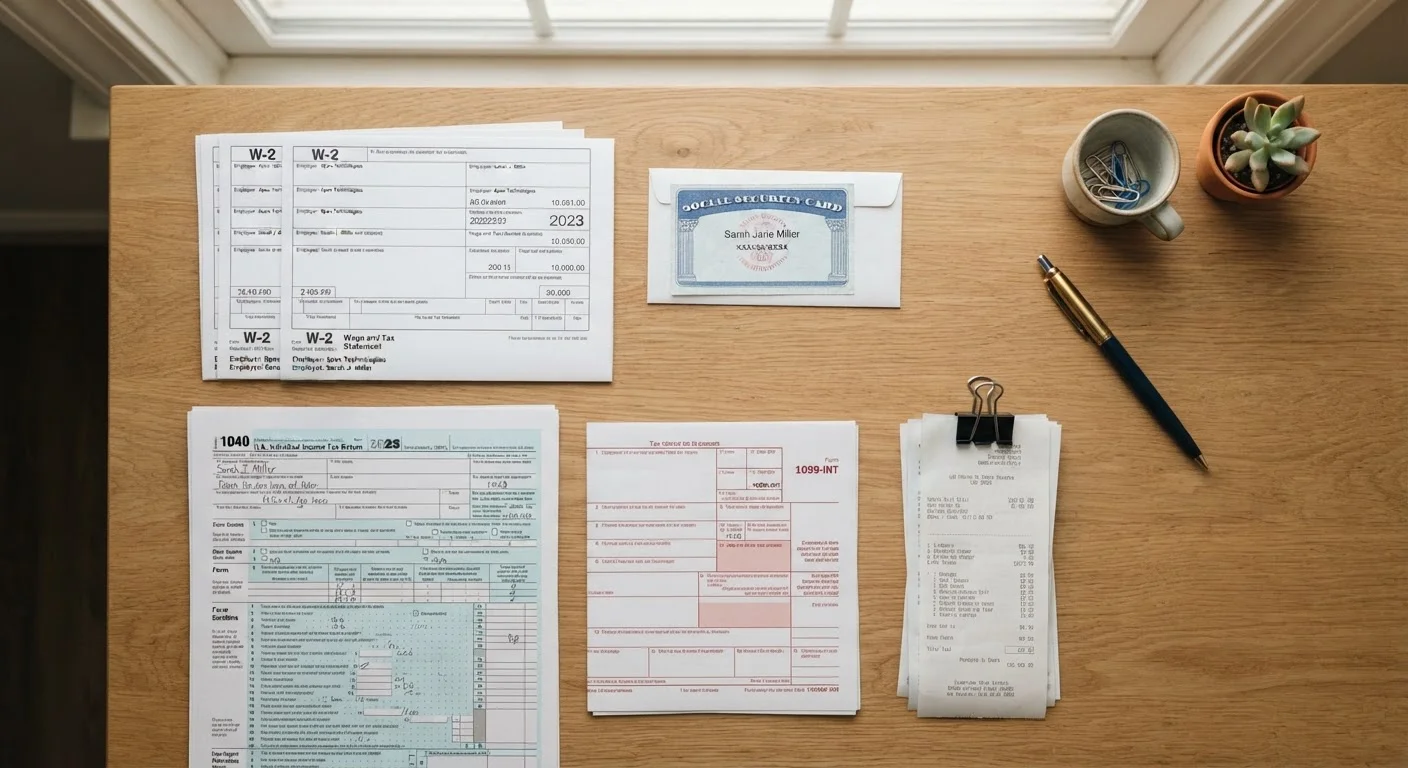
Gathering documents before opening your return prevents delays and avoidable errors.
Your W-2 or 1099 forms are the foundation of almost every tax return.
You need your Social Security Number - and those of any dependents - to file.
Bank account details are required if you want your refund deposited directly.
Deduction records only matter if you plan to itemize instead of taking the standard deduction.
Most documents arrive by mail or email by late January or mid-February each year.
A clear reference list of the forms, records, and numbers you should have on hand before starting your tax return — so nothing slows you down.
Why Preparation Matters Before You Start
Opening a tax return without your documents in front of you is one of the most common beginner mistakes. You may enter a wrong number, skip an income source you forgot about, or have to abandon a half-finished return and start over. None of that is enjoyable - and some errors can trigger IRS notices or delay your refund by weeks.
This checklist is designed to be your pre-flight check. Work through it before you open any tax software or fill in a single box. If you're filing for the very first time, you may also want to review our guide to common tax forms so you know what each document is reporting before you begin.
Not every item on this list will apply to you. Skim the categories, identify what's relevant to your situation, and gather only what you need. The goal is to sit down, open your return, and move through it without interruption.
Personal Identification
Locate your Social Security Number (SSN) or Individual Taxpayer Identification Number (ITIN) - you'll enter this on the first page of your return.Must
Gather the SSN or ITIN for your spouse if you're filing jointly.Must
Note the SSN, ITIN, and date of birth for each dependent you plan to claim.Must
Have your prior-year adjusted gross income (AGI) ready if you're e-filing - tax software uses it to verify your identity with the IRS.Must
Income Documents
Collect all W-2 forms from every employer you worked for during the tax year. Our W-2 box-by-box guide explains what each section means.Must
Gather any 1099-NEC or 1099-MISC forms if you did freelance, contract, or gig work.Must
Locate 1099-INT forms reporting interest income from bank accounts, and 1099-DIV forms reporting dividends from investments.Must
Find your 1099-B if you sold stocks, mutual funds, or other investments during the year.Must
Note any 1099-G form if you received unemployment compensation or a state tax refund.Must
If you received Social Security benefits, locate your SSA-1099.Must
Record any other income sources not covered by the above - such as rental income, alimony received (for pre-2019 agreements), or gambling winnings.Should
Deduction and Credit Records
Decide whether you'll take the standard deduction or itemize - most first-time filers use the standard deduction, so itemized records may not be needed.Must
If itemizing, gather mortgage interest statements (Form 1098), property tax records, and receipts for significant charitable donations.Should
Locate Form 1098-E if you paid student loan interest - this may be deductible even if you take the standard deduction.Should
Collect records for education expenses if you're claiming the American Opportunity Credit or Lifetime Learning Credit (Form 1098-T from your school).Should
Note any childcare costs and your provider's name, address, and tax ID if claiming the Child and Dependent Care Credit.Should
Gather Health Savings Account (HSA) contribution records if applicable (Form 5498-SA or account statements).Nice to have
Banking and Filing Details
Write down your bank's routing number and your account number if you want your refund deposited directly - this is the fastest refund method.Should
Keep last year's tax return nearby as a reference for AGI, carryover amounts, and how your information was reported previously.Should
Note any estimated tax payments you made during the year (Form 1040-ES payment records), which reduce your balance owed.Must
Locate any IRS correspondence from the past year - letters about credits, identity verification, or prior-year adjustments may affect your current return.Nice to have
What to Do If a Document Is Missing
Employers are required by law to send W-2 forms to employees by January 31 each year. Financial institutions typically send 1099 forms by mid-February. If a deadline has passed and you haven't received a form you expected, take these steps in order:
Check your email and online accounts. Many employers and brokerages deliver documents electronically through employee portals or account dashboards.
Contact the issuer directly. Your employer's payroll department or your bank's customer service line can reissue or resend a missing form.
Use IRS Form 4852 as a last resort. If a W-2 is truly unattainable, Form 4852 lets you substitute your own wage estimate based on your final pay stub. The IRS allows this, but it should be a last resort rather than a first move.
Don't Estimate Income You Have a Form For
If you received a W-2 or 1099 for income, the IRS already has a copy of that same document from the issuer. Entering a different number - even accidentally - can trigger an IRS notice or delay your refund. Always copy figures directly from your official forms rather than from memory or pay stubs.
This article provides general tax information for educational purposes only and does not constitute personalized tax, legal, or financial advice. Tax rules can change, and individual circumstances vary. Consult a qualified tax professional for guidance specific to your situation.
The content on this site is for informational purposes only and is not a substitute for professional advice. Always consult a qualified professional for guidance specific to your situation.