
How the Bracket System Actually Works
If you've ever hesitated before accepting a raise because you were afraid of "jumping into a higher tax bracket," you're not alone - and you're also mistaken. The U.S. federal income tax system is progressive, meaning it taxes successive portions of your income at successively higher rates. No single rate applies to your entire income.
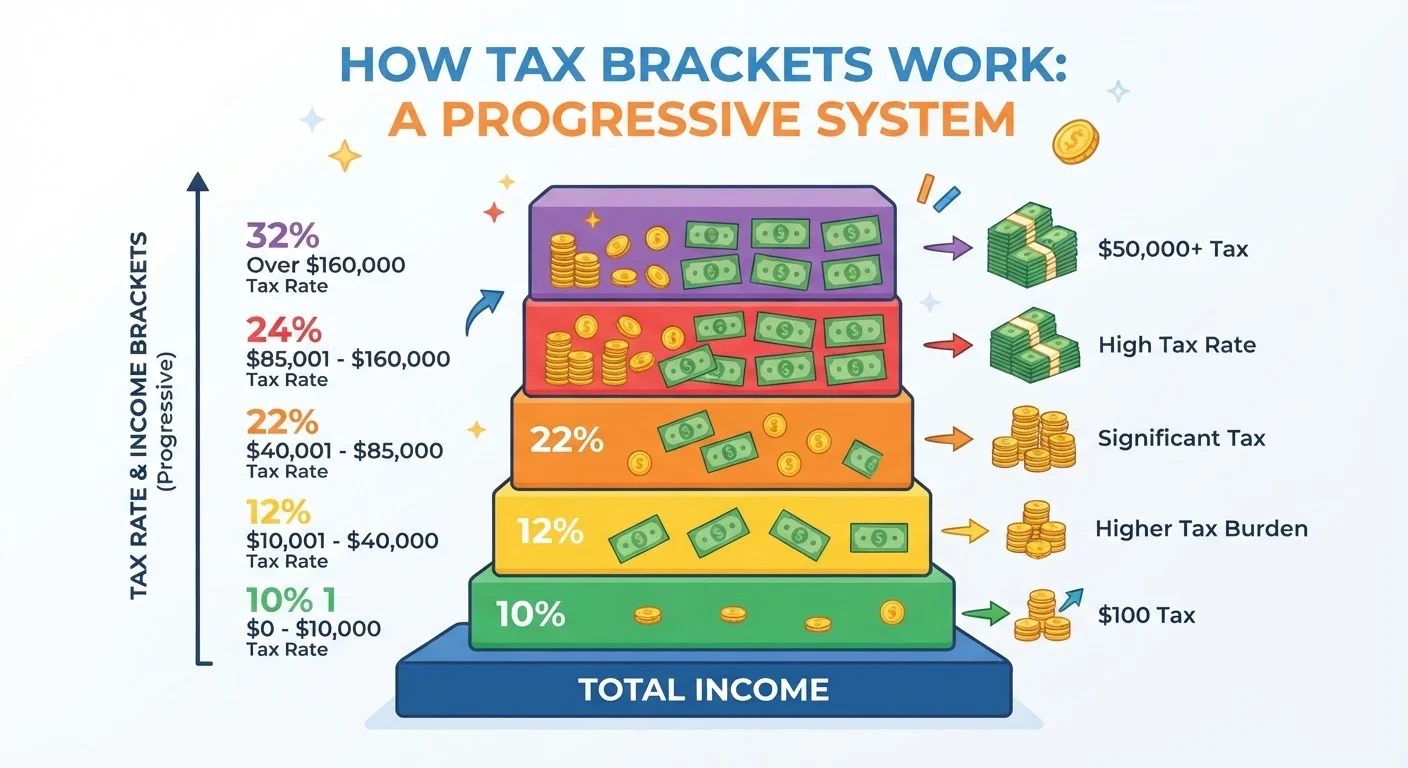
Think of it like a staircase. The IRS sets income thresholds, and each "step" has its own rate. Only the dollars that land on that step are taxed at that step's rate. Your first dollars of taxable income are taxed at the lowest rate; only the dollars above each threshold move to the next rate. To understand what counts as taxable income in the first place, see our guide to taxable income.
Here's a simplified example using hypothetical brackets:
- Income from $0-$11,000 → taxed at 10%
- Income from $11,001-$44,725 → taxed at 12%
- Income from $44,726-$95,375 → taxed at 22%
If your taxable income is $50,000, you do not pay 22% on all $50,000. You pay 10% on the first $11,000, 12% on the next $33,725, and 22% only on the remaining $5,275. Your total tax bill in this scenario would be well under 22% of $50,000.
That overall percentage - your total tax divided by your total income - is called your effective tax rate, and it's almost always lower than your top marginal rate. For a broader foundation on how income tax works, read our income tax primer.
Common Myths About Tax Brackets - Corrected
Misconceptions about brackets are among the most common tax errors beginners make. The myth-and-fact pairs below address the ones that cause the most confusion and, sometimes, costly decisions.
Myth
If I earn more and move into a higher tax bracket, I'll take home less money overall.
Fact
Earning more always increases your take-home pay. Only the dollars above a threshold are taxed at the higher rate - not your entire income.
This is the most persistent tax bracket myth. Because rates increase in steps, crossing a bracket threshold affects only the portion of income above that line. A raise that pushes $3,000 into the next bracket means only that $3,000 faces the higher rate - your other earnings are unaffected. You will always net more money after earning more.
Myth
My tax bracket tells me the percentage of my income I actually pay in taxes.
Fact
Your bracket reflects your marginal rate - the rate on your highest dollars. Your effective rate (actual taxes ÷ total income) is typically much lower.
When someone says "I'm in the 22% bracket," they mean their highest dollars are taxed at 22%. But because lower brackets absorbed most of their income at lower rates, their effective rate might be closer to 13-15%. These are two different - and both useful - numbers. Marginal rate matters for planning; effective rate reflects your actual tax burden.
Myth
The tax bracket system means that high earners pay the same rate on every dollar they earn.
Fact
High earners also benefit from lower rates on their first dollars of income, just like everyone else in the system.
Every taxpayer - regardless of total income - pays the lowest rate on the first tier of taxable income. Someone earning $500,000 still pays the 10% rate on their first bracket's worth of income, the 12% rate on the next tier, and so on. The progressive system means no one escapes the lower rungs; you always start at the bottom of the staircase.
Myth
I don't need to worry about tax brackets because my employer handles all of that.
Fact
Your employer withholds taxes based on estimates - you are still responsible for verifying accuracy and filing your own return.
Withholding is an approximation. If you have multiple jobs, freelance income, investment gains, or significant deductions, your withholding may be off in either direction. Understanding your bracket helps you evaluate whether your W-4 withholding is calibrated correctly and avoid unwelcome surprises at filing time. See common filing myths for related misconceptions about refunds and withholding.
Myth
Tax deductions are only worth pursuing if you're in a high bracket.
Fact
Deductions reduce taxable income at whatever your marginal rate is - they provide real savings at every bracket level.
A $1,000 deduction saves $100 if you're in the 10% bracket and $220 if you're in the 22% bracket. Both are real savings. While higher earners do see larger absolute reductions, deductions are worth understanding and claiming at any income level. Myths about deductions covers more misconceptions around this topic.
These aren't the only tax myths worth knowing. Our article on tax misconceptions that trip up new filers covers a broader set of errors that beginners frequently make.
Why This Knowledge Changes How You Plan
Once you understand that only your last dollars of income are taxed at your top rate, tax planning starts to make more sense. Contributing to a traditional 401(k) or IRA, for instance, reduces your taxable income - meaning some of your dollars that would have landed in a higher bracket drop to a lower one. That's a concrete, legal benefit worth understanding before filing.
Similarly, knowing your effective rate helps you evaluate paycheck withholding. Many people discover they've been over-withholding all year, essentially giving the government an interest-free loan. Others under-withhold and face a surprise bill in April.
~13%
Average effective federal income tax rate for U.S. taxpayers
According to IRS Statistics of Income data, the average effective federal income tax rate across all individual filers is well below the top marginal rates most people associate with their bracket.
7 brackets
Number of federal income tax brackets in the U.S.
The IRS currently uses seven marginal rate tiers ranging from 10% to 37%, with income thresholds adjusted annually for inflation.
Ready to take the next step? The Filing Your Taxes hub walks you through the filing process, and Deductions & Credits explains how to legally lower the income that gets pushed into those upper brackets. Knowing how brackets work is the foundation - what you do with that knowledge determines how well your tax situation serves your financial goals.
This article provides general tax education for informational purposes only and does not constitute personalized tax, legal, or financial advice. Tax laws and bracket thresholds change; consult a qualified tax professional or refer to IRS.gov for guidance specific to your situation.