
How Each Method Works
Before comparing the two, it helps to understand exactly what each approach asks you to do.
Zero-Based Budgeting
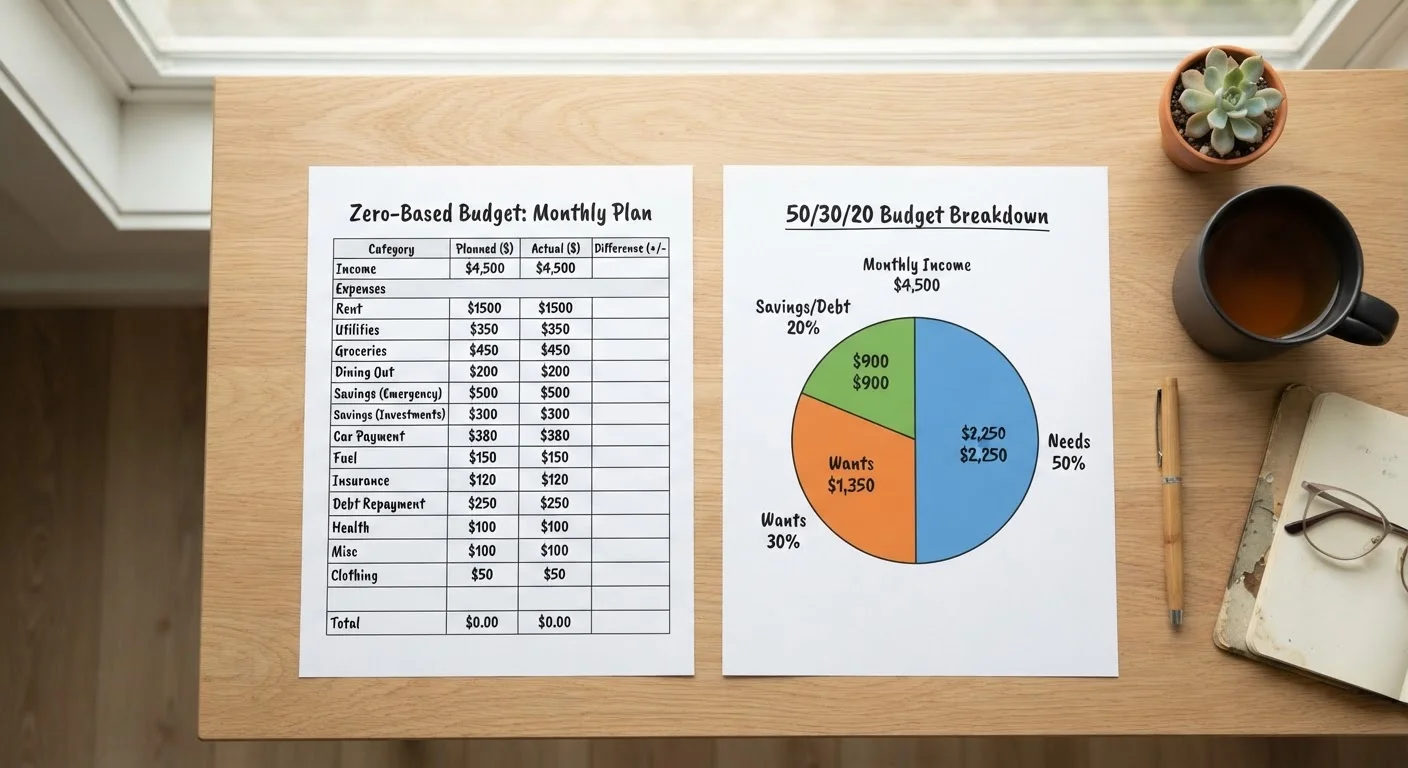
With zero-based budgeting, you start each month by listing your total take-home income, then assign every single dollar to a category - rent, groceries, savings, debt payments, subscriptions - until you reach zero. That doesn't mean you spend everything; it means every dollar has a designated purpose, including savings. If you earn $3,200 a month, your budget categories must add up to exactly $3,200.
The 50/30/20 Method
The 50/30/20 rule divides your after-tax income into three broad groups: 50% toward needs (housing, utilities, groceries, transportation), 30% toward wants (dining out, streaming services, hobbies), and 20% toward savings and debt repayment. On that same $3,200 income, you'd aim for roughly $1,600 on needs, $960 on wants, and $640 toward savings or extra debt payments. For a fuller breakdown of how the percentages work in practice, see The 50/30/20 Rule Explained.
Key Differences at a Glance
The two methods share the same ultimate goal - intentional spending - but they get there very differently.
| Zero-Based Budgeting | 50/30/20 Method | |
|---|---|---|
| Setup time | 30-60 minutes per month | Under 15 minutes |
| Level of detail | Every dollar categorized | Three broad buckets |
| Best income type | Variable or irregular income | Stable, predictable income |
| Flexibility | Low - categories are fixed | High - wide category buckets |
| Learning curve | Moderate to steep | Gentle, beginner-friendly |
| Debt payoff focus | Strong - explicit allocation | Moderate - within 20% bucket |
| Ongoing maintenance | Weekly check-ins recommended | Monthly review sufficient |
The biggest practical difference is effort. Zero-based budgeting requires you to account for every dollar every month, which can take 30-60 minutes of focused work to set up and ongoing attention to maintain. The 50/30/20 rule can be applied in minutes and reviewed just once a month. For a broader look at how these and other frameworks stack up, Budgeting Frameworks Compared walks through the most widely used approaches side by side.
Who Benefits Most From Each Approach
Zero-based budgeting tends to work well if you:
- Have variable income (freelancers, hourly workers, seasonal earners)
- Are actively working to pay off debt and want to direct every spare dollar purposefully
- Find that money disappears without explanation at the end of each month
- Want to build specific savings goals like an emergency fund or a down payment
The 50/30/20 method tends to work well if you:
- Receive a consistent paycheck and have predictable expenses
- Are new to budgeting and want a low-pressure starting point
- Prefer flexibility within categories rather than rigid line items
- Want to spend less time managing your budget each month
Neither approach is inherently better. What matters is whether the system fits your life well enough that you'll keep using it. A perfect budget abandoned after three weeks does less good than a simple one followed for years.
Honest Trade-Offs to Consider
Every budgeting method comes with real downsides worth knowing before you commit.
Zero-based budgeting drawbacks: It demands consistent time and attention. If your income fluctuates month to month, rebuilding your budget from scratch every 30 days can feel exhausting. It can also feel restrictive - some people find rigid category limits add stress rather than reduce it. For an honest look at those dynamics, The Pros and Cons of Strict Budgeting covers the real trade-offs of tightly controlled budgets.
50/30/20 drawbacks: The broad categories give flexibility, but that flexibility can become a loophole. Labeling an impulse purchase a "want" and shrugging it off is easy when there's no line-by-line accountability. The 50/30/20 split may also not be realistic for people in high cost-of-living areas, where housing alone can consume well over 50% of take-home pay.
You Can Mix Elements From Both
Some people find success using the 50/30/20 percentages as a starting framework, then applying zero-based thinking within each category - for example, specifying exactly which bills and groceries make up their 50% needs bucket. This hybrid approach gives you structure without the full time commitment of pure zero-based budgeting. Start simple, then add detail only where it genuinely helps you.
Whichever method you choose, pairing it with a simple tracking habit - even a basic spreadsheet or a free app - makes a meaningful difference in how well you stick to it. Envelope Budgeting vs. Digital Spending Trackers explores some practical tools that work alongside either budgeting approach.
This article is for general informational purposes only and does not constitute personalized financial advice. Consider speaking with a qualified financial professional about budgeting strategies suited to your specific situation.