
Why Your Credit Score Isn't a Mystery
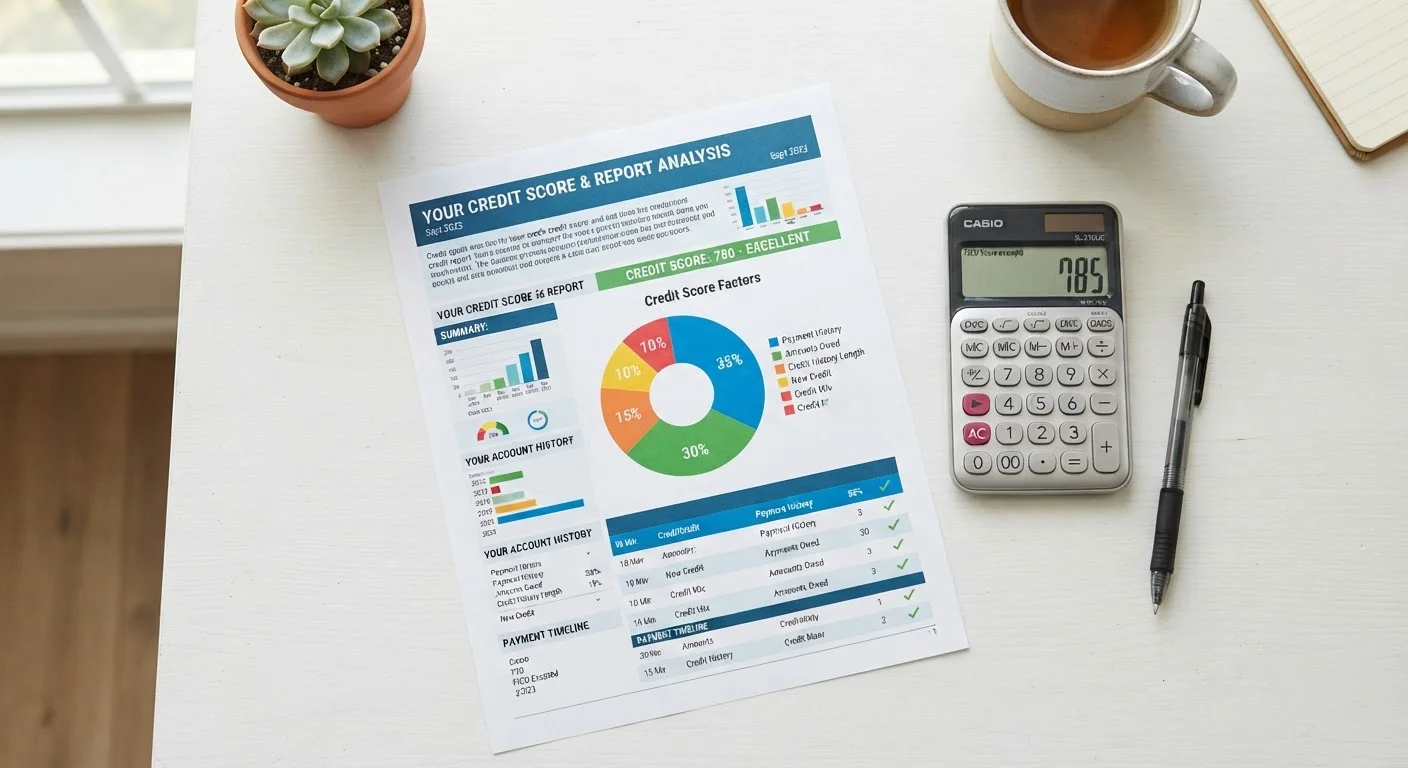
Many people assume their credit score is calculated by some unknowable formula - but it isn't. The most widely used scoring model, FICO, is built on five distinct factors, each carrying a specific percentage of your total score. Once you understand what those factors are and how much weight each one carries, the number starts to make a lot more sense.
For a broader look at how scores work and what the range of numbers actually signals to lenders, see our Credit Scores Explained guide. This article focuses specifically on the five building blocks.
| Payment History Weight | 35% of FICO score (myFICO.com) |
| Credit Utilization Weight | 30% of FICO score (myFICO.com) |
| Length of Credit History Weight | 15% of FICO score (myFICO.com) |
| Credit Mix Weight | 10% of FICO score (myFICO.com) |
| New Credit (Inquiries) Weight | 10% of FICO score (myFICO.com) |
| Late Payment Record Duration | Up to 7 years on report (Consumer Financial Protection Bureau (CFPB)) |
| Recommended Utilization Ceiling | Below 30% (CFPB general guidance) |
The Five Factors, Ranked by Weight
1. Payment History (35%)
This is the single most influential factor in your score. Lenders want to know: do you pay your bills on time? Every on-time payment builds a positive record, while a missed or late payment - especially one 30 or more days overdue - can cause a meaningful drop. The impact of a late payment diminishes over time, but it stays on your credit report for up to seven years.
2. Credit Utilization (30%)
Credit utilization measures how much of your available revolving credit (mainly credit cards) you are currently using. It is calculated as a percentage: if your total credit limit is $10,000 and your balance is $3,000, your utilization is 30%. Most credit counselors recommend keeping this figure below 30%, and lower is generally better. How your credit card activity shapes your score explores this in practical detail.
3. Length of Credit History (15%)
Scoring models consider how long your oldest account has been open, how long your newest account has been open, and the average age of all your accounts. A longer history gives lenders more data to assess your reliability. This is why closing old accounts can sometimes lower your score - it shortens your average account age.
4. Credit Mix (10%)
Having a variety of account types - credit cards, auto loans, student loans, a mortgage - can benefit your score because it shows you can manage different forms of credit responsibly. You do not need every type, and you should never take on debt you don't need just to improve your mix.
5. New Credit (10%)
Each time you apply for a new line of credit, the lender typically performs a hard inquiry on your report. A single inquiry has a small, temporary effect on your score. Multiple applications in a short period can signal financial stress to lenders. Note that rate-shopping for mortgages or auto loans within a short window (typically 14-45 days) is often counted as a single inquiry by most scoring models.
To understand how debt balances interact with several of these factors at once, see how debt affects your credit score.
Using This Knowledge to Build Better Credit
The percentages above reveal a clear priority order. Paying every bill on time and keeping your credit card balances low will move the needle more than any other action - together, those two factors account for 65% of your FICO score. The remaining three factors matter, but they tend to improve naturally over time with responsible habits.
For a complete, step-by-step walkthrough of everything that feeds into your score, including what shows up on your report and how disputes work, visit our comprehensive credit score guide. You can also explore the full Credit & Debt hub for related topics on managing borrowing wisely.
This article is for general informational purposes only and does not constitute personalized financial or legal advice. For guidance specific to your situation, consider consulting a licensed financial counselor or advisor.