
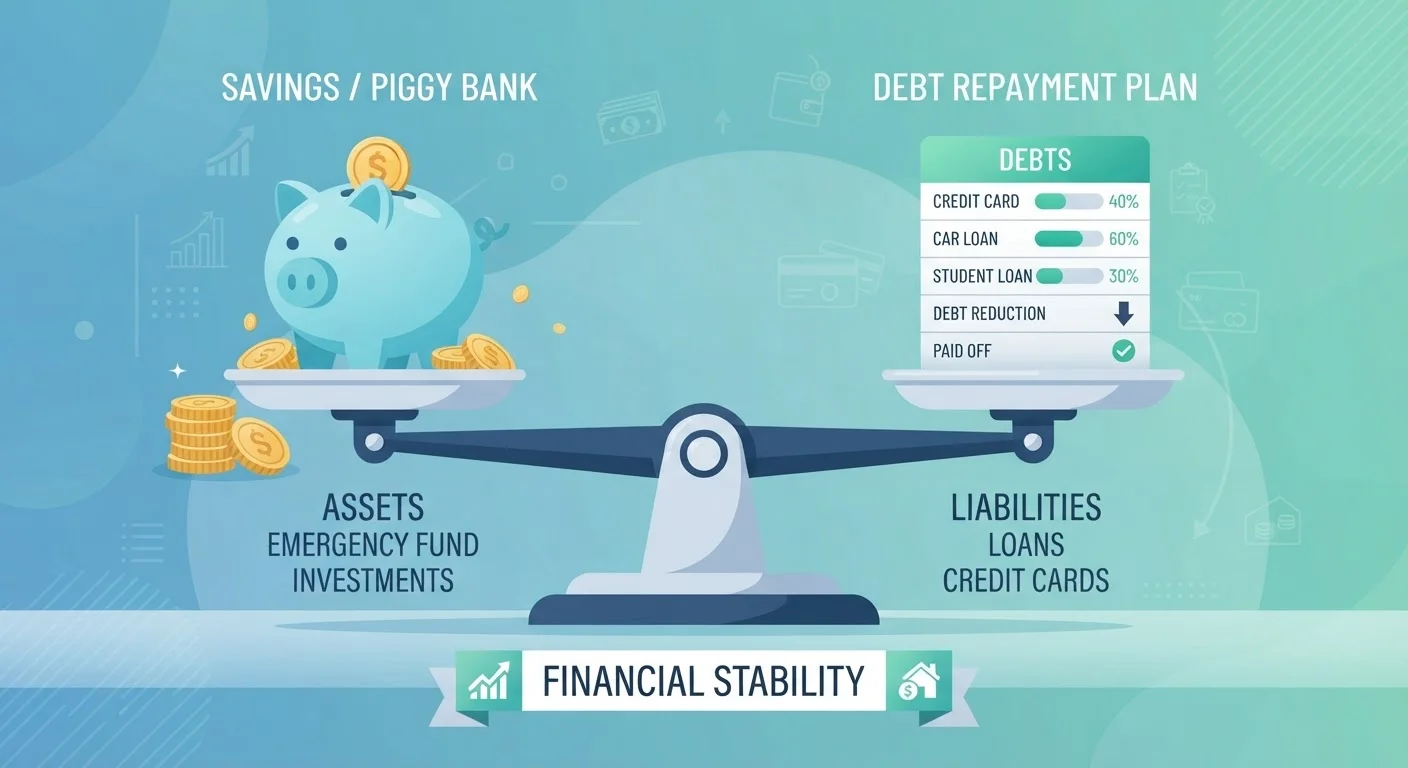
Why This Trade-Off Is So Common
Many people carrying debt also live without a financial safety net. When every spare dollar feels spoken for, deciding whether to pay down what you owe or set money aside for emergencies can feel paralyzing. The honest answer is that both goals matter - and the tension between them is real.
Without any savings, a single car repair or medical bill can force you to reach for a credit card, undoing weeks of debt progress. But if you ignore high-interest debt entirely while slowly building savings, the interest charges accumulate faster than your balance grows. Understanding this trade-off is the first step. For a broader look at how debt accumulates and how to take stock of what you owe, see our guide to managing debt without letting it manage you.
Three Approaches Compared
There are three common ways people handle the debt-versus-savings dilemma. Each has genuine strengths and real drawbacks depending on your circumstances.
| Debt-First | Savings-First | Split Approach | |
|---|---|---|---|
| Interest savings | Highest | Lowest | Moderate |
| Emergency protection | Low (no cushion) | High | Moderate |
| Risk of new debt from surprises | High | Low | Low to moderate |
| Best for debt type | High-interest (20%+ APR) | Low-interest debt | Any debt type |
| Psychological benefit | High when debt clears fast | High sense of security | Balanced motivation |
| Income stability needed | High | Moderate | Low to moderate |
Debt-First: You direct every available dollar beyond minimum payments toward debt elimination. Once debt is cleared, you redirect that money to savings. This approach minimizes total interest paid but leaves you with no cushion if something goes wrong.
Savings-First: You build a full emergency fund (typically three to six months of essential expenses) before making extra debt payments. This maximizes financial security but can be costly if your debt carries a high interest rate.
Split Approach: You set a modest savings target - often $500 to $1,000 - then divide any extra money between debt repayment and continued saving. This is the middle path most financial educators suggest for beginners. See how this thinking applies across saving goals in our overview of saving money strategies.
When the Debt-First Approach Makes Sense
If your debt carries a high interest rate - credit card debt commonly ranges from 20% to 30% APR - every month you delay repayment costs real money. In those cases, prioritizing debt repayment above aggressive saving can be mathematically sound.
However, going debt-first without any emergency fund is a risky move. Even a small buffer of $500 to $1,000 in a separate savings account can prevent you from adding to your debt balance when life surprises you. Once you've cleared your highest-rate debt, redirect those payments toward building a fuller emergency fund. To explore repayment strategies in more detail, our article on debt avalanche vs. debt snowball methods walks through both approaches side by side.
Start With a Mini Emergency Fund
Before aggressively attacking debt, set aside a small, fixed emergency target - $500 to $1,000 is a widely cited starting point. Keep it in a separate savings account so it isn't tempting to spend. Once you hit that milestone, shift your focus to extra debt payments. This small cushion dramatically reduces the chance that an unexpected expense forces you back into higher debt.
When the Split Approach Works Better
For people with lower-interest debt - such as federal student loans or an auto loan - the mathematical case for extreme debt focus weakens. The gap between your debt's interest rate and what a savings account earns is smaller, making simultaneous progress more reasonable.
A split approach also suits anyone with variable income, freelance work, or a job that feels uncertain. The psychological benefit of seeing savings grow can also help sustain motivation when debt repayment feels slow. Our guide to building an emergency fund when money is tight offers practical steps even when your budget leaves little room. You can also explore how an emergency fund fits your monthly plan in our article on building an emergency fund inside your budget.
A simple starting framework: after covering minimum debt payments, direct 70-80% of extra dollars to the highest-interest debt and 20-30% to savings until you reach your initial savings milestone. Adjust the ratio based on your interest rates and how secure your income feels. For deeper context on this exact tension, see when paying down debt and saving clash.
This article is for general informational and educational purposes only. It is not personalized financial, tax, or legal advice. Please consult a qualified financial professional for guidance specific to your situation.