
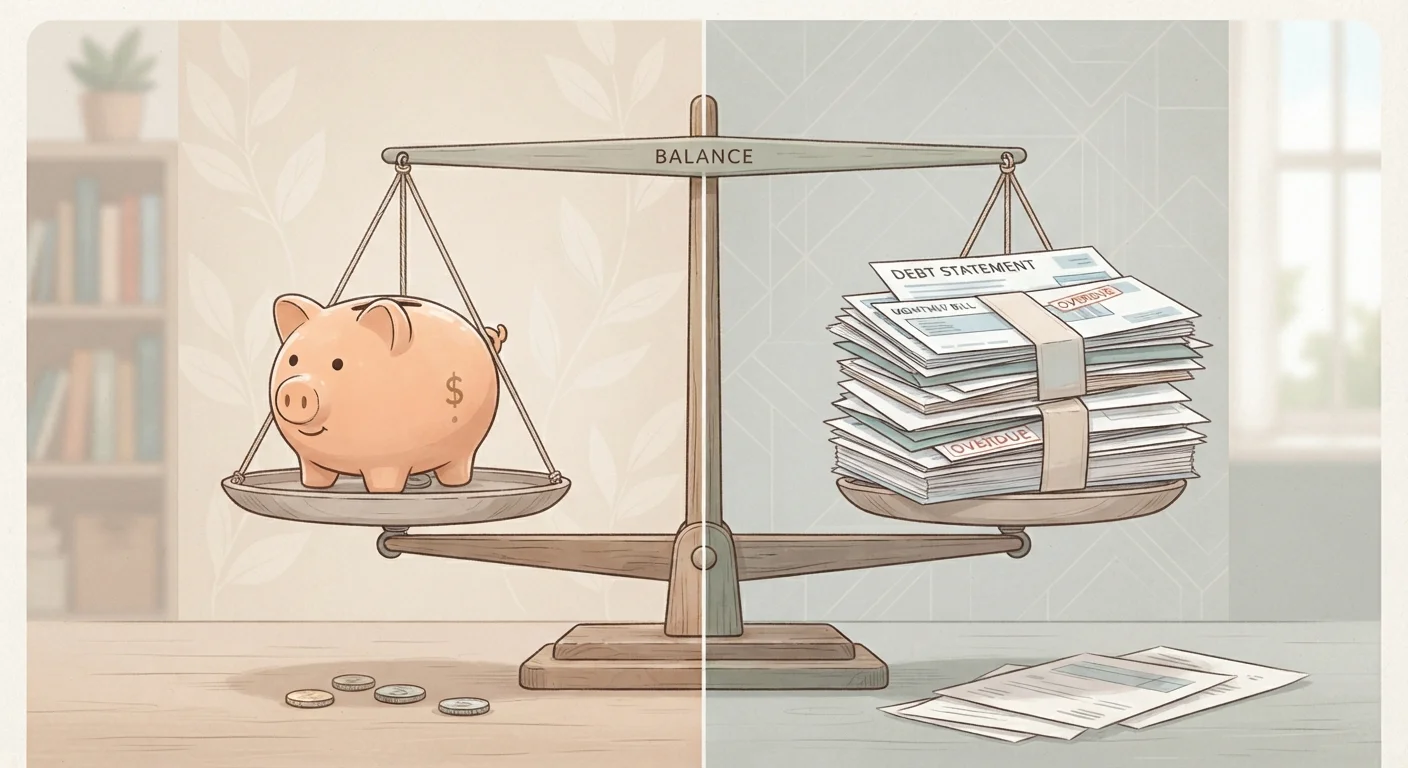
Why This Trade-Off Feels So Hard
You want to get out of debt. You also know you're supposed to be saving. But with limited income, doing both at full speed feels impossible - and the advice you find online often contradicts itself. That tension is real, and it doesn't mean you're doing anything wrong.
The reason there's no single right answer is that saving and debt repayment are competing uses of the same dollars. Every extra payment toward a balance is a dollar that isn't going into a savings account, and vice versa. Understanding what actually drives the trade-off helps you make a decision that fits your situation - not someone else's.
For a broader look at how debt builds up and how to take stock of what you owe, see our guide on managing debt without letting it manage you.
The Key Factor: Interest Rate Comparison
The most useful place to start is comparing the interest rate on your debt against the realistic return you could expect from saving or investing. This isn't about predicting the future - it's about understanding the likely cost of each choice.
If your credit card charges 22% APR (APR), every dollar left on that balance costs you 22 cents per year. A high-yield savings account, by contrast, might earn somewhere around 4-5% - and that rate can change. In that scenario, paying down the card delivers a near-certain "return" that is far higher than what saving is likely to provide.
On the other hand, a federal student loan at 5% or a low-rate car loan sits much closer to what a savings account might earn. In those cases, the math doesn't point as strongly toward aggressive repayment, and splitting your dollars starts to make more sense.
| High-Interest Debt Repayment | Building an Emergency Fund | Saving / Investing | |
|---|---|---|---|
| Typical benefit | Guaranteed interest savings | Prevents new debt from surprises | Potential long-term growth |
| Best when | Debt APR exceeds likely savings rate | You have little or no cash buffer | Debt rate is low; employer match available |
| Primary risk of ignoring | Interest compounds, balance grows | One emergency derails debt progress | Miss compounding time; no match capture |
| Certainty of outcome | High - interest avoided is fixed | High - removes a known vulnerability | Variable - returns are not guaranteed |
| Recommended starting size | Pay minimums + any extra surplus | $500-$1,000 starter fund | Enough to capture employer match |
For more on comparing repayment strategies once you've decided to tackle debt, see Debt Avalanche vs. Debt Snowball.
The Case for Saving First: Emergency Funds
Here's the overlooked problem with paying down debt aggressively while keeping no savings: when something unexpected happens - a car repair, a medical bill, a gap in income - you have no buffer. That forces many people to reach for a credit card, undoing months of repayment progress.
A small emergency fund of $500 to $1,000 acts as a circuit breaker. It isn't a wealth-building tool at that size; it's a mechanism to prevent new debt. Most personal finance educators recommend building this starter fund before accelerating debt repayment, even if it means your debt shrinks a little more slowly at first.
Our article on repaying debt while still building an emergency fund explores this balance in more depth.
Start Small, Then Grow Your Buffer
You don't need a full three-to-six month emergency fund before tackling debt. A starter fund of $500 to $1,000 is enough to handle most minor emergencies without reaching for credit. Once your high-interest debt is under control, you can grow that cushion further. Small, consistent deposits - even $25 a week - add up quickly without derailing your debt repayment.
One Exception Worth Knowing: Employer Retirement Matches
If your employer offers a retirement plan match - for example, matching 50% of your contributions up to 6% of your salary - that match is effectively an immediate 50% return on those dollars. No investment strategy reliably beats that in the short run.
For this reason, many financial educators suggest contributing at least enough to capture the full employer match, even while carrying debt. Beyond the match threshold, the calculus shifts back toward your interest rate comparison. This is general information, not personalized advice - a qualified financial professional can help you assess your specific situation.
Keep in mind that saving aggressively early in life has real long-term benefits, but it also carries short-term costs worth understanding before committing to a plan.
Making a Decision That Actually Holds
The right split between debt repayment and saving isn't purely mathematical. Your income stability, how the debt is affecting your stress levels, and whether you have dependents all shape what a sustainable plan looks like. A plan you can stick to for 18 months beats a mathematically optimal plan you abandon in three.
A practical starting framework for many beginners:
- Build a starter emergency fund ($500-$1,000).
- Contribute to retirement up to any employer match.
- Direct remaining surplus dollars toward your highest-interest debt first.
- Once high-rate debt is cleared, redirect those payments toward broader saving and investing goals.
This isn't a guarantee of any outcome - it's a sequence that addresses the most urgent risks first. For context on how different types of debt rank in terms of financial impact, see Good Debt vs. Bad Debt.
This article is for general informational and educational purposes only and does not constitute personalized financial, investment, tax, or legal advice. Everyone's financial situation is different. Please consult a qualified financial professional before making decisions about your own circumstances.