Deductions reduce your taxable income; credits reduce the actual tax you owe dollar-for-dollar.
Many taxpayers overlook credits they qualify for - reviewing each category can prevent costly omissions.
You must choose between the standard deduction and itemizing; only one applies per return.
Documentation is essential - unsupported claims can be disallowed if questioned by the IRS.
A tax professional can help confirm eligibility when your situation is complex or unclear.
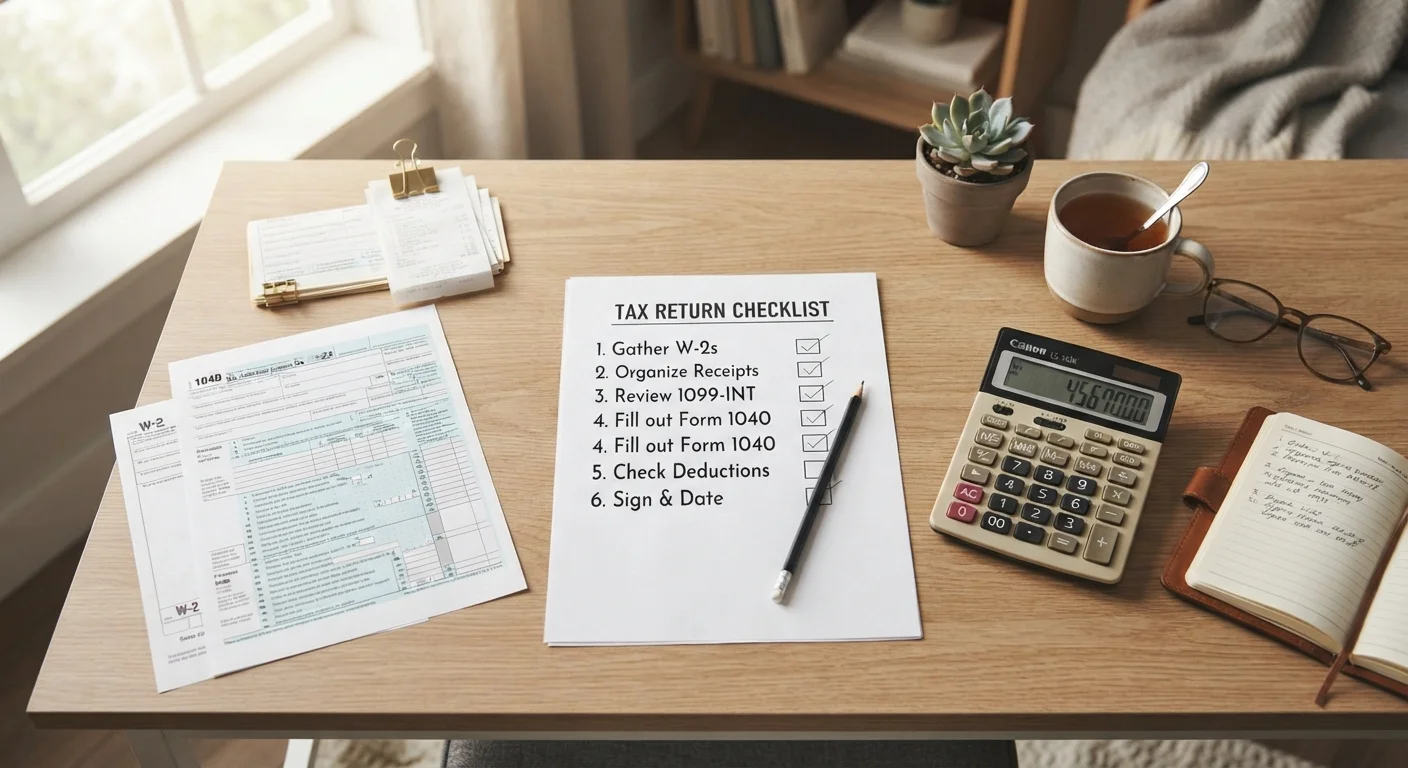
Before you file, use this checklist to make sure you haven't overlooked any deductions or credits you're entitled to claim on your return.
Why a Year-End Review Pays Off
Most filing mistakes aren't errors of arithmetic - they're omissions. A deduction or credit you forgot to claim is money you legally could have kept but didn't. Before you submit your return, a deliberate review of what you're entitled to is one of the most productive steps you can take.
This checklist is designed for everyday earners: employees, freelancers, parents, students, and anyone managing a household budget. It won't cover every niche scenario, but it hits the deductions and credits that affect the largest number of people. For broader context on how the filing process works, see our complete tax filing walkthrough.
Use this list alongside your documents. Check each item, gather supporting records, and flag anything uncertain for follow-up - ideally with a qualified tax professional if your situation is complex.
Deductions vs. Credits: Know the Difference
A deduction reduces the amount of income that is subject to tax, which lowers your tax bill indirectly. A credit reduces the actual tax you owe, dollar-for-dollar - making credits generally more valuable. Some credits are even refundable, meaning they can reduce your tax liability below zero and result in a refund. Understanding which category each item falls into helps you prioritize your review.
Tools and Records You'll Need First
Before working through the checklist, pull together the documents that feed each category. Having them in front of you prevents guesswork and speeds up the process considerably. Our guide on keeping tax records explains what to save and for how long.
Required
W-2 and 1099 Income Statements
Confirms total income received - required to accurately calculate AGI and assess deduction phaseout thresholds.
Optional
Form 1098 (Mortgage Interest Statement)
Documents mortgage interest paid during the year, needed if you plan to itemize deductions.
Optional
Charitable Donation Receipts
Required to substantiate charitable contribution deductions, especially for gifts of $250 or more.
Optional
Form 1098-T (Tuition Statement)
Issued by eligible educational institutions to support claims for education credits.
Optional
HSA Account Statement
Documents contributions and distributions from a Health Savings Account for accurate reporting.
Optional
Childcare Provider Records
Provider's name, address, and Employer Identification Number (EIN) are required to claim the Child and Dependent Care Credit.
Required
IRS Free File or Tax Software
Helps calculate deductions and credits automatically and flags common omissions during the filing process.
Deductions and Credits Checklist
Work through each group below. Items marked must are non-negotiable if the category applies to you. Items marked should are strongly recommended checks. Nice-to-have items are worth confirming but apply in narrower circumstances.
Not sure whether to itemize or take the standard deduction? Compare your total itemized deductions against the current standard deduction amount for your filing status. Whichever is larger reduces your taxable income more. Our Tax Basics hub explains how taxable income is calculated if you need a refresher.
Standard vs. Itemized Deduction
Determine your standard deduction amount based on your filing status (Single, Married Filing Jointly, Head of Household, etc.) and compare it to your total potential itemized deductions.Must
If itemizing, total all qualifying expenses - mortgage interest, state and local taxes (capped at $10,000), charitable contributions, and eligible medical expenses - before committing to that approach.Must
Check whether you qualify for an additional standard deduction amount if you are age 65 or older, or legally blind.Should
Income-Related Deductions
Confirm any contributions made to a traditional IRA for the tax year, as deductibility depends on your income and whether you're covered by a workplace retirement plan.Must
If self-employed, verify contributions to a SEP-IRA or Solo 401(k) and confirm the deduction amount aligns with IRS contribution limits.Must
Check whether you paid student loan interest during the year - up to $2,500 may be deductible depending on your income.Should
If self-employed, confirm the deduction for half of self-employment tax paid and any qualifying health insurance premiums.Must
Review contributions made to a Health Savings Account (HSA) to ensure you've claimed the above-the-line deduction for any out-of-pocket contributions.Should
Family and Dependent Credits
Confirm eligibility for the Child Tax Credit for each qualifying child under age 17 - verify that each child meets the relationship, residency, and support tests.Must
Check whether you qualify for the Child and Dependent Care Credit if you paid for childcare so you could work or look for work.Should
Review eligibility for the Earned Income Tax Credit (EITC) - income limits and credit amounts vary by filing status and number of qualifying children.Must
If you adopted a child, confirm any qualifying adoption expenses for the Adoption Tax Credit.Nice to have
Education Credits and Deductions
Confirm whether you or a dependent attended an eligible college or vocational school and check eligibility for the American Opportunity Tax Credit (AOTC) - worth up to $2,500 per eligible student.Must
If the AOTC doesn't apply (e.g., the student is beyond the first four years of higher education), review eligibility for the Lifetime Learning Credit instead.Should
Health-Related Deductions
If itemizing, tally all unreimbursed medical and dental expenses - only the amount exceeding 7.5% of your adjusted gross income (AGI) is deductible.Should
Verify that any HSA distributions were used for qualified medical expenses; non-qualified withdrawals are taxable and may trigger a penalty.Must
If you paid premiums for long-term care insurance, check whether age-based limits allow a portion to be deducted as a medical expense.Nice to have
Charitable Contributions
If itemizing, gather receipts or acknowledgment letters for all cash and non-cash donations to qualifying organizations - the IRS requires written acknowledgment for any single gift of $250 or more.Must
For non-cash donations (clothing, household goods, vehicles), confirm fair market value was used and that a qualified appraisal was obtained for any item valued over $500.Should
Energy and Home Credits
Check whether any home energy improvements made during the year (insulation, windows, heat pumps, solar panels) qualify for a federal energy tax credit.Should
If you purchased a qualifying electric or plug-in hybrid vehicle, confirm whether the clean vehicle credit applies based on the vehicle, purchase date, and your income.Nice to have
Final Verification Before Filing
Cross-reference every deduction and credit claimed with supporting documentation - receipts, statements, Form 1098, Form 1099, or letters from qualifying organizations.Must
Review your completed return against this checklist one final time before submitting to ensure nothing was missed.Must
This article is for general informational and educational purposes only. It does not constitute personalized tax, legal, or financial advice. Tax rules change and individual circumstances vary - consult a qualified tax professional before making decisions about your return.
The content on this site is for informational purposes only and is not a substitute for professional advice. Always consult a qualified professional for guidance specific to your situation.