
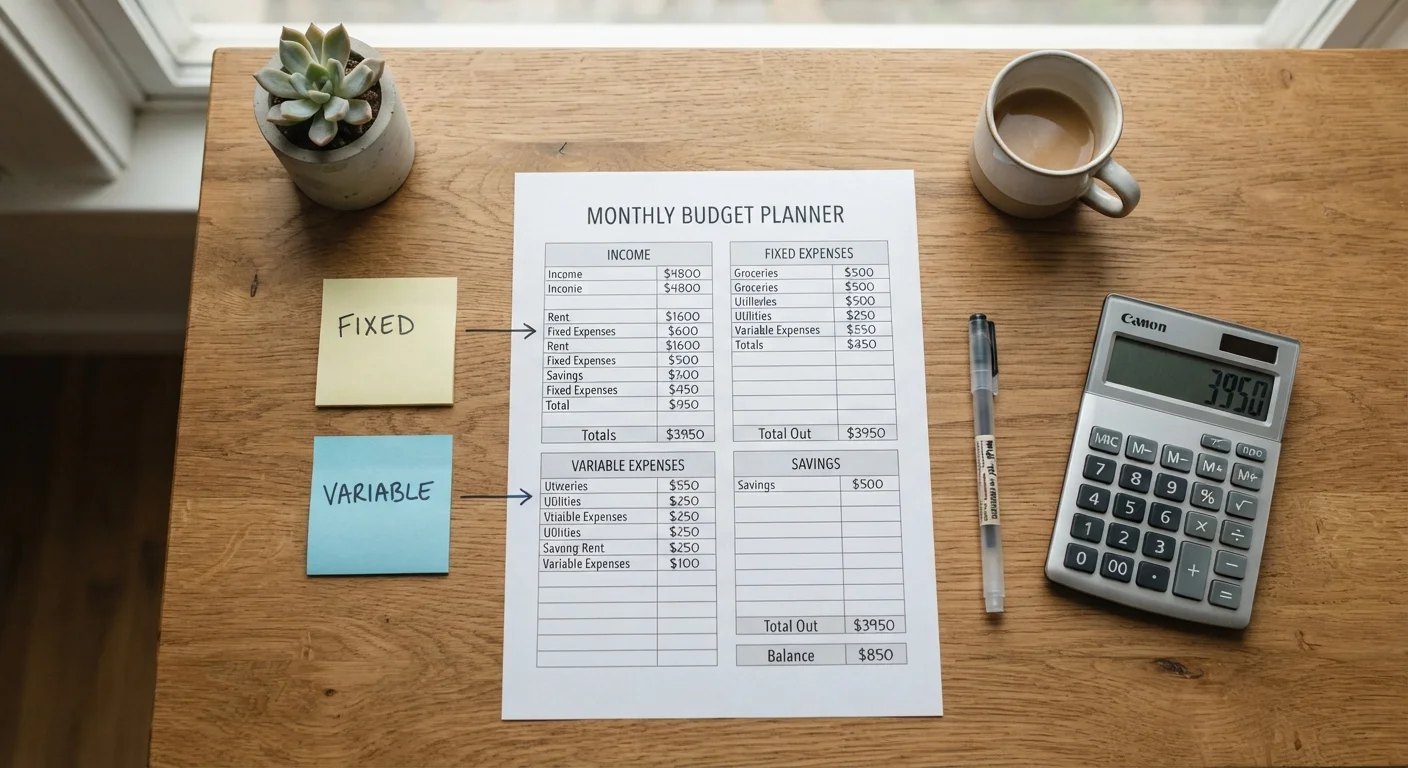
What Are Fixed Expenses?
A fixed expense is any cost that stays the same amount each billing period, regardless of how you live that month. You owe the same number whether you stayed home every weekend or went out every night.
Common examples include:
- Rent or mortgage payments
- Car loan or lease payments
- Health insurance premiums
- Subscription services billed at a flat monthly rate
- Minimum debt payments (student loans, personal loans)
Because the amount doesn't change, fixed expenses are easy to plan for. You write them into your budget once, and they stay put. That predictability is genuinely useful - it tells you exactly how much income is already spoken for before the month even begins.
For a plain-English rundown of all three main spending categories, see our budgeting terms glossary.
What Are Variable Expenses?
A variable expense changes from month to month. The amount you spend depends on your behavior, choices, or circumstances - not a locked-in contract.
Typical variable expenses include:
- Groceries and household supplies
- Gas and transportation costs
- Dining out and entertainment
- Clothing and personal care
- Utility bills (electricity and water fluctuate seasonally)
Variable expenses aren't inherently wasteful - groceries are essential, after all. The key word is flexibility. Unlike rent, you can spend more or less on groceries depending on the week. That wiggle room is exactly what makes variable costs the natural target when you need to cut back.
Once you understand where spending can be trimmed, our article on cutting fixed vs. variable costs explains which strategies work best for each type.
| Criterion | Fixed Expenses | Variable Expenses |
|---|---|---|
| Amount each month | Stays the same | Changes month to month |
| Examples | Rent, loan payments, insurance | Groceries, gas, dining out |
| Ease of planning | Easy - amount is known in advance | Requires estimating from past spending |
| Flexibility to reduce | Low - often tied to a contract | High - amount can shift with behavior |
| Role in budgeting | Sets your spending floor | Shows where you have room to adjust |
| Risk if skipped | High - missed payments affect credit | Lower - some categories can be trimmed |
Why the Distinction Matters for Your Budget
Grouping your expenses this way isn't just a labeling exercise - it shapes how you build and adjust your budget every single month.
Fixed costs define your baseline. Before you decide how much to spend on food or fun, you need to know how much is already committed. Add up your fixed expenses, and you have the minimum amount your budget must cover. If your income ever dips - a slow freelance month, a missed shift, an unexpected gap - that number tells you immediately how serious the shortfall is.
Variable costs reveal your options. When you need to free up money for a goal or recover from an unexpected expense, variable spending is where most people have real room to move. You can't easily skip a rent payment, but you can cook at home more often or delay a clothing purchase.
This distinction also helps you set realistic saving targets. Understanding whether to save a flat amount or a percentage each month ties directly back to how stable your income and fixed costs are - explore that trade-off in our guide on fixed vs. percentage-based saving targets.
How to Use This in Your First Budget
Creating your first realistic budget becomes far less intimidating when you work in this order:
- List every fixed expense. Go through your bank statements and note every recurring charge that's the same amount each month. Total them up.
- Estimate your variable expenses. Look at the past two or three months to get an average. Groceries, gas, and utilities can vary, so averages give you a workable number instead of a guess.
- Subtract both totals from your take-home income. What's left is what you have available for savings and discretionary spending.
- Adjust variable spending to reach your goals. If you want to build an emergency fund, look first at variable categories where you can spend less without breaking any commitments.
This structure keeps your budget grounded in reality. You're not guessing - you're working with actual numbers organized in a way that shows you where flexibility exists and where it doesn't.
For broader goal-setting context, our article on short-term vs. long-term financial goals can help you decide what to work toward once your budget is in place.
This article is for general informational and educational purposes only. It is not personalized financial advice. Consider speaking with a qualified financial professional about decisions specific to your situation.