
Why Tracking What You Spend Is Worth the Effort
Most people have a rough sense of their big costs - rent, car payments, utility bills. What surprises nearly everyone is the cumulative weight of smaller, everyday purchases: a streaming subscription here, a takeaway there, a few impulse buys that barely registered at the time. By the end of the month, those small amounts can add up to hundreds of dollars without triggering a single moment of deliberate choice.
Tracking spending closes that gap between assumption and reality. When you write down what you actually spend - rather than what you think you spend - patterns surface quickly. You might discover that dining out costs twice what you estimated, or that several subscriptions you'd forgotten about are still billing you monthly. Our article on why expense tracking changes everything explores this dynamic in more depth, but the core insight is simple: you can't manage money you can't see.
The good news is that tracking doesn't have to be elaborate or time-consuming. Even a rough log - one that catches 90% of spending - is enough to reveal the patterns that matter. If you're curious how much most people underestimate their own spending, this piece on where your money actually goes offers a useful reality check.
What You'll Need Before You Start
You don't need any special equipment or paid software. The most important prerequisite is access to a record of your recent transactions - whether that's a month of bank statements, a credit card app, or a folder of receipts. Everything else is optional.
What you will need
If you're building on a foundation of zero budgeting experience, our complete beginner's budgeting guide covers the underlying concepts that will make the steps below easier to understand and stick with.
How to Start Tracking Your Spending
The five steps below are designed to get you from a blank page to a functioning spending log in under an hour. Follow them in order - each one builds on the last.
Keep Your Categories Broad at First
Beginners who try to track 20+ categories often give up within a week. Start with five to seven wide buckets - like Housing, Food, Transport, and Entertainment - and split them further only once the habit is solid. Simplicity keeps you consistent, and consistency is what generates useful data.
Choose one tracking method and commit to it
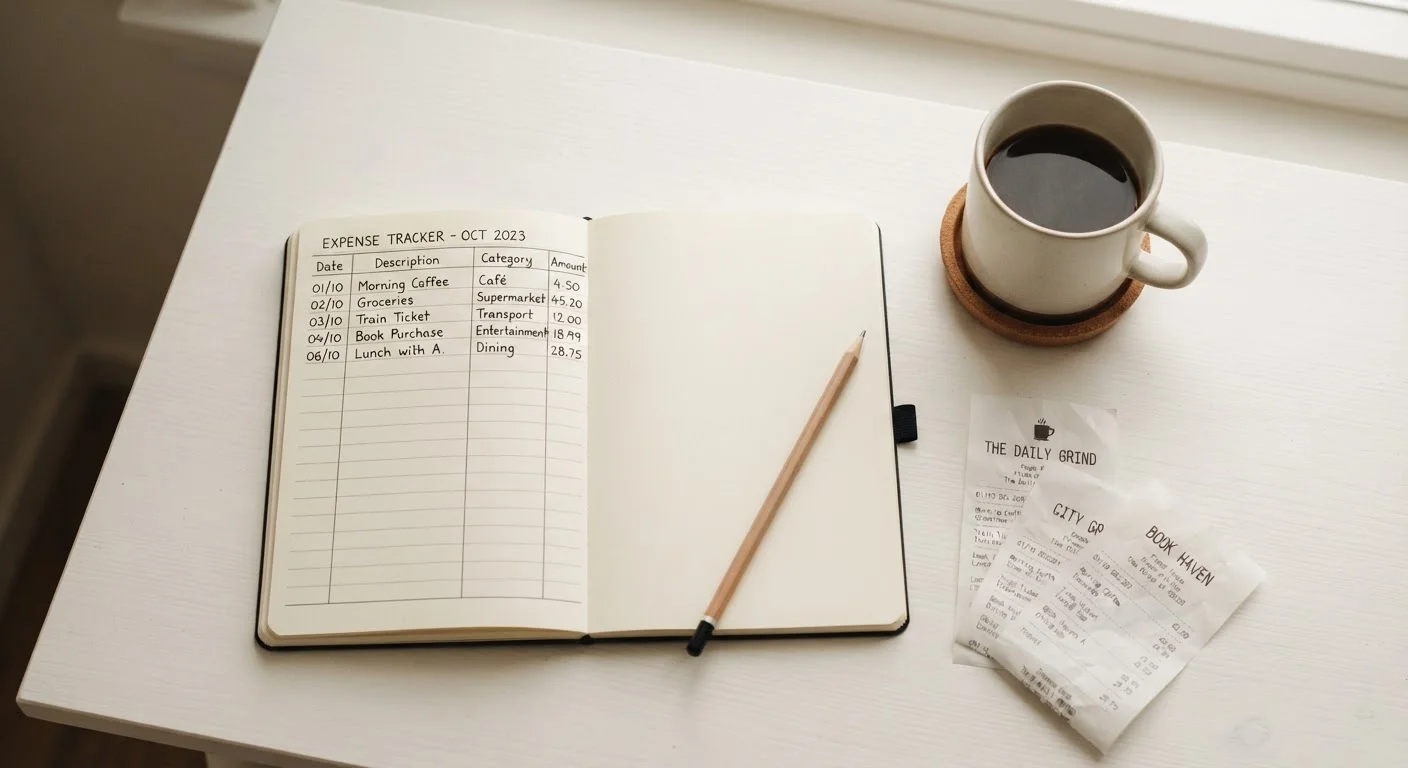
The single biggest predictor of success is picking a method you'll actually use - not the most sophisticated one. If you enjoy writing, use a pocket notebook. If you're comfortable with a spreadsheet, create a simple table with columns for Date, Description, Category, and Amount. If neither appeals, explore a free expense-tracking app that connects to your bank. Compare the approaches in our guide to envelope budgeting vs. digital trackers to help you decide.
Whatever you choose, use only one system. Splitting records across a notebook and an app creates confusion and gaps.
Set up five to seven spending categories
Categories turn a list of numbers into meaningful patterns. A simple starting set might be: Housing (rent, utilities), Food & Groceries, Transport, Entertainment & Dining Out, Health, Subscriptions, and Everything Else. Tailor these to reflect your actual life - if you commute by bicycle rather than car, swap Transport for a more relevant label.
Avoid creating a category for every merchant. The aim is a handful of buckets that capture your lifestyle, not a perfectly granular audit.
Log purchases as close to real time as possible
Memory degrades fast. A coffee bought at 8 a.m. is easy to forget by evening. Make it a two-second habit: the moment you pay, open your log and add a line. If that's not always practical, set a daily five-minute reminder - say, after dinner - to record the day's purchases while they're still fresh.
Card statements and digital receipts are your safety net. If you miss a day, cross-reference your bank app to fill the gaps rather than guessing.
Do a brief weekly review
At the end of each week, total up each category and compare it to what you expected to spend. This doesn't need to take more than ten minutes. The point is to catch patterns early - if your Food spending is already at 75% of your monthly target by week two, you can adjust now rather than overshoot by month's end.
This rhythm also makes the monthly review described in our end-of-month financial check-in much less daunting, because the work is already done in small pieces.
Use your first month's data to set realistic targets
After 30 days of logging, you have something most people lack: an honest picture of where your money goes. Total each category and compare the real numbers to what you assumed you were spending. The gap between the two is often the most revealing part of the whole exercise.
Use these figures as the baseline for your first formal budget. Our guide to budgeting from scratch walks you through turning that data into a working spending plan.
Common Stumbling Blocks - and How to Handle Them
Even with the best intentions, most new trackers hit a wall in the first two weeks. Here are the patterns to watch for:
- Cash spending disappears. If you pay cash regularly, jot purchases in a notes app immediately or keep a small slip of paper in your wallet. Cash has no automatic record, so it demands extra attention.
- Joint or shared expenses are confusing. If you share finances with a partner or housemate, decide upfront who logs shared purchases and how you'll split them. Consistency matters more than the exact method you choose.
- Irregular expenses catch you off guard. Annual subscriptions, car services, and birthday gifts don't appear every month. Note them in an "irregular" category when they occur, and factor them into your annual picture.
Don't Let Perfection Stall You
Many first-time trackers quit after missing a day or miscategorizing a purchase. A 90%-complete spending log is far more valuable than a blank page. If you fall behind, estimate what you can and move forward - the goal is awareness, not a flawless ledger.
Once your tracking habit is solid, you'll be well-placed to look at where cuts might be possible. Our introduction to cutting expenses for the first time is a natural next step. And if you want a framework for reviewing your overall financial progress - not just your spending - explore the Tracking Your Progress hub for broader strategies.
This article is for general informational purposes only and does not constitute personalized financial, tax, or legal advice. Please consult a qualified financial professional before making decisions based on your individual circumstances.