
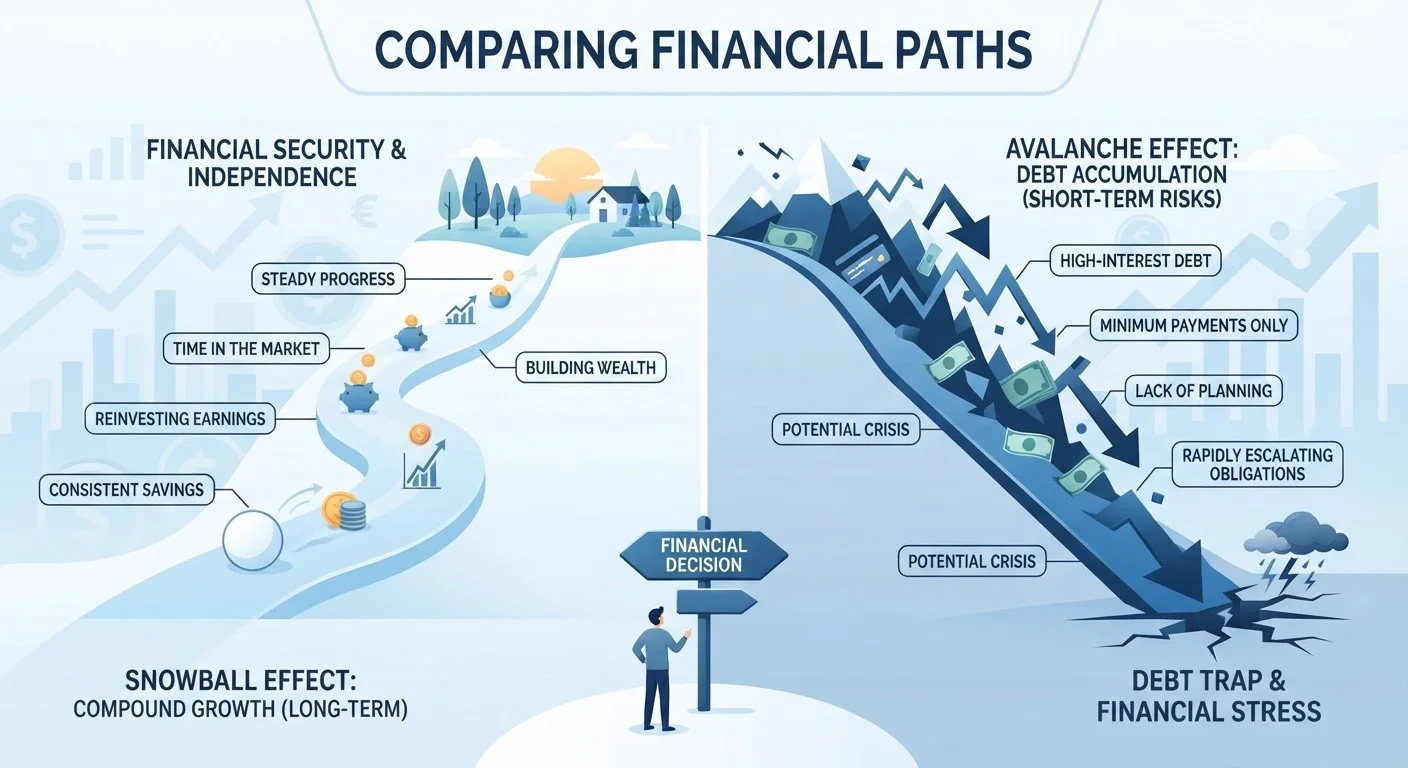
How Each Method Works
Both strategies share the same foundation: you make minimum payments on every debt, then direct any additional money toward one priority debt at a time. Where they diverge is in how that priority debt is chosen.
Debt Avalanche: You rank your debts from highest to lowest interest rate (APR) and attack the top of that list first. Once the highest-rate balance is cleared, you roll its payment into the next highest, and so on. Because interest is the cost of borrowing, eliminating the most expensive debt first limits how much extra you pay over time.
Debt Snowball: You rank debts from smallest to largest balance, regardless of interest rate, and focus all extra payments on the smallest balance first. When that debt is gone, you roll that payment into the next-smallest. Each closed account is a tangible milestone - a signal that the plan is working.
For a structured walkthrough on listing your debts and setting up either approach, see our step-by-step repayment plan guide.
| Criterion | Debt Avalanche | Debt Snowball |
|---|---|---|
| Priority order | Highest interest rate first | Smallest balance first |
| Total interest paid | Generally lower | Generally higher |
| Time to first paid-off debt | Often longer | Often shorter |
| Psychological reward | Delayed - wins come later | Early - quick account closures |
| Best when | High-APR debts dominate your list | Motivation is the biggest barrier |
| Complexity | Requires tracking APRs carefully | Simple balance ranking |
The Real Difference: Math vs. Motivation
On paper, the Avalanche wins. Because interest compounds on your remaining balance every billing cycle, directing extra payments toward the highest-rate debt first reduces the principal that interest is calculated on - faster. Over months or years, this difference can add up to a meaningful sum, particularly if you carry credit card balances with APRs above 20%.
In practice, however, behavior often determines outcomes more than math. Research in behavioral economics has found that people tend to respond strongly to visible, measurable progress - sometimes more than to abstract future savings. The Snowball method leverages this: closing a debt account entirely, even a small one, provides a concrete sense of accomplishment that can reinforce the habit of paying extra each month.
The key question is honest self-assessment: Do I stay disciplined when progress is slow, or do I need early wins to stay committed? There is no shame in either answer. A plan you follow through on will always outperform a theoretically superior plan you abandon. Learn more about the habits that support consistent repayment in our article on managing debt without letting it manage you.
Applying the Method You Choose
Once you've chosen a framework, setup follows three steps:
- List all your debts with their balances, minimum payments, and interest rates.
- Rank them - by APR descending for the Avalanche, by balance ascending for the Snowball.
- Direct every extra dollar beyond minimums to the top debt on your list. When it's paid off, add that freed payment to the next debt's payment.
One practical note: both methods assume you are not taking on new debt while repaying existing balances. If spending habits led to the debt in the first place, pairing either strategy with a realistic budget is essential. Our overview on managing debt as a beginner covers that broader context.
You may also be weighing whether to pause saving while you repay - a common and valid concern. The article on repaying debt while building an emergency fund explores how to think through that trade-off.
This article is for general informational and educational purposes only and does not constitute personalized financial, legal, or tax advice. Consult a qualified financial professional before making decisions based on your individual circumstances.